O22785
Gene name |
PRP19B (MAC3B, PUB60, At2g33340, F4P9.11) |
Protein name |
Pre-mRNA-processing factor 19 homolog 2 |
Names |
MOS4-associated complex protein 3B, MAC protein 3B, Plant U-box protein 60, RING-type E3 ubiquitin transferase PRP19 2, U-box domain-containing protein 60 |
Species |
Arabidopsis thaliana (Mouse-ear cress) |
KEGG Pathway |
ath:AT2G33340 |
EC number |
2.3.2.27: Aminoacyltransferases |
Protein Class |
|
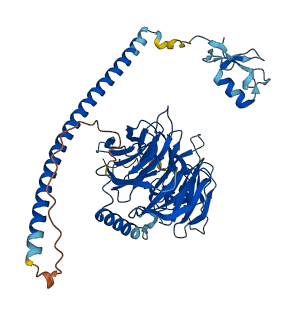
Descriptions
The autoinhibited protein was predicted that may have potential autoinhibitory elements via cis-regPred.
Autoinhibitory domains (AIDs)
Target domain |
|
Relief mechanism |
|
Assay |
cis-regPred |
Accessory elements
No accessory elements
Autoinhibited structure

Activated structure
1 structures for O22785
| Entry ID | Method | Resolution | Chain | Position | Source |
|---|---|---|---|---|---|
| AF-O22785-F1 | Predicted | AlphaFoldDB |
25 variants for O22785
| Variant ID(s) | Position | Change | Description | Diseaes Association | Provenance |
|---|---|---|---|---|---|
| ENSVATH00258451 | 46 | T>A | No | 1000Genomes | |
| tmp_2_14130495_G_A | 55 | T>I | No | 1000Genomes | |
| tmp_2_14129988_A_C | 83 | L>V | No | 1000Genomes | |
| ENSVATH00258445 | 176 | I>T | No | 1000Genomes | |
| ENSVATH14580898 | 177 | I>N | No | 1000Genomes | |
| ENSVATH00258444 | 197 | P>S | No | 1000Genomes | |
| ENSVATH13515895 | 201 | A>T | No | 1000Genomes | |
| ENSVATH13515882 | 246 | A>S | No | 1000Genomes | |
| tmp_2_14128638_T_A | 255 | Q>L | No | 1000Genomes | |
| ENSVATH05649538 | 261 | T>N | No | 1000Genomes | |
| ENSVATH05649535 | 271 | K>R | No | 1000Genomes | |
| ENSVATH05649534 | 284 | A>T | No | 1000Genomes | |
| tmp_2_14128087_C_A | 297 | G>W | No | 1000Genomes | |
| ENSVATH14580884 | 301 | C>S | No | 1000Genomes | |
| ENSVATH00258439 | 304 | T>A | No | 1000Genomes | |
| tmp_2_14127881_C_T | 334 | C>Y | No | 1000Genomes | |
| ENSVATH13515863 | 350 | D>G | No | 1000Genomes | |
| tmp_2_14127604_C_T | 350 | D>N | No | 1000Genomes | |
| ENSVATH13515861 | 402 | S>T | No | 1000Genomes | |
| ENSVATH14580883 | 403 | F>Y | No | 1000Genomes | |
| tmp_2_14127218_A_T | 416 | D>E | No | 1000Genomes | |
| ENSVATH13515859 | 434 | S>F | No | 1000Genomes | |
| ENSVATH05649519 | 456 | I>F | No | 1000Genomes | |
| tmp_2_14126679_C_T | 495 | V>I | No | 1000Genomes | |
| tmp_2_14126610_C_T | 518 | D>N | No | 1000Genomes |
No associated diseases with O22785
6 regional properties for O22785
| Type | Name | Position | InterPro Accession |
|---|---|---|---|
| repeat | WD40 repeat | 205 - 250 | IPR001680-1 |
| repeat | WD40 repeat | 253 - 292 | IPR001680-2 |
| repeat | WD40 repeat | 298 - 460 | IPR001680-3 |
| repeat | WD40 repeat | 467 - 508 | IPR001680-4 |
| domain | U-box domain | 1 - 70 | IPR003613 |
| domain | Pre-mRNA-splicing factor 19 | 66 - 131 | IPR013915 |
Functions
| Description | ||
|---|---|---|
| EC Number | 2.3.2.27 | Aminoacyltransferases |
| Subcellular Localization |
|
|
| PANTHER Family | ||
| PANTHER Subfamily | ||
| PANTHER Protein Class | ||
| PANTHER Pathway Category | No pathway information available | |
7 GO annotations of cellular component
| Name | Definition |
|---|---|
| Cul4-RING E3 ubiquitin ligase complex | A ubiquitin ligase complex in which a cullin from the Cul4 family and a RING domain protein form the catalytic core; substrate specificity is conferred by an adaptor protein. |
| cytoplasm | The contents of a cell excluding the plasma membrane and nucleus, but including other subcellular structures. |
| endoplasmic reticulum | The irregular network of unit membranes, visible only by electron microscopy, that occurs in the cytoplasm of many eukaryotic cells. The membranes form a complex meshwork of tubular channels, which are often expanded into slitlike cavities called cisternae. The ER takes two forms, rough (or granular), with ribosomes adhering to the outer surface, and smooth (with no ribosomes attached). |
| nucleus | A membrane-bounded organelle of eukaryotic cells in which chromosomes are housed and replicated. In most cells, the nucleus contains all of the cell's chromosomes except the organellar chromosomes, and is the site of RNA synthesis and processing. In some species, or in specialized cell types, RNA metabolism or DNA replication may be absent. |
| plant-type cell wall | A more or less rigid stucture lying outside the cell membrane of a cell and composed of cellulose and pectin and other organic and inorganic substances. |
| Prp19 complex | A protein complex consisting of Prp19 and associated proteins that is involved in the transition from the precatalytic spliceosome to the activated form that catalyzes step 1 of splicing, and which remains associated with the spliceosome through the second catalytic step. It is widely conserved, found in both yeast and mammals, though the exact composition varies. In S. cerevisiae, it contains Prp19p, Ntc20p, Snt309p, Isy1p, Syf2p, Cwc2p, Prp46p, Clf1p, Cef1p, and Syf1p. |
| U2-type catalytic step 1 spliceosome | A spliceosomal complex that is formed by the displacement of the U1 and U4 snRNPs from the precatalytic spliceosome; the U2, U5 and U6 snRNPs remain associated with the mRNA. This complex, sometimes called the activated spliceosome, is the catalytically active form of the spliceosome, and includes many proteins in addition to those found in the U2, and U5 and U6 snRNPs. |
2 GO annotations of molecular function
| Name | Definition |
|---|---|
| ubiquitin protein ligase activity | Catalysis of the transfer of ubiquitin to a substrate protein via the reaction X-ubiquitin + S -> X + S-ubiquitin, where X is either an E2 or E3 enzyme, the X-ubiquitin linkage is a thioester bond, and the S-ubiquitin linkage is an amide bond: an isopeptide bond between the C-terminal glycine of ubiquitin and the epsilon-amino group of lysine residues in the substrate or, in the linear extension of ubiquitin chains, a peptide bond the between the C-terminal glycine and N-terminal methionine of ubiquitin residues. |
| ubiquitin-protein transferase activity | Catalysis of the transfer of ubiquitin from one protein to another via the reaction X-Ub + Y --> Y-Ub + X, where both X-Ub and Y-Ub are covalent linkages. |
5 GO annotations of biological process
| Name | Definition |
|---|---|
| defense response to bacterium | Reactions triggered in response to the presence of a bacterium that act to protect the cell or organism. |
| DNA repair | The process of restoring DNA after damage. Genomes are subject to damage by chemical and physical agents in the environment (e.g. UV and ionizing radiations, chemical mutagens, fungal and bacterial toxins, etc.) and by free radicals or alkylating agents endogenously generated in metabolism. DNA is also damaged because of errors during its replication. A variety of different DNA repair pathways have been reported that include direct reversal, base excision repair, nucleotide excision repair, photoreactivation, bypass, double-strand break repair pathway, and mismatch repair pathway. |
| innate immune response | Innate immune responses are defense responses mediated by germline encoded components that directly recognize components of potential pathogens. |
| mRNA splicing, via spliceosome | The joining together of exons from one or more primary transcripts of messenger RNA (mRNA) and the excision of intron sequences, via a spliceosomal mechanism, so that mRNA consisting only of the joined exons is produced. |
| protein K63-linked ubiquitination | A protein ubiquitination process in which a polymer of ubiquitin, formed by linkages between lysine residues at position 63 of the ubiquitin monomers, is added to a protein. K63-linked ubiquitination does not target the substrate protein for degradation, but is involved in several pathways, notably as a signal to promote error-free DNA postreplication repair. |
| 10 | 20 | 30 | 40 | 50 | 60 |
| MNCAISGEVP | VEPVVSTKSG | LLFERRLIER | HISDYGKCPV | TGEPLTIDDI | VPIKTGEIIK |
| 70 | 80 | 90 | 100 | 110 | 120 |
| PKTLHTASIP | GLLGTFQNEW | DGLMLSNFAL | EQQLHTARQE | LSHALYQHDS | ACRVIARLKK |
| 130 | 140 | 150 | 160 | 170 | 180 |
| ERDEARQLLA | EVERHIPAAP | EAVTANAALS | NGKRAAVDEE | LGPDAKKLCP | GISAEIITEL |
| 190 | 200 | 210 | 220 | 230 | 240 |
| TDCNAALSQK | RKKRQIPQTL | ASIDTLERFT | QLSSHPLHKT | NKPGICSMDI | LHSKDVIATG |
| 250 | 260 | 270 | 280 | 290 | 300 |
| GVDATAVLFD | RPSGQILSTL | TGHSKKVTSV | KFVGDSDLVL | TASADKTVRI | WRNPGDGNYA |
| 310 | 320 | 330 | 340 | 350 | 360 |
| CGYTLNDHSA | EVRAVTVHPT | NKYFVSASLD | GTWCFYDLSS | GSCLAQVSDD | SKNVDYTAAA |
| 370 | 380 | 390 | 400 | 410 | 420 |
| FHPDGLILGT | GTSQSVVKIW | DVKSQANVAK | FDGHTGEVTA | ISFSENGYFL | ATAAEDGVRL |
| 430 | 440 | 450 | 460 | 470 | 480 |
| WDLRKLRNFK | SFLSADANSV | EFDPSGSYLG | IAASDIKVYQ | TASVKAEWNL | IKTLPDLSGT |
| 490 | 500 | 510 | 520 | ||
| GKATCVKFGS | DAQYVAVGSM | DRNLRIFGLP | GDEKANVDDD | SAQDS |