Q93796
Gene name |
nrf-5 |
Protein name |
Nose resistant to fluoxetine protein 5 |
Names |
Protein nrf-5 |
Species |
Caenorhabditis elegans |
KEGG Pathway |
cel:CELE_F55B12.5 |
EC number |
|
Protein Class |
|
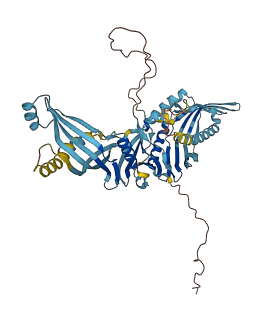
Descriptions
The autoinhibited protein was predicted that may have potential autoinhibitory elements via cis-regPred.
Autoinhibitory domains (AIDs)
Target domain |
|
Relief mechanism |
|
Assay |
cis-regPred |
Accessory elements
No accessory elements
Autoinhibited structure

Activated structure
1 structures for Q93796
| Entry ID | Method | Resolution | Chain | Position | Source |
|---|---|---|---|---|---|
| AF-Q93796-F1 | Predicted | AlphaFoldDB |
No variants for Q93796
| Variant ID(s) | Position | Change | Description | Diseaes Association | Provenance |
|---|---|---|---|---|---|
| No variants for Q93796 | |||||
3 associated diseases with Q93796
[MIM: 176430]: Premature chromatid separation trait (PCS)
Consists of separate and splayed chromatids with discernible centromeres and involves all or most chromosomes of a metaphase. It is found in up to 2% of metaphases in cultured lymphocytes from approximately 40% of normal individuals. When PCS is present in 5% or more of cells, it is known as the heterozygous PCS trait and has no obvious phenotypic effect, although some have reported decreased fertility. Inheritance is autosomal dominant. {ECO:0000269|PubMed:16411201}. Note=The disease is caused by variants affecting the gene represented in this entry.
[MIM: 257300]: Mosaic variegated aneuploidy syndrome 1 (MVA1)
A severe developmental disorder characterized by mosaic aneuploidies, predominantly trisomies and monosomies, involving multiple different chromosomes and tissues. Affected individuals typically present with severe intrauterine growth retardation and microcephaly. Eye anomalies, mild dysmorphism, variable developmental delay, and a broad spectrum of additional congenital abnormalities and medical conditions may also occur. The risk of malignancy is high, with rhabdomyosarcoma, Wilms tumor and leukemia reported in several cases. {ECO:0000269|PubMed:15475955}. Note=The disease is caused by variants affecting the gene represented in this entry. MVA1 is caused by biallelic mutations in the BUB1B gene.
Without disease ID
- Consists of separate and splayed chromatids with discernible centromeres and involves all or most chromosomes of a metaphase. It is found in up to 2% of metaphases in cultured lymphocytes from approximately 40% of normal individuals. When PCS is present in 5% or more of cells, it is known as the heterozygous PCS trait and has no obvious phenotypic effect, although some have reported decreased fertility. Inheritance is autosomal dominant. {ECO:0000269|PubMed:16411201}. Note=The disease is caused by variants affecting the gene represented in this entry.
- A severe developmental disorder characterized by mosaic aneuploidies, predominantly trisomies and monosomies, involving multiple different chromosomes and tissues. Affected individuals typically present with severe intrauterine growth retardation and microcephaly. Eye anomalies, mild dysmorphism, variable developmental delay, and a broad spectrum of additional congenital abnormalities and medical conditions may also occur. The risk of malignancy is high, with rhabdomyosarcoma, Wilms tumor and leukemia reported in several cases. {ECO:0000269|PubMed:15475955}. Note=The disease is caused by variants affecting the gene represented in this entry. MVA1 is caused by biallelic mutations in the BUB1B gene.
1 regional properties for Q93796
| Type | Name | Position | InterPro Accession |
|---|---|---|---|
| domain | Mad3/Bub1 homology region 1 | 55 - 226 | IPR013212 |
2 GO annotations of cellular component
| Name | Definition |
|---|---|
| extracellular region | The space external to the outermost structure of a cell. For cells without external protective or external encapsulating structures this refers to space outside of the plasma membrane. This term covers the host cell environment outside an intracellular parasite. |
| extracellular space | That part of a multicellular organism outside the cells proper, usually taken to be outside the plasma membranes, and occupied by fluid. |
1 GO annotations of molecular function
| Name | Definition |
|---|---|
| phosphatidylserine binding | Binding to phosphatidylserine, a class of glycophospholipids in which a phosphatidyl group is esterified to the hydroxyl group of L-serine. |
2 GO annotations of biological process
| Name | Definition |
|---|---|
| lipid transport | The directed movement of lipids into, out of or within a cell, or between cells, by means of some agent such as a transporter or pore. Lipids are compounds soluble in an organic solvent but not, or sparingly, in an aqueous solvent. |
| positive regulation of engulfment of apoptotic cell | Any process that activates or increases the frequency, rate or extent of engulfment of apoptotic cell. |
3 homologous proteins in AiPD
| 10 | 20 | 30 | 40 | 50 | 60 |
| MSRNFHIFFL | LVSIIQVGNS | ADSSEITHKP | AGIYVRLNQK | AVDYVADLAS | DALPAILNNL |
| 70 | 80 | 90 | 100 | 110 | 120 |
| SPPDIVTDMA | KITKLHISNV | AKPNLSAKFI | DGKGVAYNIS | LASFRASAYA | EISVFVWSYE |
| 130 | 140 | 150 | 160 | 170 | 180 |
| GDFTAELREL | SIESELHFDY | NGTTTVNASV | CNVTHSELSL | VFPPGSSLSA | LQSEIKGQIV |
| 190 | 200 | 210 | 220 | 230 | 240 |
| SALRDAVCTT | AVEALTFVMA | QKPIPPESPN | YQKPEAGDPN | GFSVAELGAS | LCQVDTVNGF |
| 250 | 260 | 270 | 280 | 290 | 300 |
| EDSEQEEGNV | ETTVAPTPDD | DNSTLTTEET | QKSYWGVDLS | VNHPPTFTDE | DMIIGLDGGI |
| 310 | 320 | 330 | 340 | 350 | 360 |
| LFNGWKADSA | QQLQILNKTR | LDKKMVGILL | SEYIPNTLFH | HIYMYDLGNF | KHRYTPSSLP |
| 370 | 380 | 390 | 400 | 410 | 420 |
| KILQKLSKAV | CSKCYVEVSA | NLTEQPILQI | DAHLGARVQL | SGNVSIMFHG | REQLHDVLHA |
| 430 | 440 | 450 | 460 | 470 | 480 |
| NTKLHVTLKP | TVRHSRIFGD | VSLTNVDVNV | FDLGLGGPLA | APIEKLFSFV | VPRVLWPQVK |
| 490 | 500 | 510 | 520 | 530 | 540 |
| KRLRFAMNRR | GVKLPIFCGV | ELEHTELDFV | DHAVLLNTDF | SFDLPLFLAK | FKKYLDAKSK |
| 550 | |||||
| INPNLPKYVI | I |