Q92905
Gene name |
COPS5 (CSN5, JAB1) |
Protein name |
COP9 signalosome complex subunit 5 |
Names |
SGN5, Signalosome subunit 5, Jun activation domain-binding protein 1 |
Species |
Homo sapiens (Human) |
KEGG Pathway |
hsa:10987 |
EC number |
|
Protein Class |
|
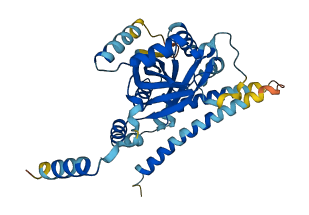
Descriptions
The autoinhibited protein was predicted that may have potential autoinhibitory elements via cis-regPred.
Autoinhibitory domains (AIDs)
Target domain |
|
Relief mechanism |
|
Assay |
cis-regPred |
Accessory elements
No accessory elements
Autoinhibited structure

Activated structure
15 structures for Q92905
| Entry ID | Method | Resolution | Chain | Position | Source |
|---|---|---|---|---|---|
| 4D10 | X-ray | 380 A | E/M | 1-334 | PDB |
| 4D18 | X-ray | 408 A | E/M | 12-334 | PDB |
| 4F7O | X-ray | 260 A | A/B | 1-257 | PDB |
| 4WSN | X-ray | 550 A | E/M/U/c/k/s | 14-334 | PDB |
| 5JOG | X-ray | 246 A | A | 2-257 | PDB |
| 5JOH | X-ray | 199 A | A | 2-257 | PDB |
| 5M5Q | X-ray | 220 A | A | 2-257 | PDB |
| 6R6H | EM | 840 A | E | 1-334 | PDB |
| 6R7F | EM | 820 A | E | 24-334 | PDB |
| 6R7H | EM | 880 A | E | 24-334 | PDB |
| 6R7I | EM | 590 A | E | 1-334 | PDB |
| 8H38 | EM | 425 A | E | 1-334 | PDB |
| 8H3A | EM | 751 A | E | 1-334 | PDB |
| 8H3F | EM | 673 A | E | 1-334 | PDB |
| AF-Q92905-F1 | Predicted | AlphaFoldDB |
117 variants for Q92905
| Variant ID(s) | Position | Change | Description | Diseaes Association | Provenance |
|---|---|---|---|---|---|
|
CA371207249 rs1585721644 |
4 | S>A | No |
ClinGen Ensembl |
|
|
CA4769966 rs772964914 |
6 | S>R | No |
ClinGen ExAC gnomAD |
|
|
CA371207184 rs1384038745 |
7 | G>R | No |
ClinGen gnomAD |
|
|
rs1443256217 CA371207148 |
8 | M>I | No |
ClinGen TOPMed gnomAD |
|
|
rs1804694 CA178225754 |
9 | A>S | No |
ClinGen Ensembl |
|
|
CA371207055 rs1585721541 |
12 | T>I | No |
ClinGen Ensembl |
|
|
CA178225685 rs866725884 |
16 | A>T | No |
ClinGen TOPMed |
|
|
rs780531661 CA4769960 |
16 | A>V | No |
ClinGen ExAC gnomAD |
|
|
CA4769959 rs148576713 |
17 | N>S | No |
ClinGen ESP ExAC TOPMed gnomAD |
|
|
rs1490543063 CA371206875 |
19 | M>I | No |
ClinGen gnomAD |
|
|
rs1232078431 CA371206859 |
20 | Q>R | No |
ClinGen TOPMed |
|
|
rs779252592 CA4769957 |
22 | A>S | No |
ClinGen ExAC TOPMed gnomAD |
|
|
rs779252592 CA4769958 |
22 | A>T | No |
ClinGen ExAC TOPMed gnomAD |
|
|
CA4769956 rs757811563 |
22 | A>V | No |
ClinGen ExAC TOPMed gnomAD |
|
|
rs764258200 CA4769954 |
24 | S>N | No |
ClinGen ExAC gnomAD |
|
|
rs1333739034 CA371206675 |
28 | I>L | No |
ClinGen gnomAD |
|
|
rs1482708464 CA371206628 |
31 | Y>H | No |
ClinGen Ensembl |
|
|
CA371206563 rs1490507809 |
33 | K>M | No |
ClinGen TOPMed |
|
|
CA4769952 rs576133944 |
36 | Q>R | No |
ClinGen 1000Genomes ExAC gnomAD |
|
| TCGA novel | 41 | A>V | Variant assessed as Somatic; impact. [NCI-TCGA] | No | NCI-TCGA |
|
rs145855785 COSM107766 CA178225628 |
45 | W>* | skin [Cosmic] | No |
ClinGen cosmic curated Ensembl |
|
rs200023878 CA178225619 |
48 | D>N | No |
ClinGen 1000Genomes gnomAD |
|
|
CA4769917 rs778376302 |
53 | K>E | No |
ClinGen ExAC gnomAD |
|
|
rs866280415 CA178223794 |
55 | C>Y | No |
ClinGen Ensembl |
|
|
CA371205596 rs1424094783 |
56 | K>R | No |
ClinGen gnomAD |
|
|
rs1010003084 CA178223783 |
57 | I>M | No |
ClinGen TOPMed gnomAD |
|
| TCGA novel | 60 | L>C | Variant assessed as Somatic; impact. [NCI-TCGA] | No | NCI-TCGA |
|
rs748216094 CA4769915 |
63 | L>P | No |
ClinGen ExAC gnomAD |
|
|
CA918281325 rs1563448122 |
65 | M>Q | No |
ClinGen Ensembl |
|
|
CA4769914 rs781307881 |
67 | M>I | No |
ClinGen ExAC gnomAD |
|
|
CA178223767 rs144850801 |
67 | M>K | No |
ClinGen ESP TOPMed gnomAD |
|
|
rs755211980 CA4769913 |
68 | H>Y | No |
ClinGen ExAC gnomAD |
|
|
rs112353634 CA178223749 |
69 | A>T | No |
ClinGen Ensembl |
|
|
rs113434892 CA178223709 |
74 | N>S | No |
ClinGen Ensembl |
|
|
CA178223697 rs11557198 |
80 | L>M | No |
ClinGen Ensembl |
|
| TCGA novel | 81 | M>I | Variant assessed as Somatic; impact. [NCI-TCGA] | No | NCI-TCGA |
| TCGA novel | 81 | M>V | Variant assessed as Somatic; impact. [NCI-TCGA] | No | NCI-TCGA |
|
CA178223688 rs547886299 |
86 | D>N | No |
ClinGen TOPMed |
|
|
rs547886299 CA178223682 |
86 | D>Y | No |
ClinGen TOPMed |
|
| TCGA novel | 88 | E>K | Variant assessed as Somatic; impact. [NCI-TCGA] | No | NCI-TCGA |
|
rs756985013 CA4769910 |
91 | I>V | No |
ClinGen ExAC |
|
|
rs1001853949 CA178223671 |
93 | M>L | No |
ClinGen TOPMed |
|
|
CA371204927 rs1269145339 |
93 | M>T | No |
ClinGen gnomAD |
|
| TCGA novel | 94 | D>N | Variant assessed as Somatic; impact. [NCI-TCGA] | No | NCI-TCGA |
| TCGA novel | 99 | P>H | Variant assessed as Somatic; impact. [NCI-TCGA] | No | NCI-TCGA |
| TCGA novel | 101 | E>D | Variant assessed as Somatic; impact. [NCI-TCGA] | No | NCI-TCGA |
|
CA178223655 rs11557196 |
109 | A>S | No |
ClinGen Ensembl |
|
|
rs760643887 CA4769907 |
111 | A>S | No |
ClinGen ExAC gnomAD |
|
|
CA371204749 rs1306668062 |
114 | Y>F | No |
ClinGen gnomAD |
|
|
rs1444548992 CA371204719 |
118 | A>S | No |
ClinGen TOPMed |
|
|
rs1347693682 CA371204715 |
119 | A>T | No |
ClinGen gnomAD |
|
|
rs1284147503 CA371204697 |
121 | I>T | No |
ClinGen gnomAD |
|
| TCGA novel | 124 | A>V | Variant assessed as Somatic; impact. [NCI-TCGA] | No | NCI-TCGA |
|
rs759117469 CA4769904 |
126 | Q>H | No |
ClinGen ExAC gnomAD |
|
|
rs758313448 CA178222790 |
127 | V>F | No |
ClinGen Ensembl |
|
|
CA371203416 rs1254987524 |
129 | R>C | No |
ClinGen TOPMed |
|
|
CA178222788 rs889246427 |
129 | R>H | No |
ClinGen TOPMed |
|
|
CA178222765 rs1051932630 |
134 | I>V | No |
ClinGen gnomAD |
|
|
CA371203350 rs1380557410 |
137 | Y>F | No |
ClinGen TOPMed gnomAD |
|
|
CA4769889 rs756075307 |
145 | C>W | No |
ClinGen ExAC gnomAD |
|
|
CA371203160 rs1585716180 |
150 | I>V | No |
ClinGen Ensembl |
|
|
CA371203109 rs1343218790 |
153 | S>N | No |
ClinGen gnomAD |
|
|
rs775341801 CA4769887 |
158 | N>S | No |
ClinGen ExAC gnomAD |
|
|
CA4769886 rs759037579 |
166 | V>I | No |
ClinGen ExAC TOPMed gnomAD |
|
|
rs866340690 CA178222234 |
171 | D>Y | No |
ClinGen Ensembl |
|
|
CA4769864 rs201634747 |
174 | R>G | No |
ClinGen 1000Genomes ExAC gnomAD |
|
|
CA178222199 rs199708915 |
175 | T>A | No |
ClinGen 1000Genomes |
|
|
rs765529888 CA4769860 |
176 | I>T | No |
ClinGen ExAC gnomAD |
|
|
CA4769861 rs369630651 |
176 | I>V | Variant assessed as Somatic; 0.0 impact. [NCI-TCGA] | No |
ClinGen ESP ExAC NCI-TCGA TOPMed gnomAD |
|
CA4769859 rs762186633 |
177 | S>A | No |
ClinGen ExAC TOPMed gnomAD |
|
|
CA4769857 rs764699097 |
178 | A>S | No |
ClinGen ExAC gnomAD |
|
| TCGA novel | 178 | A>T | Variant assessed as Somatic; impact. [NCI-TCGA] | No | NCI-TCGA |
|
rs951219755 CA178222117 |
185 | A>G | No |
ClinGen Ensembl |
|
|
CA4769853 rs372916530 |
185 | A>T | No |
ClinGen ESP ExAC TOPMed gnomAD |
|
|
rs1289111343 CA371202707 |
186 | F>L | No |
ClinGen gnomAD |
|
|
CA178221246 rs1038600714 |
192 | G>C | No |
ClinGen Ensembl |
|
|
CA371201944 rs1332197567 |
192 | G>D | No |
ClinGen TOPMed |
|
|
CA178221213 rs201539863 |
193 | Y>C | No |
ClinGen 1000Genomes |
|
|
rs746955448 CA4769792 |
195 | P>T | No |
ClinGen ExAC gnomAD |
|
|
CA371201799 rs1340467886 |
199 | G>E | No |
ClinGen TOPMed |
|
| TCGA novel | 204 | Q>missing | Variant assessed as Somatic; impact. [NCI-TCGA] | No | NCI-TCGA |
| TCGA novel | 206 | I>V | Variant assessed as Somatic; impact. [NCI-TCGA] | No | NCI-TCGA |
|
CA4769788 rs778260803 |
219 | K>R | No |
ClinGen ExAC gnomAD |
|
|
CA4769789 rs778260803 |
219 | K>T | No |
ClinGen ExAC gnomAD |
|
|
CA371200197 rs1229286706 |
223 | A>D | No |
ClinGen gnomAD |
|
| TCGA novel | 234 | D>Y | Variant assessed as Somatic; impact. [NCI-TCGA] | No | NCI-TCGA |
|
rs1378846658 COSM1700166 CA371200005 |
235 | R>C | Variant assessed as Somatic; 0.0 impact. skin [NCI-TCGA, Cosmic] | No |
ClinGen cosmic curated NCI-TCGA gnomAD |
|
rs138638780 CA4769758 |
235 | R>H | Variant assessed as Somatic; 0.0 impact. [NCI-TCGA] | No |
ClinGen ESP ExAC NCI-TCGA TOPMed gnomAD |
| TCGA novel | 236 | K>I | Variant assessed as Somatic; impact. [NCI-TCGA] | No | NCI-TCGA |
|
rs1307575325 CA371199815 |
249 | T>A | No |
ClinGen gnomAD |
|
| TCGA novel | 249 | T>M | Variant assessed as Somatic; impact. [NCI-TCGA] | No | NCI-TCGA |
|
rs1367430036 CA371199775 |
252 | S>T | No |
ClinGen TOPMed gnomAD |
|
|
rs766493793 CA4769755 |
253 | S>C | No |
ClinGen ExAC gnomAD |
|
| TCGA novel | 256 | L>F | Variant assessed as Somatic; impact. [NCI-TCGA] | No | NCI-TCGA |
|
rs1158572768 CA371197212 |
259 | A>V | No |
ClinGen TOPMed |
|
|
rs759216042 CA4769726 |
263 | T>I | No |
ClinGen ExAC gnomAD |
|
|
CA4769724 rs766276256 |
266 | V>F | No |
ClinGen ExAC TOPMed gnomAD |
|
|
CA178212534 rs766276256 |
266 | V>I | No |
ClinGen ExAC TOPMed gnomAD |
|
|
rs762937165 CA4769723 |
267 | F>S | No |
ClinGen ExAC TOPMed gnomAD |
|
| TCGA novel | 271 | E>K | Variant assessed as Somatic; impact. [NCI-TCGA] | No | NCI-TCGA |
|
rs1444521716 CA371196934 |
279 | Q>H | No |
ClinGen TOPMed |
|
|
CA178212500 rs866920136 |
281 | G>* | No |
ClinGen Ensembl |
|
| TCGA novel | 282 | R>* | Variant assessed as Somatic; impact. [NCI-TCGA] | No | NCI-TCGA |
|
rs760694418 CA178212457 |
282 | R>Q | No |
ClinGen Ensembl |
|
|
CA4769718 rs769096210 |
286 | M>T | No |
ClinGen ExAC TOPMed gnomAD |
|
| TCGA novel | 291 | T>A | Variant assessed as Somatic; impact. [NCI-TCGA] | No | NCI-TCGA |
|
CA4769717 rs143525514 COSM289061 |
291 | T>M | Variant assessed as Somatic; 0.0 impact. large_intestine [NCI-TCGA, Cosmic] | No |
ClinGen cosmic curated ESP ExAC NCI-TCGA TOPMed gnomAD |
|
rs201128315 CA178212408 |
299 | K>R | No |
ClinGen 1000Genomes |
|
|
CA4769712 rs757365559 |
304 | T>A | No |
ClinGen ExAC TOPMed gnomAD |
|
|
CA371196166 rs1585707100 |
304 | T>I | No |
ClinGen Ensembl |
|
|
CA371195561 rs1459788146 |
308 | C>F | No |
ClinGen gnomAD |
|
|
rs1332891390 CA371195350 |
315 | I>V | No |
ClinGen TOPMed gnomAD |
|
|
CA4769700 rs776171390 |
325 | D>N | No |
ClinGen ExAC gnomAD |
|
|
CA371195042 rs776171390 |
325 | D>Y | No |
ClinGen ExAC gnomAD |
|
|
CA178210511 rs541187848 |
333 | I>M | No |
ClinGen 1000Genomes |
|
|
CA371194814 rs1224571316 |
333 | I>V | No |
ClinGen gnomAD |
|
|
rs75381739 CA178210509 |
334 | S>Y | No |
ClinGen Ensembl |
No associated diseases with Q92905
Functions
9 GO annotations of cellular component
| Name | Definition |
|---|---|
| anchoring junction | A cell junction that mechanically attaches a cell (and its cytoskeleton) to neighboring cells or to the extracellular matrix. |
| COP9 signalosome | A protein complex that catalyzes the deneddylation of proteins, including the cullin component of SCF ubiquitin E3 ligase; deneddylation increases the activity of cullin family ubiquitin ligases. The signalosome is involved in many regulatory process, including some which control development, in many species; also regulates photomorphogenesis in plants; in many species its subunits are highly similar to those of the proteasome. |
| cytoplasm | The contents of a cell excluding the plasma membrane and nucleus, but including other subcellular structures. |
| cytosol | The part of the cytoplasm that does not contain organelles but which does contain other particulate matter, such as protein complexes. |
| eukaryotic translation initiation factor 3 complex | A complex of several polypeptides that plays at least two important roles in protein synthesis: First, eIF3 binds to the 40S ribosome and facilitates loading of the Met-tRNA/eIF2.GTP ternary complex to form the 43S preinitiation complex. Subsequently, eIF3 apparently assists eIF4 in recruiting mRNAs to the 43S complex. The eIF3 complex contains five conserved core subunits, and may contain several additional proteins; the non-core subunits are thought to mediate association of the complex with specific sets of mRNAs. |
| nucleoplasm | That part of the nuclear content other than the chromosomes or the nucleolus. |
| nucleus | A membrane-bounded organelle of eukaryotic cells in which chromosomes are housed and replicated. In most cells, the nucleus contains all of the cell's chromosomes except the organellar chromosomes, and is the site of RNA synthesis and processing. In some species, or in specialized cell types, RNA metabolism or DNA replication may be absent. |
| perinuclear region of cytoplasm | Cytoplasm situated near, or occurring around, the nucleus. |
| synaptic vesicle | A secretory organelle, typically 50 nm in diameter, of presynaptic nerve terminals; accumulates in high concentrations of neurotransmitters and secretes these into the synaptic cleft by fusion with the 'active zone' of the presynaptic plasma membrane. |
9 GO annotations of molecular function
| Name | Definition |
|---|---|
| deNEDDylase activity | An isopeptidase activity that cleaves NEDD8 from a target protein to which it is conjugated. |
| enzyme binding | Binding to an enzyme, a protein with catalytic activity. |
| macrophage migration inhibitory factor binding | Binding to the cytokine, macrophage migration inhibitory factor. |
| metal ion binding | Binding to a metal ion. |
| metal-dependent deubiquitinase activity | An metal-dependent isopeptidase activity that cleaves ubiquitin from a target protein to which it is conjugated. |
| metalloendopeptidase activity | Catalysis of the hydrolysis of internal, alpha-peptide bonds in a polypeptide chain by a mechanism in which water acts as a nucleophile, one or two metal ions hold the water molecule in place, and charged amino acid side chains are ligands for the metal ions. |
| metallopeptidase activity | Catalysis of the hydrolysis of peptide bonds by a mechanism in which water acts as a nucleophile, one or two metal ions hold the water molecule in place, and charged amino acid side chains are ligands for the metal ions. |
| transcription coactivator activity | A transcription coregulator activity that activates or increases the transcription of specific gene sets via binding to a DNA-bound DNA-binding transcription factor, either on its own or as part of a complex. Coactivators often act by altering chromatin structure and modifications. For example, one class of transcription coactivators modifies chromatin structure through covalent modification of histones. A second class remodels the conformation of chromatin in an ATP-dependent fashion. A third class modulates interactions of DNA-bound DNA-binding transcription factors with other transcription coregulators. A fourth class of coactivator activity is the bridging of a DNA-binding transcription factor to the general (basal) transcription machinery. The Mediator complex, which bridges sequence-specific DNA binding transcription factors and RNA polymerase, is also a transcription coactivator. |
| translation initiation factor activity | Functions in the initiation of ribosome-mediated translation of mRNA into a polypeptide. |
13 GO annotations of biological process
| Name | Definition |
|---|---|
| exosomal secretion | The process whereby a membrane-bounded vesicle is released into the extracellular region by fusion of the limiting endosomal membrane of a multivesicular body with the plasma membrane. |
| negative regulation of apoptotic process | Any process that stops, prevents, or reduces the frequency, rate or extent of cell death by apoptotic process. |
| positive regulation of DNA-binding transcription factor activity | Any process that activates or increases the frequency, rate or extent of activity of a transcription factor, any factor involved in the initiation or regulation of transcription. |
| positive regulation of transcription by RNA polymerase II | Any process that activates or increases the frequency, rate or extent of transcription from an RNA polymerase II promoter. |
| post-translational protein modification | The process of covalently altering one or more amino acids in a protein after the protein has been completely translated and released from the ribosome. |
| protein deneddylation | The removal of a ubiquitin-like protein of the NEDD8 type from a protein. |
| protein deubiquitination | The removal of one or more ubiquitin groups from a protein. |
| protein neddylation | Covalent attachment of the ubiquitin-like protein NEDD8 (RUB1) to another protein. |
| regulation of cell cycle | Any process that modulates the rate or extent of progression through the cell cycle. |
| regulation of IRE1-mediated unfolded protein response | Any process that modulates the frequency, rate or extent of the IRE1-mediated unfolded protein response. |
| regulation of JNK cascade | Any process that modulates the frequency, rate or extent of signal transduction mediated by the JNK cascade. |
| regulation of protein neddylation | Any process that modulates the frequency, rate or extent of protein neddylation. |
| translation | The cellular metabolic process in which a protein is formed, using the sequence of a mature mRNA or circRNA molecule to specify the sequence of amino acids in a polypeptide chain. Translation is mediated by the ribosome, and begins with the formation of a ternary complex between aminoacylated initiator methionine tRNA, GTP, and initiation factor 2, which subsequently associates with the small subunit of the ribosome and an mRNA or circRNA. Translation ends with the release of a polypeptide chain from the ribosome. |
| 10 | 20 | 30 | 40 | 50 | 60 |
| MAASGSGMAQ | KTWELANNMQ | EAQSIDEIYK | YDKKQQQEIL | AAKPWTKDHH | YFKYCKISAL |
| 70 | 80 | 90 | 100 | 110 | 120 |
| ALLKMVMHAR | SGGNLEVMGL | MLGKVDGETM | IIMDSFALPV | EGTETRVNAQ | AAAYEYMAAY |
| 130 | 140 | 150 | 160 | 170 | 180 |
| IENAKQVGRL | ENAIGWYHSH | PGYGCWLSGI | DVSTQMLNQQ | FQEPFVAVVI | DPTRTISAGK |
| 190 | 200 | 210 | 220 | 230 | 240 |
| VNLGAFRTYP | KGYKPPDEGP | SEYQTIPLNK | IEDFGVHCKQ | YYALEVSYFK | SSLDRKLLEL |
| 250 | 260 | 270 | 280 | 290 | 300 |
| LWNKYWVNTL | SSSSLLTNAD | YTTGQVFDLS | EKLEQSEAQL | GRGSFMLGLE | THDRKSEDKL |
| 310 | 320 | 330 | |||
| AKATRDSCKT | TIEAIHGLMS | QVIKDKLFNQ | INIS |