O35864
Gene name |
Cops5 (Csn5, Jab1, Kic2) |
Protein name |
COP9 signalosome complex subunit 5 |
Names |
SGN5, Signalosome subunit 5, Jun activation domain-binding protein 1, Kip1 C-terminus-interacting protein 2 |
Species |
Mus musculus (Mouse) |
KEGG Pathway |
mmu:26754 |
EC number |
|
Protein Class |
|
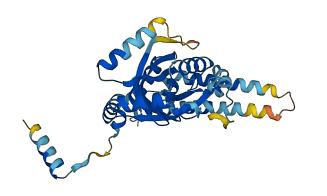
Descriptions
The autoinhibited protein was predicted that may have potential autoinhibitory elements via cis-regPred.
Autoinhibitory domains (AIDs)
Target domain |
|
Relief mechanism |
|
Assay |
cis-regPred |
Accessory elements
No accessory elements
Autoinhibited structure

Activated structure
1 structures for O35864
| Entry ID | Method | Resolution | Chain | Position | Source |
|---|---|---|---|---|---|
| AF-O35864-F1 | Predicted | AlphaFoldDB |
15 variants for O35864
| Variant ID(s) | Position | Change | Description | Diseaes Association | Provenance |
|---|---|---|---|---|---|
| rs254880931 | 10 | Q>P | No | EVA | |
| rs13468241 | 30 | K>N | No | EVA | |
| rs3388456450 | 31 | Y>H | No | EVA | |
| rs1131746462 | 87 | G>S | No | EVA | |
| rs1134635592 | 88 | E>K | No | EVA | |
| rs3388456668 | 133 | A>T | No | EVA | |
| rs3388457025 | 188 | T>I | No | EVA | |
| rs3389643787 | 281 | G>E | No | EVA | |
| rs3388457720 | 283 | G>A | No | EVA | |
| rs3388457720 | 283 | G>D | No | EVA | |
| rs3389652192 | 285 | F>S | No | EVA | |
| rs3388456716 | 287 | L>M | No | EVA | |
| rs3388456890 | 292 | H>Q | No | EVA | |
| rs3388456900 | 325 | D>E | No | EVA | |
| rs3388456603 | 328 | F>L | No | EVA |
No associated diseases with O35864
Functions
10 GO annotations of cellular component
| Name | Definition |
|---|---|
| anchoring junction | A cell junction that mechanically attaches a cell (and its cytoskeleton) to neighboring cells or to the extracellular matrix. |
| chromatin | The ordered and organized complex of DNA, protein, and sometimes RNA, that forms the chromosome. |
| COP9 signalosome | A protein complex that catalyzes the deneddylation of proteins, including the cullin component of SCF ubiquitin E3 ligase; deneddylation increases the activity of cullin family ubiquitin ligases. The signalosome is involved in many regulatory process, including some which control development, in many species; also regulates photomorphogenesis in plants; in many species its subunits are highly similar to those of the proteasome. |
| cytoplasm | The contents of a cell excluding the plasma membrane and nucleus, but including other subcellular structures. |
| cytosol | The part of the cytoplasm that does not contain organelles but which does contain other particulate matter, such as protein complexes. |
| nucleoplasm | That part of the nuclear content other than the chromosomes or the nucleolus. |
| nucleus | A membrane-bounded organelle of eukaryotic cells in which chromosomes are housed and replicated. In most cells, the nucleus contains all of the cell's chromosomes except the organellar chromosomes, and is the site of RNA synthesis and processing. In some species, or in specialized cell types, RNA metabolism or DNA replication may be absent. |
| perinuclear region of cytoplasm | Cytoplasm situated near, or occurring around, the nucleus. |
| synaptic vesicle | A secretory organelle, typically 50 nm in diameter, of presynaptic nerve terminals; accumulates in high concentrations of neurotransmitters and secretes these into the synaptic cleft by fusion with the 'active zone' of the presynaptic plasma membrane. |
| transcription regulator complex | A protein complex that is capable of associating with DNA by direct binding, or via other DNA-binding proteins or complexes, and regulating transcription. |
8 GO annotations of molecular function
| Name | Definition |
|---|---|
| deNEDDylase activity | An isopeptidase activity that cleaves NEDD8 from a target protein to which it is conjugated. |
| enzyme binding | Binding to an enzyme, a protein with catalytic activity. |
| macrophage migration inhibitory factor binding | Binding to the cytokine, macrophage migration inhibitory factor. |
| metal ion binding | Binding to a metal ion. |
| metal-dependent deubiquitinase activity | An metal-dependent isopeptidase activity that cleaves ubiquitin from a target protein to which it is conjugated. |
| metalloendopeptidase activity | Catalysis of the hydrolysis of internal, alpha-peptide bonds in a polypeptide chain by a mechanism in which water acts as a nucleophile, one or two metal ions hold the water molecule in place, and charged amino acid side chains are ligands for the metal ions. |
| metallopeptidase activity | Catalysis of the hydrolysis of peptide bonds by a mechanism in which water acts as a nucleophile, one or two metal ions hold the water molecule in place, and charged amino acid side chains are ligands for the metal ions. |
| transcription coactivator activity | A transcription coregulator activity that activates or increases the transcription of specific gene sets via binding to a DNA-bound DNA-binding transcription factor, either on its own or as part of a complex. Coactivators often act by altering chromatin structure and modifications. For example, one class of transcription coactivators modifies chromatin structure through covalent modification of histones. A second class remodels the conformation of chromatin in an ATP-dependent fashion. A third class modulates interactions of DNA-bound DNA-binding transcription factors with other transcription coregulators. A fourth class of coactivator activity is the bridging of a DNA-binding transcription factor to the general (basal) transcription machinery. The Mediator complex, which bridges sequence-specific DNA binding transcription factors and RNA polymerase, is also a transcription coactivator. |
10 GO annotations of biological process
| Name | Definition |
|---|---|
| exosomal secretion | The process whereby a membrane-bounded vesicle is released into the extracellular region by fusion of the limiting endosomal membrane of a multivesicular body with the plasma membrane. |
| negative regulation of apoptotic process | Any process that stops, prevents, or reduces the frequency, rate or extent of cell death by apoptotic process. |
| positive regulation of DNA-binding transcription factor activity | Any process that activates or increases the frequency, rate or extent of activity of a transcription factor, any factor involved in the initiation or regulation of transcription. |
| positive regulation of transcription by RNA polymerase II | Any process that activates or increases the frequency, rate or extent of transcription from an RNA polymerase II promoter. |
| protein deneddylation | The removal of a ubiquitin-like protein of the NEDD8 type from a protein. |
| protein deubiquitination | The removal of one or more ubiquitin groups from a protein. |
| regulation of cell cycle | Any process that modulates the rate or extent of progression through the cell cycle. |
| regulation of DNA-templated transcription | Any process that modulates the frequency, rate or extent of cellular DNA-templated transcription. |
| regulation of IRE1-mediated unfolded protein response | Any process that modulates the frequency, rate or extent of the IRE1-mediated unfolded protein response. |
| regulation of JNK cascade | Any process that modulates the frequency, rate or extent of signal transduction mediated by the JNK cascade. |
| 10 | 20 | 30 | 40 | 50 | 60 |
| MAASGSGMAQ | KTWELANNMQ | EAQSIDEIYK | YDKKQQQEIL | AAKPWTKDHH | YFKYCKISAL |
| 70 | 80 | 90 | 100 | 110 | 120 |
| ALLKMVMHAR | SGGNLEVMGL | MLGKVDGETM | IIMDSFALPV | EGTETRVNAQ | AAAYEYMAAY |
| 130 | 140 | 150 | 160 | 170 | 180 |
| IENAKQVGRL | ENAIGWYHSH | PGYGCWLSGI | DVSTQMLNQQ | FQEPFVAVVI | DPTRTISAGK |
| 190 | 200 | 210 | 220 | 230 | 240 |
| VNLGAFRTYP | KGYKPPDEGP | SEYQTIPLNK | IEDFGVHCKQ | YYALEVSYFK | SSLDRKLLEL |
| 250 | 260 | 270 | 280 | 290 | 300 |
| LWNKYWVNTL | SSSSLLTNAD | YTTGQVFDLS | EKLEQSEAQL | GRGSFMLGLE | THDRKSEDKL |
| 310 | 320 | 330 | |||
| AKATRDSCKT | TIEAIHGLMS | QVIKDKLFNQ | INVA |