Q922Q9
Gene name |
Chid1 |
Protein name |
Chitinase domain-containing protein 1 |
Names |
|
Species |
Mus musculus (Mouse) |
KEGG Pathway |
mmu:68038 |
EC number |
|
Protein Class |
|
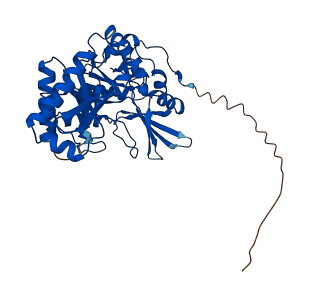
Descriptions
The autoinhibited protein was predicted that may have potential autoinhibitory elements via cis-regPred.
Autoinhibitory domains (AIDs)
Target domain |
|
Relief mechanism |
|
Assay |
cis-regPred |
Accessory elements
No accessory elements
Autoinhibited structure

Activated structure
1 structures for Q922Q9
| Entry ID | Method | Resolution | Chain | Position | Source |
|---|---|---|---|---|---|
| AF-Q922Q9-F1 | Predicted | AlphaFoldDB |
14 variants for Q922Q9
| Variant ID(s) | Position | Change | Description | Diseaes Association | Provenance |
|---|---|---|---|---|---|
| rs3388948483 | 47 | D>V | No | EVA | |
| rs3388962350 | 55 | I>V | No | EVA | |
| rs222692189 | 70 | S>A | No | EVA | |
| rs3388955820 | 89 | N>Y | No | EVA | |
| rs3398691099 | 98 | V>D | No | EVA | |
| rs3398641723 | 99 | F>L | No | EVA | |
| rs3388967029 | 149 | R>Q | No | EVA | |
| rs3398571308 | 211 | H>Q | No | EVA | |
| rs587531575 | 235 | T>A | No | EVA | |
| rs3388932701 | 248 | Q>* | No | EVA | |
| rs3398571333 | 267 | Q>L | No | EVA | |
| rs3388944724 | 308 | A>V | No | EVA | |
| rs3388948453 | 368 | E>K | No | EVA | |
| rs3398721040 | 385 | G>L | No | EVA |
No associated diseases with Q922Q9
1 regional properties for Q922Q9
| Type | Name | Position | InterPro Accession |
|---|---|---|---|
| domain | CBS domain | 609 - 668 | IPR000644 |
5 GO annotations of cellular component
| Name | Definition |
|---|---|
| extracellular region | The space external to the outermost structure of a cell. For cells without external protective or external encapsulating structures this refers to space outside of the plasma membrane. This term covers the host cell environment outside an intracellular parasite. |
| extracellular space | That part of a multicellular organism outside the cells proper, usually taken to be outside the plasma membranes, and occupied by fluid. |
| late endosome | A prelysosomal endocytic organelle differentiated from early endosomes by lower lumenal pH and different protein composition. Late endosomes are more spherical than early endosomes and are mostly juxtanuclear, being concentrated near the microtubule organizing center. |
| lysosome | A small lytic vacuole that has cell cycle-independent morphology found in most animal cells and that contains a variety of hydrolases, most of which have their maximal activities in the pH range 5-6. The contained enzymes display latency if properly isolated. About 40 different lysosomal hydrolases are known and lysosomes have a great variety of morphologies and functions. |
| trans-Golgi network | The network of interconnected tubular and cisternal structures located within the Golgi apparatus on the side distal to the endoplasmic reticulum, from which secretory vesicles emerge. The trans-Golgi network is important in the later stages of protein secretion where it is thought to play a key role in the sorting and targeting of secreted proteins to the correct destination. |
2 GO annotations of molecular function
| Name | Definition |
|---|---|
| chitin binding | Binding to chitin, a linear polysaccharide consisting of beta-(1->4)-linked N-acetyl-D-glucosamine residues. |
| oligosaccharide binding | Binding to an oligosaccharide, a molecule with between two and (about) 20 monosaccharide residues connected by glycosidic linkages. |
3 GO annotations of biological process
| Name | Definition |
|---|---|
| carbohydrate metabolic process | The chemical reactions and pathways involving carbohydrates, any of a group of organic compounds based of the general formula Cx(H2O)y. |
| innate immune response | Innate immune responses are defense responses mediated by germline encoded components that directly recognize components of potential pathogens. |
| negative regulation of cytokine production involved in inflammatory response | Any process that stops, prevents or reduces the frequency, rate or extent of cytokine production involved in inflammatory response. |
3 homologous proteins in AiPD
| 10 | 20 | 30 | 40 | 50 | 60 |
| MWPLLHVLWL | ALVCGSVHTT | LSKSDAKKAA | SKMLLEKTQF | SDKPVQDRGL | VVTDIKAEDV |
| 70 | 80 | 90 | 100 | 110 | 120 |
| VLEHRSYCSS | RARERNFAGE | VLGYVTPWNS | HGYDVAKVFG | SKFTQISPVW | LQLKRRGREM |
| 130 | 140 | 150 | 160 | 170 | 180 |
| FEITGLHDVD | QGWMRAVKKH | AKGVRIVPRL | LFEDWTYDDF | RNVLDSEDEI | EELSKTVAQV |
| 190 | 200 | 210 | 220 | 230 | 240 |
| AKNQHFDGFV | VEVWSQLLSQ | KHVGLIHMLT | HLAEALHQAR | LLVILVIPPA | VTPGTDQLGM |
| 250 | 260 | 270 | 280 | 290 | 300 |
| FTHKEFEQLA | PILDGFSLMT | YDYSTSQQPG | PNAPLSWIRA | CVQVLDPKSQ | WRSKILLGLN |
| 310 | 320 | 330 | 340 | 350 | 360 |
| FYGMDYAASK | DAREPVIGAR | YVQTLKDHRP | RVVWDSQAAE | HFFEYKKNRG | GRHVVFYPTL |
| 370 | 380 | 390 | |||
| KSLQVRLELA | RELGVGVSIW | ELGQGLDYFY | DLL |