Q91ZP3
Gene name |
Lpin1 (Flde) |
Protein name |
Phosphatidate phosphatase LPIN1 |
Names |
Fatty liver dystrophy protein, Lipin-1 |
Species |
Mus musculus (Mouse) |
KEGG Pathway |
mmu:14245 |
EC number |
3.1.3.4: Phosphoric monoester hydrolases |
Protein Class |
|
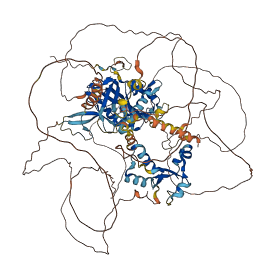
Descriptions
The autoinhibited protein was predicted that may have potential autoinhibitory elements via cis-regPred.
Autoinhibitory domains (AIDs)
Target domain |
|
Relief mechanism |
|
Assay |
cis-regPred |
Accessory elements
No accessory elements
Autoinhibited structure

Activated structure
3 structures for Q91ZP3
| Entry ID | Method | Resolution | Chain | Position | Source |
|---|---|---|---|---|---|
| 7KIH | X-ray | 147 A | A | 491-581 | PDB |
| 7KIL | X-ray | 190 A | A/B | 491-581 | PDB |
| AF-Q91ZP3-F1 | Predicted | AlphaFoldDB |
1 variants for Q91ZP3
| Variant ID(s) | Position | Change | Description | Diseaes Association | Provenance |
|---|---|---|---|---|---|
| 84 | G>R | allele FLD2J; causes the fatty liver dystrophy phenotype (fld), characterized by neonatal fatty liver and hypertriglyceridemia that resolve at weaning and neuropathy affecting peripheral nerve in adulthood [UniProt] | No |
1 associated diseases with Q91ZP3
Without disease ID
Functions
| Description | ||
|---|---|---|
| EC Number | 3.1.3.4 | Phosphoric monoester hydrolases |
| Subcellular Localization |
|
|
| PANTHER Family | ||
| PANTHER Subfamily | ||
| PANTHER Protein Class | ||
| PANTHER Pathway Category | No pathway information available | |
8 GO annotations of cellular component
| Name | Definition |
|---|---|
| cytoplasm | The contents of a cell excluding the plasma membrane and nucleus, but including other subcellular structures. |
| cytosol | The part of the cytoplasm that does not contain organelles but which does contain other particulate matter, such as protein complexes. |
| endoplasmic reticulum | The irregular network of unit membranes, visible only by electron microscopy, that occurs in the cytoplasm of many eukaryotic cells. The membranes form a complex meshwork of tubular channels, which are often expanded into slitlike cavities called cisternae. The ER takes two forms, rough (or granular), with ribosomes adhering to the outer surface, and smooth (with no ribosomes attached). |
| endoplasmic reticulum membrane | The lipid bilayer surrounding the endoplasmic reticulum. |
| mitochondrial outer membrane | The outer, i.e. cytoplasm-facing, lipid bilayer of the mitochondrial envelope. |
| nuclear membrane | Either of the lipid bilayers that surround the nucleus and form the nuclear envelope; excludes the intermembrane space. |
| nucleus | A membrane-bounded organelle of eukaryotic cells in which chromosomes are housed and replicated. In most cells, the nucleus contains all of the cell's chromosomes except the organellar chromosomes, and is the site of RNA synthesis and processing. In some species, or in specialized cell types, RNA metabolism or DNA replication may be absent. |
| transcription regulator complex | A protein complex that is capable of associating with DNA by direct binding, or via other DNA-binding proteins or complexes, and regulating transcription. |
5 GO annotations of molecular function
| Name | Definition |
|---|---|
| histone deacetylase binding | Binding to histone deacetylase. |
| peroxisome proliferator activated receptor binding | Binding to a peroxisome proliferator activated receptor, alpha, beta or gamma. |
| phosphatidate phosphatase activity | Catalysis of the reaction: a 1,2-diacylglycerol 3-phosphate + H2O = a 1,2-diacyl-sn-glycerol + phosphate. |
| RNA polymerase II-specific DNA-binding transcription factor binding | Binding to a sequence-specific DNA binding RNA polymerase II transcription factor, any of the factors that interact selectively and non-covalently with a specific DNA sequence in order to modulate transcription. |
| transcription coactivator activity | A transcription coregulator activity that activates or increases the transcription of specific gene sets via binding to a DNA-bound DNA-binding transcription factor, either on its own or as part of a complex. Coactivators often act by altering chromatin structure and modifications. For example, one class of transcription coactivators modifies chromatin structure through covalent modification of histones. A second class remodels the conformation of chromatin in an ATP-dependent fashion. A third class modulates interactions of DNA-bound DNA-binding transcription factors with other transcription coregulators. A fourth class of coactivator activity is the bridging of a DNA-binding transcription factor to the general (basal) transcription machinery. The Mediator complex, which bridges sequence-specific DNA binding transcription factors and RNA polymerase, is also a transcription coactivator. |
20 GO annotations of biological process
| Name | Definition |
|---|---|
| actin cytoskeleton reorganization | A process that is carried out at the cellular level which results in dynamic structural changes to the arrangement of constituent parts of cytoskeletal structures comprising actin filaments and their associated proteins. |
| cellular lipid metabolic process | The chemical reactions and pathways involving lipids, as carried out by individual cells. |
| cellular response to insulin stimulus | Any process that results in a change in state or activity of a cell (in terms of movement, secretion, enzyme production, gene expression, etc.) as a result of an insulin stimulus. Insulin is a polypeptide hormone produced by the islets of Langerhans of the pancreas in mammals, and by the homologous organs of other organisms. |
| fat cell differentiation | The process in which a relatively unspecialized cell acquires specialized features of an adipocyte, an animal connective tissue cell specialized for the synthesis and storage of fat. |
| fatty acid catabolic process | The chemical reactions and pathways resulting in the breakdown of a fatty acid, any of the aliphatic monocarboxylic acids that can be liberated by hydrolysis from naturally occurring fats and oils. Fatty acids are predominantly straight-chain acids of 4 to 24 carbon atoms, which may be saturated or unsaturated; branched fatty acids and hydroxy fatty acids also occur, and very long chain acids of over 30 carbons are found in waxes. |
| immune response | Any immune system process that functions in the calibrated response of an organism to a potential internal or invasive threat. |
| lipid metabolic process | The chemical reactions and pathways involving lipids, compounds soluble in an organic solvent but not, or sparingly, in an aqueous solvent. Includes fatty acids; neutral fats, other fatty-acid esters, and soaps; long-chain (fatty) alcohols and waxes; sphingoids and other long-chain bases; glycolipids, phospholipids and sphingolipids; and carotenes, polyprenols, sterols, terpenes and other isoprenoids. |
| mitochondrial fission | The division of a mitochondrion within a cell to form two or more separate mitochondrial compartments. |
| negative regulation of myelination | Any process that stops, prevents, or reduces the frequency, rate or extent of the formation of a myelin sheath around nerve axons. |
| negative regulation of phosphatidate phosphatase activity | Any process that stops, prevents or reduces the frequency, rate or extent of phosphatidate phosphatase activity. |
| negative regulation of transcription by RNA polymerase II | Any process that stops, prevents, or reduces the frequency, rate or extent of transcription mediated by RNA polymerase II. |
| phosphatidic acid metabolic process | The chemical reactions and pathways involving phosphatidic acid, any derivative of glycerol phosphate in which both the remaining hydroxyl groups of the glycerol moiety are esterified with fatty acids. |
| positive regulation of cold-induced thermogenesis | Any process that activates or increases the frequency, rate or extent of cold-induced thermogenesis. |
| positive regulation of DNA replication | Any process that activates or increases the frequency, rate or extent of DNA replication. |
| positive regulation of histone deacetylation | Any process that activates or increases the frequency, rate or extent of the removal of acetyl groups from histones. |
| positive regulation of transcription by RNA polymerase II | Any process that activates or increases the frequency, rate or extent of transcription from an RNA polymerase II promoter. |
| regulation of fat cell differentiation | Any process that modulates the frequency, rate or extent of adipocyte differentiation. |
| ruffle organization | A process that is carried out at the cellular level which results in the assembly, arrangement of constituent parts, or disassembly of a ruffle, a projection at the leading edge of a crawling cell. |
| triglyceride biosynthetic process | The chemical reactions and pathways resulting in the formation of a triglyceride, any triester of glycerol. |
| triglyceride mobilization | The release of triglycerides, any triester of glycerol, from storage within cells or tissues, making them available for metabolism. |
5 homologous proteins in AiPD
| UniProt AC | Gene Name | Protein Name | Species | Evidence Code |
|---|---|---|---|---|
| Q92539 | LPIN2 | Phosphatidate phosphatase LPIN2 | Homo sapiens (Human) | PR |
| Q9BQK8 | LPIN3 | Phosphatidate phosphatase LPIN3 | Homo sapiens (Human) | PR |
| Q14693 | LPIN1 | Phosphatidate phosphatase LPIN1 | Homo sapiens (Human) | PR |
| Q99PI5 | Lpin2 | Phosphatidate phosphatase LPIN2 | Mus musculus (Mouse) | PR |
| Q9FMN2 | PAH2 | Phosphatidate phosphatase PAH2 | Arabidopsis thaliana (Mouse-ear cress) | PR |
| 10 | 20 | 30 | 40 | 50 | 60 |
| MNYVGQLAGQ | VFVTVKELYK | GLNPATLSGC | IDIIVIRQPN | GSLQCSPFHV | RFGKMGVLRS |
| 70 | 80 | 90 | 100 | 110 | 120 |
| REKVVDIEIN | GESVDLHMKL | GDNGEAFFVQ | ETDNDQEIIP | MYLATSPILS | EGAARMESQL |
| 130 | 140 | 150 | 160 | 170 | 180 |
| KRNSVDRIRC | LDPTTAAQGL | PPSDTPSTGS | LGKKRRKRRR | KAQLDNLKRD | DNVNSSEDED |
| 190 | 200 | 210 | 220 | 230 | 240 |
| MFPIEMSSDE | DTAPMDGSRT | LPNDVPPFQD | DIPKENFPSI | STHPQSASYP | SSDREWSPSP |
| 250 | 260 | 270 | 280 | 290 | 300 |
| SSLVDCQRTP | PHLAEGVLSS | SCPLQSCHFH | ASESPSGSRP | STPKSDSELV | SKSADRLTPK |
| 310 | 320 | 330 | 340 | 350 | 360 |
| NNLEMLWLWG | ELPQAAKSSS | PHKMKESSPL | GSRKTPDKMN | FQAIHSESSD | TFSDQSPTMA |
| 370 | 380 | 390 | 400 | 410 | 420 |
| RGLLIHQSKA | QTEMQFVNEE | DLESLGAAAP | PSPVAEELKA | PYPNTAQSSS | KTDSPSRKKD |
| 430 | 440 | 450 | 460 | 470 | 480 |
| KRSRHLGADG | VYLDDLTDMD | PEVAALYFPK | NGDPGGLPKQ | ASDNGARSAN | QSPQSVGGSG |
| 490 | 500 | 510 | 520 | 530 | 540 |
| IDSGVESTSD | SLRDLPSIAI | SLCGGLSDHR | EITKDAFLEQ | AVSYQQFADN | PAIIDDPNLV |
| 550 | 560 | 570 | 580 | 590 | 600 |
| VKVGNKYYNW | TTAAPLLLAM | QAFQKPLPKA | TVESIMRDKM | PKKGGRWWFS | WRGRNATIKE |
| 610 | 620 | 630 | 640 | 650 | 660 |
| ESKPEQCLTG | KGHNTGEQPA | QLGLATRIKH | ESSSSDEEHA | AAKPSGSSHL | SLLSNVSYKK |
| 670 | 680 | 690 | 700 | 710 | 720 |
| TLRLTSEQLK | SLKLKNGPND | VVFSVTTQYQ | GTCRCEGTIY | LWNWDDKVII | SDIDGTITRS |
| 730 | 740 | 750 | 760 | 770 | 780 |
| DTLGHILPTL | GKDWTHQGIA | KLYHKVSQNG | YKFLYCSARA | IGMADMTRGY | LHWVNERGTV |
| 790 | 800 | 810 | 820 | 830 | 840 |
| LPQGPLLLSP | SSLFSALHRE | VIEKKPEKFK | VQCLTDIKNL | FFPNTEPFYA | AFGNRPADVY |
| 850 | 860 | 870 | 880 | 890 | 900 |
| SYKQVGVSLN | RIFTVNPKGE | LVQEHAKTNI | SSYVRLCEVV | DHVFPLLKRS | HSCDFPCSDT |
| 910 | 920 | ||||
| FSNFTFWREP | LPPFENQDMH | SASA |