Q8R071
Gene name |
Itpka |
Protein name |
Inositol-trisphosphate 3-kinase A |
Names |
Inositol 1,4,5-trisphosphate 3-kinase A, IP3 3-kinase A, IP3K A, InsP 3-kinase A |
Species |
Mus musculus (Mouse) |
KEGG Pathway |
mmu:228550 |
EC number |
2.7.1.127: Phosphotransferases with an alcohol group as acceptor |
Protein Class |
|
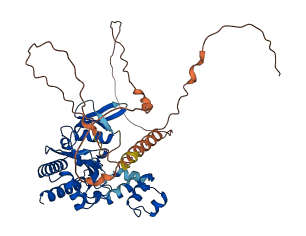
Descriptions
The autoinhibited protein was predicted that may have potential autoinhibitory elements via cis-regPred.
Autoinhibitory domains (AIDs)
Target domain |
|
Relief mechanism |
|
Assay |
cis-regPred |
Accessory elements
No accessory elements
Autoinhibited structure

Activated structure
1 structures for Q8R071
| Entry ID | Method | Resolution | Chain | Position | Source |
|---|---|---|---|---|---|
| AF-Q8R071-F1 | Predicted | AlphaFoldDB |
15 variants for Q8R071
| Variant ID(s) | Position | Change | Description | Diseaes Association | Provenance |
|---|---|---|---|---|---|
| rs229258596 | 91 | T>A | No | EVA | |
| rs213176506 | 100 | Q>P | No | EVA | |
| rs3388580681 | 166 | Q>R | No | EVA | |
| rs3388578782 | 171 | M>K | No | EVA | |
| rs3388569988 | 263 | M>T | No | EVA | |
| rs3388581365 | 266 | R>K | No | EVA | |
| rs3391971712 | 291 | L>M | No | EVA | |
| rs3388579828 | 298 | P>S | No | EVA | |
| rs864273676 | 302 | E>G | No | EVA | |
| rs3388575992 | 328 | F>Y | No | EVA | |
| rs3388582164 | 337 | D>H | No | EVA | |
| rs3392112858 | 391 | H>Q | No | EVA | |
| rs3388578744 | 425 | Q>* | No | EVA | |
| rs3388577030 | 431 | R>S | No | EVA | |
| rs3388581355 | 435 | E>V | No | EVA |
No associated diseases with Q8R071
No regional properties for Q8R071
| Type | Name | Position | InterPro Accession |
|---|---|---|---|
| No domain, repeats, and functional sites for Q8R071 | |||
Functions
| Description | ||
|---|---|---|
| EC Number | 2.7.1.127 | Phosphotransferases with an alcohol group as acceptor |
| Subcellular Localization |
|
|
| PANTHER Family | ||
| PANTHER Subfamily | ||
| PANTHER Protein Class | ||
| PANTHER Pathway Category | No pathway information available | |
4 GO annotations of cellular component
| Name | Definition |
|---|---|
| cytoplasm | The contents of a cell excluding the plasma membrane and nucleus, but including other subcellular structures. |
| cytoskeleton | A cellular structure that forms the internal framework of eukaryotic and prokaryotic cells. The cytoskeleton includes intermediate filaments, microfilaments, microtubules, the microtrabecular lattice, and other structures characterized by a polymeric filamentous nature and long-range order within the cell. The various elements of the cytoskeleton not only serve in the maintenance of cellular shape but also have roles in other cellular functions, including cellular movement, cell division, endocytosis, and movement of organelles. |
| dendritic spine | A small, membranous protrusion from a dendrite that forms a postsynaptic compartment, typically receiving input from a single presynapse. They function as partially isolated biochemical and an electrical compartments. Spine morphology is variable:they can be thin, stubby, mushroom, or branched, with a continuum of intermediate morphologies. They typically terminate in a bulb shape, linked to the dendritic shaft by a restriction. Spine remodeling is though to be involved in synaptic plasticity. |
| nucleus | A membrane-bounded organelle of eukaryotic cells in which chromosomes are housed and replicated. In most cells, the nucleus contains all of the cell's chromosomes except the organellar chromosomes, and is the site of RNA synthesis and processing. In some species, or in specialized cell types, RNA metabolism or DNA replication may be absent. |
7 GO annotations of molecular function
| Name | Definition |
|---|---|
| ATP binding | Binding to ATP, adenosine 5'-triphosphate, a universally important coenzyme and enzyme regulator. |
| calmodulin binding | Binding to calmodulin, a calcium-binding protein with many roles, both in the calcium-bound and calcium-free states. |
| calmodulin-dependent protein kinase activity | Calmodulin-dependent catalysis of the reactions: ATP + a protein serine = ADP + protein serine phosphate; and ATP + a protein threonine = ADP + protein threonine phosphate. |
| inositol hexakisphosphate kinase activity | Catalysis of the reaction: ATP + 1D-myo-inositol 1,2,3,4,5,6-hexakisphosphate = ADP + diphospho-1D-myo-inositol-pentakisphosphate. The isomeric configuration of diphospho-1D-myo-inositol-pentakisphosphate (PP-IP5) is unknown. |
| inositol-1,4,5-trisphosphate 3-kinase activity | Catalysis of the reaction: 1D-myo-inositol 1,4,5-trisphosphate + ATP = 1D-myo-inositol 1,3,4,5-tetrakisphosphate + ADP + 2 H(+). |
| kinase activity | Catalysis of the transfer of a phosphate group, usually from ATP, to a substrate molecule. |
| small GTPase binding | Binding to a small monomeric GTPase. |
10 GO annotations of biological process
| Name | Definition |
|---|---|
| actin cytoskeleton organization | A process that is carried out at the cellular level which results in the assembly, arrangement of constituent parts, or disassembly of cytoskeletal structures comprising actin filaments and their associated proteins. |
| cellular response to calcium ion | Any process that results in a change in state or activity of a cell (in terms of movement, secretion, enzyme production, gene expression, etc.) as a result of a calcium ion stimulus. |
| dendritic spine maintenance | The organization process that preserves a dendritic spine in a stable functional or structural state. A dendritic spine is a specialized protrusion from a neuronal dendrite and is involved in synaptic transmission. |
| inositol metabolic process | The chemical reactions and pathways involving inositol, 1,2,3,4,5,6-cyclohexanehexol, a growth factor for animals and microorganisms. |
| inositol phosphate biosynthetic process | The chemical reactions and pathways resulting in the formation of an inositol phosphate, 1,2,3,4,5,6-cyclohexanehexol, with one or more phosphate groups attached. |
| phosphatidylinositol phosphate biosynthetic process | The chemical reactions and pathways resulting in the formation of phosphatidylinositol phosphate. |
| phosphorylation | The process of introducing a phosphate group into a molecule, usually with the formation of a phosphoric ester, a phosphoric anhydride or a phosphoric amide. |
| positive regulation of dendritic spine morphogenesis | Any process that increases the rate, frequency, or extent of dendritic spine morphogenesis, the process in which the anatomical structures of a dendritic spine are generated and organized. A dendritic spine is a protrusion from a dendrite and a specialized subcellular compartment involved in synaptic transmission. |
| regulation of synaptic plasticity | A process that modulates synaptic plasticity, the ability of synapses to change as circumstances require. They may alter function, such as increasing or decreasing their sensitivity, or they may increase or decrease in actual numbers. |
| response to calcium ion | Any process that results in a change in state or activity of a cell or an organism (in terms of movement, secretion, enzyme production, gene expression, etc.) as a result of a calcium ion stimulus. |
4 homologous proteins in AiPD
| UniProt AC | Gene Name | Protein Name | Species | Evidence Code |
|---|---|---|---|---|
| P27987 | ITPKB | Inositol-trisphosphate 3-kinase B | Homo sapiens (Human) | PR |
| P23677 | ITPKA | Inositol-trisphosphate 3-kinase A | Homo sapiens (Human) | PR |
| Q96DU7 | ITPKC | Inositol-trisphosphate 3-kinase C | Homo sapiens (Human) | PR |
| Q6PD10 | Ip6k1 | Inositol hexakisphosphate kinase 1 | Mus musculus (Mouse) | PR |
| 10 | 20 | 30 | 40 | 50 | 60 |
| MTLPGRPTGM | ARPRGAGPCS | PGLERAPRRS | VGELRLLFEA | RCAAVAAAAA | AGEPRARGAK |
| 70 | 80 | 90 | 100 | 110 | 120 |
| RRGGQVPNGL | PRAAPAPVIP | QLTVTSEEDV | TPASPGPPDQ | EGNWLPAAGS | HLQQPRRLST |
| 130 | 140 | 150 | 160 | 170 | 180 |
| SSLSSTGSSS | LLEDSEDDLL | SDSESRSRGN | VQLETSEDVG | QKSHWQKIRT | MVNLPVMSPF |
| 190 | 200 | 210 | 220 | 230 | 240 |
| RKRYSWVQLA | GHTGSFKAAG | TSGLILKRSS | EPEHYCLVRL | MADVLRGCVP | AFHGIVERDG |
| 250 | 260 | 270 | 280 | 290 | 300 |
| ESYLQLQDLL | DGFDGPCVLD | CKMGVRTYLE | EELTKARERP | KLRKDMYKKM | LAVDPEAPTE |
| 310 | 320 | 330 | 340 | 350 | 360 |
| EEHAQRAVTK | PRYMQWREGI | SSSTTLGFRI | EGIKKADGSC | STDFKTTRSR | EQVTRVFEEF |
| 370 | 380 | 390 | 400 | 410 | 420 |
| MQGDAEVLRR | YLNRLQQIRD | TLEISDFFRR | HEVIGSSLLF | VHDHCHRAGV | WLIDFGKTTP |
| 430 | 440 | 450 | |||
| LPDGQILDHR | RPWEEGNRED | GYLLGLDNLI | GILASLAER |