Q6PD10
Gene name |
Ip6k1 (Ihpk1) |
Protein name |
Inositol hexakisphosphate kinase 1 |
Names |
InsP6 kinase 1, Inositol hexaphosphate kinase 1 |
Species |
Mus musculus (Mouse) |
KEGG Pathway |
mmu:27399 |
EC number |
2.7.4.21: Phosphotransferases with a phosphate group as acceptor |
Protein Class |
|
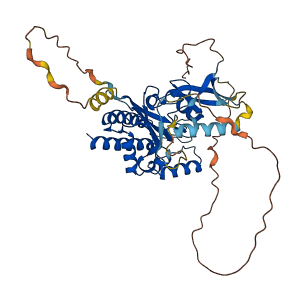
Descriptions
The autoinhibited protein was predicted that may have potential autoinhibitory elements via cis-regPred.
Autoinhibitory domains (AIDs)
Target domain |
|
Relief mechanism |
|
Assay |
cis-regPred |
Accessory elements
No accessory elements
Autoinhibited structure

Activated structure
1 structures for Q6PD10
| Entry ID | Method | Resolution | Chain | Position | Source |
|---|---|---|---|---|---|
| AF-Q6PD10-F1 | Predicted | AlphaFoldDB |
24 variants for Q6PD10
| Variant ID(s) | Position | Change | Description | Diseaes Association | Provenance |
|---|---|---|---|---|---|
| rs3389052258 | 34 | G>A | No | EVA | |
| rs3400655938 | 35 | G>I | No | EVA | |
| rs3389052210 | 41 | R>W | No | EVA | |
| rs3389018638 | 49 | K>R | No | EVA | |
| rs3389077162 | 68 | E>K | No | EVA | |
| rs3389064630 | 146 | S>F | No | EVA | |
| rs3389081594 | 159 | H>L | No | EVA | |
| rs3389071668 | 159 | H>N | No | EVA | |
| rs3389070772 | 166 | M>I | No | EVA | |
| rs3399560265 | 190 | Q>L | No | EVA | |
| rs3400630340 | 191 | Q>L | No | EVA | |
| rs3400792681 | 193 | S>C | No | EVA | |
| rs3400655937 | 193 | S>R | No | EVA | |
| rs3400746463 | 202 | R>Q | No | EVA | |
| rs3389072864 | 265 | V>A | No | EVA | |
| rs3389039906 | 296 | Y>F | No | EVA | |
| rs3389074496 | 313 | S>I | No | EVA | |
| rs3389081667 | 340 | D>Y | No | EVA | |
| rs33277832 | 353 | V>M | No | EVA | |
| rs3389074001 | 360 | V>A | No | EVA | |
| rs3389061043 | 394 | H>Y | No | EVA | |
| rs3389071677 | 401 | R>L | No | EVA | |
| rs3389039843 | 420 | N>S | No | EVA | |
| rs3389039833 | 429 | R>Q | No | EVA |
No associated diseases with Q6PD10
No regional properties for Q6PD10
| Type | Name | Position | InterPro Accession |
|---|---|---|---|
| No domain, repeats, and functional sites for Q6PD10 | |||
Functions
| Description | ||
|---|---|---|
| EC Number | 2.7.4.21 | Phosphotransferases with a phosphate group as acceptor |
| Subcellular Localization |
|
|
| PANTHER Family | ||
| PANTHER Subfamily | ||
| PANTHER Protein Class | ||
| PANTHER Pathway Category | No pathway information available | |
5 GO annotations of cellular component
| Name | Definition |
|---|---|
| cytoplasm | The contents of a cell excluding the plasma membrane and nucleus, but including other subcellular structures. |
| cytosol | The part of the cytoplasm that does not contain organelles but which does contain other particulate matter, such as protein complexes. |
| fibrillar center | A structure found most metazoan nucleoli, but not usually found in lower eukaryotes; surrounded by the dense fibrillar component; the zone of transcription from multiple copies of the pre-rRNA genes is in the border region between these two structures. |
| nucleoplasm | That part of the nuclear content other than the chromosomes or the nucleolus. |
| nucleus | A membrane-bounded organelle of eukaryotic cells in which chromosomes are housed and replicated. In most cells, the nucleus contains all of the cell's chromosomes except the organellar chromosomes, and is the site of RNA synthesis and processing. In some species, or in specialized cell types, RNA metabolism or DNA replication may be absent. |
7 GO annotations of molecular function
| Name | Definition |
|---|---|
| ATP binding | Binding to ATP, adenosine 5'-triphosphate, a universally important coenzyme and enzyme regulator. |
| inositol hexakisphosphate 1-kinase activity | Catalysis of the reaction: ATP + 1D-myo-inositol hexakisphosphate = ADP + 1-diphospho-1D-myo-inositol (2,3,4,5,6)pentakisphosphate. |
| inositol hexakisphosphate 3-kinase activity | Catalysis of the reaction: ATP + 1D-myo-inositol hexakisphosphate = ADP + 3-diphospho-1D-myo-inositol (1,2,4,5,6)pentakisphosphate. |
| inositol hexakisphosphate 5-kinase activity | Catalysis of the reaction: ATP + 1D-myo-inositol 1,2,3,4,5,6-hexakisphosphate = ADP + 5-diphospho-1D-myo-inositol (1,2,3,4,6)pentakisphosphate. |
| inositol hexakisphosphate kinase activity | Catalysis of the reaction: ATP + 1D-myo-inositol 1,2,3,4,5,6-hexakisphosphate = ADP + diphospho-1D-myo-inositol-pentakisphosphate. The isomeric configuration of diphospho-1D-myo-inositol-pentakisphosphate (PP-IP5) is unknown. |
| inositol-1,3,4,5,6-pentakisphosphate kinase activity | Catalysis of the reaction: ATP + 1D-myo-inositol 1,3,4,5,6-pentakisphosphate = ADP + diphospho-1D-myo-inositol tetrakisphosphate. The isomeric configuration of diphospho-1D-myo-inositol tetrakisphosphate is unknown. |
| kinase activity | Catalysis of the transfer of a phosphate group, usually from ATP, to a substrate molecule. |
5 GO annotations of biological process
| Name | Definition |
|---|---|
| inositol metabolic process | The chemical reactions and pathways involving inositol, 1,2,3,4,5,6-cyclohexanehexol, a growth factor for animals and microorganisms. |
| inositol phosphate biosynthetic process | The chemical reactions and pathways resulting in the formation of an inositol phosphate, 1,2,3,4,5,6-cyclohexanehexol, with one or more phosphate groups attached. |
| negative regulation of cold-induced thermogenesis | Any process that stops, prevents, or reduces the rate of cold-induced thermogenesis. |
| phosphatidylinositol phosphate biosynthetic process | The chemical reactions and pathways resulting in the formation of phosphatidylinositol phosphate. |
| phosphorylation | The process of introducing a phosphate group into a molecule, usually with the formation of a phosphoric ester, a phosphoric anhydride or a phosphoric amide. |
| 10 | 20 | 30 | 40 | 50 | 60 |
| MCVCQTMEVG | QYGKNASRAG | DRGVLLEPFI | HQVGGHSSMM | RYDDHTVCKP | LISREQRFYE |
| 70 | 80 | 90 | 100 | 110 | 120 |
| SLPPEMKEFT | PEYKGVVSVC | FEGDSDGYIN | LVAYPYVESE | TVEQDDTPER | EQPRRKHSRR |
| 130 | 140 | 150 | 160 | 170 | 180 |
| SLHRSGSGSD | HKEEKASLSF | ETSESSQEAK | SPKVELHSHS | DVPFQMLDSN | SGLSSEKISY |
| 190 | 200 | 210 | 220 | 230 | 240 |
| NPWSLRCHKQ | QLSRMRSESK | DRKLYKFLLL | ENVVHHFKYP | CVLDLKMGTR | QHGDDASAEK |
| 250 | 260 | 270 | 280 | 290 | 300 |
| AARQMRKCEQ | STSATLGVRV | CGMQVYQLDT | GHYLCRNKYY | GRGLSIEGFR | NALYQYLHNG |
| 310 | 320 | 330 | 340 | 350 | 360 |
| LDLRRDLFEP | ILSKLRGLKA | VLERQASYRF | YSSSLLVIYD | GKECRSELRL | KHVDMGLPEV |
| 370 | 380 | 390 | 400 | 410 | 420 |
| PPPCGPSTSP | SSTSLEAGPS | SPPKVDVRMI | DFAHSTFKGF | RDDPTVHDGP | DRGYVFGLEN |
| 430 | |||||
| LISIMEQMRD | ENQ |