Q8K352
Gene name |
Sash3 (Sly) |
Protein name |
SAM and SH3 domain-containing protein 3 |
Names |
SH3 protein expressed in lymphocytes |
Species |
Mus musculus (Mouse) |
KEGG Pathway |
mmu:74131 |
EC number |
|
Protein Class |
|
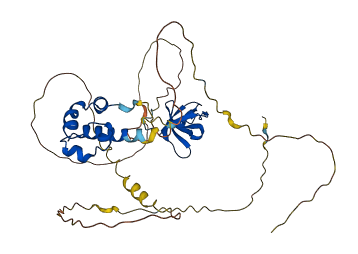
Descriptions
The autoinhibited protein was predicted that may have potential autoinhibitory elements via cis-regPred.
Autoinhibitory domains (AIDs)
Target domain |
|
Relief mechanism |
|
Assay |
cis-regPred |
Accessory elements
No accessory elements
Autoinhibited structure

Activated structure
3 structures for Q8K352
| Entry ID | Method | Resolution | Chain | Position | Source |
|---|---|---|---|---|---|
| 6FXF | X-ray | 205 A | A | 254-317 | PDB |
| 6G8O | NMR | - | A/B | 254-321 | PDB |
| AF-Q8K352-F1 | Predicted | AlphaFoldDB |
17 variants for Q8K352
| Variant ID(s) | Position | Change | Description | Diseaes Association | Provenance |
|---|---|---|---|---|---|
| rs3409999769 | 39 | P>H | No | EVA | |
| rs253864935 | 56 | D>E | No | EVA | |
| rs243437467 | 107 | G>S | No | EVA | |
| rs3389570442 | 110 | S>C | No | EVA | |
| rs3389570368 | 113 | S>F | No | EVA | |
| rs3409344295 | 115 | D>G | No | EVA | |
| rs3408891152 | 119 | D>E | No | EVA | |
| rs260484615 | 136 | R>H | No | EVA | |
| rs3389554419 | 138 | P>A | No | EVA | |
| rs30150057 | 138 | P>L | No | EVA | |
| rs3389568659 | 169 | Q>H | No | EVA | |
| rs3410311362 | 299 | D>E | No | EVA | |
| rs3389568578 | 330 | S>T | No | EVA | |
| rs3389507112 | 335 | A>T | No | EVA | |
| rs251951622 | 341 | P>L | No | EVA | |
| rs3407965778 | 376 | L>Q | No | EVA | |
| rs3410253003 | 377 | S>T | No | EVA |
No associated diseases with Q8K352
2 GO annotations of cellular component
| Name | Definition |
|---|---|
| cytoplasm | The contents of a cell excluding the plasma membrane and nucleus, but including other subcellular structures. |
| nucleus | A membrane-bounded organelle of eukaryotic cells in which chromosomes are housed and replicated. In most cells, the nucleus contains all of the cell's chromosomes except the organellar chromosomes, and is the site of RNA synthesis and processing. In some species, or in specialized cell types, RNA metabolism or DNA replication may be absent. |
No GO annotations of molecular function
| Name | Definition |
|---|---|
| No GO annotations for molecular function |
18 GO annotations of biological process
| Name | Definition |
|---|---|
| B cell homeostasis | The process of regulating the proliferation and elimination of B cells such that the total number of B cells within a whole or part of an organism is stable over time in the absence of an outside stimulus. |
| B cell proliferation | The expansion of a B cell population by cell division. Follows B cell activation. |
| CD4-positive, alpha-beta T cell differentiation | The process in which a relatively unspecialized T cell acquires specialized features of a mature CD4-positive, alpha-beta T cell. |
| homeostasis of number of cells within a tissue | Any biological process involved in the maintenance of the steady-state number of cells within a population of cells in a tissue. |
| positive regulation of adaptive immune response | Any process that activates or increases the frequency, rate, or extent of an adaptive immune response. |
| positive regulation of B cell proliferation | Any process that activates or increases the rate or extent of B cell proliferation. |
| positive regulation of CD4-positive, alpha-beta T cell differentiation | Any process that activates or increases the frequency, rate or extent of CD4-positive, alpha-beta T cell differentiation. |
| positive regulation of immunoglobulin production | Any process that activates or increases the frequency, rate, or extent of immunoglobulin production. |
| positive regulation of interferon-gamma production | Any process that activates or increases the frequency, rate, or extent of interferon-gamma production. Interferon-gamma is also known as type II interferon. |
| positive regulation of interleukin-10 production | Any process that activates or increases the frequency, rate, or extent of interleukin-10 production. |
| positive regulation of interleukin-2 production | Any process that activates or increases the frequency, rate, or extent of interleukin-2 production. |
| positive regulation of interleukin-4 production | Any process that activates or increases the frequency, rate, or extent of interleukin-4 production. |
| positive regulation of lymphocyte activation | Any process that activates or increases the frequency, rate or extent of lymphocyte activation. |
| positive regulation of organ growth | Any process that activates or increases the frequency, rate or extent of growth of an organ of an organism. |
| positive regulation of T cell cytokine production | Any process that activates or increases the frequency, rate, or extent of T cell cytokine production. |
| positive regulation of T cell proliferation | Any process that activates or increases the rate or extent of T cell proliferation. |
| positive regulation of tumor necrosis factor production | Any process that activates or increases the frequency, rate or extent of tumor necrosis factor production. |
| T cell proliferation | The expansion of a T cell population by cell division. Follows T cell activation. |
| 10 | 20 | 30 | 40 | 50 | 60 |
| MLRRKPSNAS | DKEPTQKKKL | SLQRSSSFKD | FAKSKPSSPV | VSEKEFNLDD | NIPEDDSGVL |
| 70 | 80 | 90 | 100 | 110 | 120 |
| TPEDSGKSGK | KLGKKWRAVI | SRTMNRKMGK | MMVKALSEEM | GDTLEEGSAS | PTSPDCSLDS |
| 130 | 140 | 150 | 160 | 170 | 180 |
| PGPEKMALAF | TEQEEREPPS | LSRQTSTGSE | LCSPGPGSGS | FLEESPAPQY | TGPFCGRARV |
| 190 | 200 | 210 | 220 | 230 | 240 |
| HTDFTPSPYD | HDSLKLQKGD | VIQIVEKPPV | GTWLGLLNGK | LGSFKFIYVD | VLPEEAVGPV |
| 250 | 260 | 270 | 280 | 290 | 300 |
| RPSRRQSKGK | RPKPKTLHEL | LERIGLEEHT | STLLLNGYQT | LEDFKELRET | HLNELNIMDP |
| 310 | 320 | 330 | 340 | 350 | 360 |
| QHRAKLLTAA | ELLLDYDTGS | EEAEEGAESS | QEPVAHTVSE | PKVDIPRDSG | CFEGSESGRD |
| 370 | |||||
| EAELAGTEEQ | LQGLSLSGAP |