Q8K1R3
Gene name |
Pnpt1 (Pnpase) |
Protein name |
Polyribonucleotide nucleotidyltransferase 1, mitochondrial |
Names |
3'-5' RNA exonuclease OLD35, PNPase old-35, Polynucleotide phosphorylase 1, PNPase 1, Polynucleotide phosphorylase-like protein |
Species |
Mus musculus (Mouse) |
KEGG Pathway |
mmu:71701 |
EC number |
2.7.7.8: Nucleotidyltransferases |
Protein Class |
|
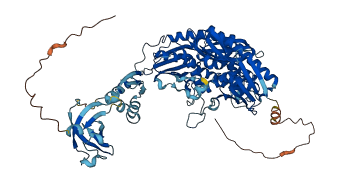
Descriptions
The autoinhibited protein was predicted that may have potential autoinhibitory elements via cis-regPred.
Autoinhibitory domains (AIDs)
Target domain |
|
Relief mechanism |
|
Assay |
cis-regPred |
Accessory elements
No accessory elements
Autoinhibited structure

Activated structure
2 structures for Q8K1R3
| Entry ID | Method | Resolution | Chain | Position | Source |
|---|---|---|---|---|---|
| 1WHU | NMR | - | A | 273-363 | PDB |
| AF-Q8K1R3-F1 | Predicted | AlphaFoldDB |
27 variants for Q8K1R3
| Variant ID(s) | Position | Change | Description | Diseaes Association | Provenance |
|---|---|---|---|---|---|
| rs252009948 | 8 | C>R | No | EVA | |
| rs50324622 | 90 | A>P | No | EVA | |
| rs246691328 | 126 | R>K | No | EVA | |
| rs3389155911 | 163 | N>I | No | EVA | |
| rs3389157955 | 185 | N>S | No | EVA | |
| rs1134949377 | 187 | P>T | No | EVA | |
| rs3402267623 | 189 | G>V | No | EVA | |
| rs3389140637 | 193 | I>M | No | EVA | |
| rs3389134543 | 195 | M>L | No | EVA | |
| rs1131773324 | 198 | G>V | No | EVA | |
| rs1134198052 | 199 | E>V | No | EVA | |
| rs3389118762 | 200 | C>Y | No | EVA | |
| rs1134811475 | 201 | V>F | No | EVA | |
| rs1132138640 | 204 | P>T | No | EVA | |
| rs3389110685 | 316 | I>K | No | EVA | |
| rs3389085171 | 316 | I>L | No | EVA | |
| rs3389118845 | 445 | R>Q | No | EVA | |
| rs1131820174 | 589 | M>L | No | EVA | |
| rs3402002173 | 591 | K>KTISKPRASRKENGPVVGKTLKLLPVV**Y | No | EVA | |
| rs3402002173 | 598 | A>K | No | EVA | |
| rs1134291781 | 608 | E>* | No | EVA | |
| rs3389122358 | 645 | E>D | No | EVA | |
| rs3402060888 | 682 | Y>* | No | EVA | |
| rs3402146893 | 685 | T>P | No | EVA | |
| rs258348468 | 758 | T>S | No | EVA | |
| rs221024591 | 759 | A>V | No | EVA | |
| rs3389157896 | 761 | K>* | No | EVA |
No associated diseases with Q8K1R3
8 regional properties for Q8K1R3
| Type | Name | Position | InterPro Accession |
|---|---|---|---|
| domain | Exoribonuclease, phosphorolytic domain 1 | 54 - 183 | IPR001247-1 |
| domain | Exoribonuclease, phosphorolytic domain 1 | 367 - 501 | IPR001247-2 |
| domain | S1 domain | 678 - 750 | IPR003029 |
| domain | K Homology domain | 604 - 669 | IPR004087 |
| domain | K Homology domain, type 1 | 608 - 665 | IPR004088 |
| domain | Exoribonuclease, phosphorolytic domain 2 | 186 - 250 | IPR015847 |
| domain | Polyribonucleotide nucleotidyltransferase, RNA-binding domain | 288 - 363 | IPR015848 |
| domain | RNA-binding domain, S1 | 677 - 750 | IPR022967 |
Functions
| Description | ||
|---|---|---|
| EC Number | 2.7.7.8 | Nucleotidyltransferases |
| Subcellular Localization |
|
|
| PANTHER Family | ||
| PANTHER Subfamily | ||
| PANTHER Protein Class | ||
| PANTHER Pathway Category | No pathway information available | |
9 GO annotations of cellular component
| Name | Definition |
|---|---|
| cytoplasm | The contents of a cell excluding the plasma membrane and nucleus, but including other subcellular structures. |
| cytosol | The part of the cytoplasm that does not contain organelles but which does contain other particulate matter, such as protein complexes. |
| endoplasmic reticulum membrane | The lipid bilayer surrounding the endoplasmic reticulum. |
| mitochondrial degradosome | A mitochondrial protein complex with 3' to 5' exoribonuclease activity that participates in intron-independent turnover and processing of mitochondrial transcripts. In humans, the mitochondrial degradosome is a pentameric complex, and in yeast it exists as a heterodimer. |
| mitochondrial intermembrane space | The region between the inner and outer lipid bilayers of the mitochondrial envelope. |
| mitochondrial matrix | The gel-like material, with considerable fine structure, that lies in the matrix space, or lumen, of a mitochondrion. It contains the enzymes of the tricarboxylic acid cycle and, in some organisms, the enzymes concerned with fatty acid oxidation. |
| mitochondrion | A semiautonomous, self replicating organelle that occurs in varying numbers, shapes, and sizes in the cytoplasm of virtually all eukaryotic cells. It is notably the site of tissue respiration. |
| nucleus | A membrane-bounded organelle of eukaryotic cells in which chromosomes are housed and replicated. In most cells, the nucleus contains all of the cell's chromosomes except the organellar chromosomes, and is the site of RNA synthesis and processing. In some species, or in specialized cell types, RNA metabolism or DNA replication may be absent. |
| polysomal ribosome | A ribosome bound to mRNA that forms part of a polysome. |
5 GO annotations of molecular function
| Name | Definition |
|---|---|
| 3'-5'-exoribonuclease activity | Catalysis of the sequential cleavage of mononucleotides from a free 3' terminus of an RNA molecule. |
| miRNA binding | Binding to a microRNA, a 21-23 nucleotide RNA that is processed from a stem-loop RNA precursor (pre-miRNA) that is encoded within plant and animal genomes. |
| poly(G) binding | Binding to a sequence of guanine residues in an RNA molecule. |
| poly(U) RNA binding | Binding to a sequence of uracil residues in an RNA molecule. |
| polyribonucleotide nucleotidyltransferase activity | Catalysis of the reaction: RNA(n+1) + phosphate <=> RNA(n) + a nucleoside diphosphate. |
26 GO annotations of biological process
| Name | Definition |
|---|---|
| cellular response to interferon-beta | Any process that results in a change in state or activity of a cell (in terms of movement, secretion, enzyme production, gene expression, etc.) as a result of an interferon-beta stimulus. Interferon-beta is a type I interferon. |
| cellular response to oxidative stress | Any process that results in a change in state or activity of a cell (in terms of movement, secretion, enzyme production, gene expression, etc.) as a result of oxidative stress, a state often resulting from exposure to high levels of reactive oxygen species, e.g. superoxide anions, hydrogen peroxide (H2O2), and hydroxyl radicals. |
| liver regeneration | The regrowth of lost or destroyed liver. |
| mitochondrial mRNA catabolic process | The chemical reactions and pathways resulting in the breakdown of mRNA transcribed from the mitochondrial genome and occurring in the mitochondrion. |
| mitochondrial mRNA polyadenylation | The enzymatic addition of a sequence of 40-60 adenylyl residues at the 3' end of a eukaryotic mitochondrial mRNA primary transcript. Mitochondria contain both stabilizing and destabilizing poly(A) tails. |
| mitochondrial RNA 3'-end processing | Any process involved in forming the mature 3' end of an RNA molecule transcribed from a mitochondrial genome; occurs in the mitochondrion. |
| mitochondrial RNA 5'-end processing | Any process involved in forming the mature 5' end of an RNA molecule transcribed from a mitochondrial genome; occurs in the mitochondrion. |
| mitochondrial RNA catabolic process | The chemical reactions and pathways resulting in the breakdown of RNA transcribed from the mitochondrial genome and occurring in the mitochondrion. |
| mitochondrion morphogenesis | The process in which the anatomical structures of a mitochondrion are generated and organized. |
| mRNA catabolic process | The chemical reactions and pathways resulting in the breakdown of mRNA, messenger RNA, which is responsible for carrying the coded genetic 'message', transcribed from DNA, to sites of protein assembly at the ribosomes. |
| negative regulation of growth | Any process that stops, prevents or reduces the rate or extent of growth, the increase in size or mass of all or part of an organism. |
| nuclear polyadenylation-dependent mRNA catabolic process | The chemical reactions and pathways occurring in the nucleus and resulting in the breakdown of a messenger RNA (mRNA) molecule, initiated by the enzymatic addition of a sequence of adenylyl residues (polyadenylation) at the 3' end the target mRNA. |
| positive regulation of miRNA catabolic process | Any process that activates or increases the frequency, rate or extent of miRNA catabolic process. |
| positive regulation of mitochondrial RNA catabolic process | Any process that activates or increases the frequency, rate or extent of the chemical reactions and pathways involving catabolism in the mitochondrion of RNA transcribed from the mitochondrial genome. |
| positive regulation of mRNA catabolic process | Any process that increases the rate, frequency, or extent of a mRNA catabolic process, the chemical reactions and pathways resulting in the breakdown of RNA, ribonucleic acid, one of the two main type of nucleic acid, consisting of a long, unbranched macromolecule formed from ribonucleotides joined in 3',5'-phosphodiester linkage. |
| protein homooligomerization | The process of creating protein oligomers, compounds composed of a small number, usually between three and ten, of identical component monomers. Oligomers may be formed by the polymerization of a number of monomers or the depolymerization of a large protein polymer. |
| protein homotrimerization | The formation of a protein homotrimer, a macromolecular structure consisting of three noncovalently associated identical subunits. |
| regulation of cell cycle | Any process that modulates the rate or extent of progression through the cell cycle. |
| regulation of cellular respiration | Any process that modulates the frequency, rate or extent of cellular respiration, the enzymatic release of energy from organic compounds. |
| regulation of cellular senescence | Any process that modulates the frequency, rate or extent of cellular senescence. |
| response to cAMP | Any process that results in a change in state or activity of a cell or an organism (in terms of movement, secretion, enzyme production, gene expression, etc.) as a result of a cAMP (cyclic AMP, adenosine 3',5'-cyclophosphate) stimulus. |
| response to growth hormone | Any process that results in a change in state or activity of a cell or an organism (in terms of movement, secretion, enzyme production, gene expression, etc.) as a result of a growth hormone stimulus. Growth hormone is a peptide hormone that binds to the growth hormone receptor and stimulates growth. |
| RNA catabolic process | The chemical reactions and pathways resulting in the breakdown of RNA, ribonucleic acid, one of the two main type of nucleic acid, consisting of a long, unbranched macromolecule formed from ribonucleotides joined in 3',5'-phosphodiester linkage. |
| RNA import into mitochondrion | The process in which a rRNA, ribosomal ribonucleic acid, is transported from the cytosol into the mitochondrial matrix. |
| RNA polyadenylation | The enzymatic addition of a sequence of adenylyl residues at the 3' end of an RNA molecule. |
| rRNA import into mitochondrion | The process in which a rRNA, ribosomal ribonucleic acid, transported from the cytosol into the mitochondrial matrix. |
3 homologous proteins in AiPD
| UniProt AC | Gene Name | Protein Name | Species | Evidence Code |
|---|---|---|---|---|
| P05055 | pnp | Polyribonucleotide nucleotidyltransferase | Escherichia coli (strain K12) | PR |
| Q8TCS8 | PNPT1 | Polyribonucleotide nucleotidyltransferase 1, mitochondrial | Homo sapiens (Human) | PR |
| Q6KAI0 | PNP2 | Polyribonucleotide nucleotidyltransferase 2, mitochondrial | Oryza sativa subsp japonica (Rice) | PR |
| 10 | 20 | 30 | 40 | 50 | 60 |
| MAACRLCCLC | PCLRPLGCGP | LGRPGRNRAL | SYLQMRALWS | STGSRAVTVD | LGHRKLEISS |
| 70 | 80 | 90 | 100 | 110 | 120 |
| GKLARFADGC | AVIQSGDTAV | MVTAVSKTKA | SPSQFMPLVV | DYRQKAAAAG | RIPTNYLRRE |
| 130 | 140 | 150 | 160 | 170 | 180 |
| IGSSDREVLT | SRVIDRSIRP | LFPAGYFYDT | QVLCNLLAVD | GINEPDILAV | NGASVALSLS |
| 190 | 200 | 210 | 220 | 230 | 240 |
| DIPWNGPVGA | VRIGMIDGEC | VVNPTRREMS | SSTLNLVVAG | APKSQIVMLE | ASAENILQQD |
| 250 | 260 | 270 | 280 | 290 | 300 |
| FCHAIKVGVK | YTQQIIQGIQ | QLVKEIGVAK | RTPQKIFTPS | AEIVKYTKII | AMEKLYAVFT |
| 310 | 320 | 330 | 340 | 350 | 360 |
| DYEHDKVSRD | EAVNKIRLDT | EEHLKEKFPE | VDQFEIIESF | NIVAKEVFRS | IILNEYKRCD |
| 370 | 380 | 390 | 400 | 410 | 420 |
| GRDLTSLRNI | SCEVDMFKTL | HGSALFQRGQ | TQVLCTVTFD | SLESSIKSDQ | IITAINGVKD |
| 430 | 440 | 450 | 460 | 470 | 480 |
| KNFMLHYEFP | PYATNETGKV | TGVNRRELGH | GALAEKALCP | VIPKDFPFTI | RVTSEVLESN |
| 490 | 500 | 510 | 520 | 530 | 540 |
| GSSSMASACG | GSLALMDAGV | PISSAVAGVA | VGLVTKTNPE | KGEIEDYRLL | TDILGIEDYN |
| 550 | 560 | 570 | 580 | 590 | 600 |
| GDMDFKIAGT | NKGITALQAD | IKLPGVPIKI | IMEAIQQASV | AKKEILQIMN | KTISKPRASR |
| 610 | 620 | 630 | 640 | 650 | 660 |
| KENGPVVETV | KVPLSKRAKF | VGPGGYHLKK | LQAETGVTIS | QVDEETFSIF | APTPTAMHEA |
| 670 | 680 | 690 | 700 | 710 | 720 |
| RDFITEICRD | DQEQQLEFGA | VYTATITEIR | DTGVMVKLYP | NMTAVLLHNS | QLDQRKIKHP |
| 730 | 740 | 750 | 760 | 770 | 780 |
| TALGLEVGQE | IQVKYFGRDP | ADGRMRLSRK | VLQSPATTAL | KTLNDRSSIV | MGEPVSQSSN |
| SNP |