Q8CG46
Gene name |
Smc5 (Kiaa0594, Smc5l1) |
Protein name |
Structural maintenance of chromosomes protein 5 |
Names |
SMC protein 5, SMC-5, mSMC5, Protein expressed in male leptotene and zygotene spermatocytes 453, MLZ-453 |
Species |
Mus musculus (Mouse) |
KEGG Pathway |
mmu:226026 |
EC number |
|
Protein Class |
|
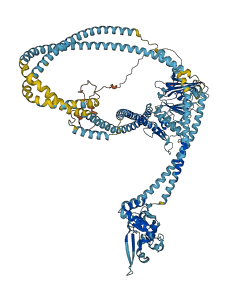
Descriptions
The autoinhibited protein was predicted that may have potential autoinhibitory elements via cis-regPred.
Autoinhibitory domains (AIDs)
Target domain |
|
Relief mechanism |
|
Assay |
cis-regPred |
Accessory elements
No accessory elements
Autoinhibited structure

Activated structure
1 structures for Q8CG46
| Entry ID | Method | Resolution | Chain | Position | Source |
|---|---|---|---|---|---|
| AF-Q8CG46-F1 | Predicted | AlphaFoldDB |
58 variants for Q8CG46
| Variant ID(s) | Position | Change | Description | Diseaes Association | Provenance |
|---|---|---|---|---|---|
| rs3407111649 | 21 | P>A | No | EVA | |
| rs3389525855 | 21 | P>L | No | EVA | |
| rs3389525855 | 21 | P>R | No | EVA | |
| rs3389480181 | 39 | P>A | No | EVA | |
| rs3389544104 | 80 | G>E | No | EVA | |
| rs3389524760 | 131 | S>Y | No | EVA | |
| rs3389540103 | 134 | L>H | No | EVA | |
| rs3389524219 | 145 | N>I | No | EVA | |
| rs3389530383 | 153 | K>I | No | EVA | |
| rs3389540080 | 175 | L>P | No | EVA | |
| rs3389544029 | 239 | M>T | No | EVA | |
| rs3389524178 | 272 | W>* | No | EVA | |
| rs3389498213 | 273 | V>M | No | EVA | |
| rs3389525865 | 290 | D>E | No | EVA | |
| rs3389524771 | 311 | E>* | No | EVA | |
| rs248647850 | 318 | H>R | No | EVA | |
| rs212286835 | 318 | H>Y | No | EVA | |
| rs3389480191 | 381 | E>K | No | EVA | |
| rs238616787 | 402 | T>A | No | EVA | |
| rs3389498228 | 405 | N>I | No | EVA | |
| rs3409022055 | 409 | R>L | No | EVA | |
| rs3389540105 | 521 | E>G | No | EVA | |
| rs3389524718 | 529 | D>G | No | EVA | |
| rs30799857 | 545 | Y>C | No | EVA | |
| rs3389524785 | 551 | S>* | No | EVA | |
| rs3389498249 | 581 | C>S | No | EVA | |
| rs3389546653 | 587 | H>Y | No | EVA | |
| rs3409138908 | 591 | V>L | No | EVA | |
| rs3389488312 | 599 | R>K | No | EVA | |
| rs3389531851 | 628 | N>K | No | EVA | |
| rs3389530387 | 674 | A>T | No | EVA | |
| rs237408120 | 675 | A>T | No | EVA | |
| rs3389531855 | 680 | N>S | No | EVA | |
| rs3389439607 | 681 | R>G | No | EVA | |
| rs3389536264 | 700 | R>S | No | EVA | |
| rs3408694443 | 712 | S>C | No | EVA | |
| rs230503519 | 733 | R>L | No | EVA | |
| rs230503519 | 733 | R>Q | No | EVA | |
| rs3409267141 | 800 | Q>H | No | EVA | |
| rs3409093225 | 803 | I>N | No | EVA | |
| rs249572687 | 807 | D>E | No | EVA | |
| rs240319211 | 822 | K>R | No | EVA | |
| rs239578935 | 838 | E>G | No | EVA | |
| rs224859162 | 844 | P>A | No | EVA | |
| rs3408991294 | 847 | P>W | No | EVA | |
| rs3389480226 | 911 | K>I | No | EVA | |
| rs3389536227 | 925 | K>E | No | EVA | |
| rs3389544041 | 937 | E>D | No | EVA | |
| rs3389530437 | 981 | T>S | No | EVA | |
| rs3389546581 | 1002 | L>I | No | EVA | |
| rs3389498262 | 1019 | D>G | No | EVA | |
| rs3389531845 | 1024 | G>D | No | EVA | |
| rs3389524719 | 1029 | N>D | No | EVA | |
| rs3389524173 | 1037 | V>D | No | EVA | |
| rs1133089041 | 1041 | A>S | No | EVA | |
| rs3389546648 | 1047 | S>P | No | EVA | |
| rs3389524787 | 1055 | K>* | No | EVA | |
| rs1132762056 | 1055 | K>M | No | EVA |
No associated diseases with Q8CG46
1 regional properties for Q8CG46
| Type | Name | Position | InterPro Accession |
|---|---|---|---|
| domain | RecF/RecN/SMC, N-terminal | 53 - 1053 | IPR003395 |
Functions
11 GO annotations of cellular component
| Name | Definition |
|---|---|
| cell junction | A cellular component that forms a specialized region of connection between two or more cells, or between a cell and the extracellular matrix, or between two membrane-bound components of a cell, such as flagella. |
| chromosome, centromeric region | The region of a chromosome that includes the centromeric DNA and associated proteins. In monocentric chromosomes, this region corresponds to a single area of the chromosome, whereas in holocentric chromosomes, it is evenly distributed along the chromosome. |
| chromosome, telomeric region | The end of a linear chromosome, required for the integrity and maintenance of the end. A chromosome telomere usually includes a region of telomerase-encoded repeats the length of which rarely exceeds 20 bp each and that permits the formation of a telomeric loop (T-loop). The telomeric repeat region is usually preceded by a sub-telomeric region that is gene-poor but rich in repetitive elements. Some telomeres only consist of the latter part (for eg. D. melanogaster telomeres). |
| cytoplasm | The contents of a cell excluding the plasma membrane and nucleus, but including other subcellular structures. |
| interchromatin granule | A class of nuclear body measuring 20-25 nm in diameter and distributed throughout the interchromatin space, linked together by thin fibrils. They are believed to be storage centers for various snRNAs, snRNPs, serine/arginine-rich proteins and RNA polymerase II. A typical mammalian cell contains 25-50 clusters of interchromatin granules. Interchromatin granule clusters do not contain the heterogeneous nuclear RNA-binding proteins (hnRNPs). |
| nuclear speck | A discrete extra-nucleolar subnuclear domain, 20-50 in number, in which splicing factors are seen to be localized by immunofluorescence microscopy. |
| nucleus | A membrane-bounded organelle of eukaryotic cells in which chromosomes are housed and replicated. In most cells, the nucleus contains all of the cell's chromosomes except the organellar chromosomes, and is the site of RNA synthesis and processing. In some species, or in specialized cell types, RNA metabolism or DNA replication may be absent. |
| PML body | A class of nuclear body; they react against SP100 auto-antibodies (PML, promyelocytic leukemia); cells typically contain 10-30 PML bodies per nucleus; alterations in the localization of PML bodies occurs after viral infection. |
| sex chromosome | A chromosome involved in sex determination. |
| site of double-strand break | A region of a chromosome at which a DNA double-strand break has occurred. DNA damage signaling and repair proteins accumulate at the lesion to respond to the damage and repair the DNA to form a continuous DNA helix. |
| Smc5-Smc6 complex | A conserved complex that contains a heterodimer of SMC proteins (Smc5p and Smc6p, or homologs thereof) and several other proteins, and is involved in DNA repair and maintaining cell cycle arrest following DNA damage. In S. cerevisiae, this is an octameric complex called Mms21-Smc5-Smc6 complex, with at least five of its subunits conserved in fission yeast and humans. |
3 GO annotations of molecular function
| Name | Definition |
|---|---|
| ATP binding | Binding to ATP, adenosine 5'-triphosphate, a universally important coenzyme and enzyme regulator. |
| ATP hydrolysis activity | Catalysis of the reaction: ATP + H2O = ADP + H+ phosphate. ATP hydrolysis is used in some reactions as an energy source, for example to catalyze a reaction or drive transport against a concentration gradient. |
| single-stranded DNA binding | Binding to single-stranded DNA. |
13 GO annotations of biological process
| Name | Definition |
|---|---|
| cell division | The process resulting in division and partitioning of components of a cell to form more cells; may or may not be accompanied by the physical separation of a cell into distinct, individually membrane-bounded daughter cells. |
| cellular response to DNA damage stimulus | Any process that results in a change in state or activity of a cell (in terms of movement, secretion, enzyme production, gene expression, etc.) as a result of a stimulus indicating damage to its DNA from environmental insults or errors during metabolism. |
| cellular senescence | A cell aging process stimulated in response to cellular stress, whereby normal cells lose the ability to divide through irreversible cell cycle arrest. |
| chromosome condensation | The progressive compaction of dispersed interphase chromatin into threadlike chromosomes prior to mitotic or meiotic nuclear division, or during apoptosis, in eukaryotic cells. |
| chromosome segregation | The process in which genetic material, in the form of chromosomes, is organized into specific structures and then physically separated and apportioned to two or more sets. In eukaryotes, chromosome segregation begins with the condensation of chromosomes, includes chromosome separation, and ends when chromosomes have completed movement to the spindle poles. |
| double-strand break repair via homologous recombination | The error-free repair of a double-strand break in DNA in which the broken DNA molecule is repaired using homologous sequences. A strand in the broken DNA searches for a homologous region in an intact chromosome to serve as the template for DNA synthesis. The restoration of two intact DNA molecules results in the exchange, reciprocal or nonreciprocal, of genetic material between the intact DNA molecule and the broken DNA molecule. |
| internal peptidyl-lysine acetylation | The addition of an acetyl group to a non-terminal lysine residue in a protein. |
| mitotic cell cycle phase transition | The cell cycle process by which a cell commits to entering the next mitotic cell cycle phase. |
| positive regulation of chromosome segregation | Any process that activates or increases the frequency, rate or extent of chromosome segregation, the process in which genetic material, in the form of chromosomes, is organized and then physically separated and apportioned to two or more sets. |
| positive regulation of maintenance of mitotic sister chromatid cohesion | Any process that increases the extent to which the association between sister chromatids of a replicated chromosome is maintained during a mitotic cell cycle. |
| protein localization to chromosome, centromeric region | Any process in which a protein is transported to, or maintained at, the centromeric region of a chromosome. |
| stem cell population maintenance | The process by which an organism or tissue maintains a population of stem cells of a single type. This can be achieved by a number of mechanisms: stem cell asymmetric division maintains stem cell numbers; stem cell symmetric division increases them; maintenance of a stem cell niche maintains the conditions for commitment to the stem cell fate for some types of stem cell; stem cells may arise de novo from other cell types. |
| telomere maintenance via recombination | Any recombinational process that contributes to the maintenance of proper telomeric length. |
2 homologous proteins in AiPD
| 10 | 20 | 30 | 40 | 50 | 60 |
| MATPSGKAAP | PNPQVSKRSL | PRDASSEVPS | KRKNSNPLPT | LPRPSGTFVE | GSIVRIAMEN |
| 70 | 80 | 90 | 100 | 110 | 120 |
| FLTYDICEVS | PGPHLNMIIG | ANGTGKSSIV | CAICLGLAGK | PAFMGRADKV | GFFVKRGCSK |
| 130 | 140 | 150 | 160 | 170 | 180 |
| GLVEIELFRT | SGNLIITREI | DVIKNQSFWF | INKKPVTQKI | VEEQVAALNI | QVGNLCQFLP |
| 190 | 200 | 210 | 220 | 230 | 240 |
| QDKVGEFAKL | SKIELLEATE | KSVGPPEMHR | YHCELKNFRE | KEKQLETSCK | EKTEYLEKMV |
| 250 | 260 | 270 | 280 | 290 | 300 |
| QRNERYKQDV | ERFYERKRHL | DLIEMLEAKR | PWVEYENVRQ | EYEGVKLIRD | RVKEEVRKLK |
| 310 | 320 | 330 | 340 | 350 | 360 |
| EGQIPMTRRI | EEIDRQRHTL | EVRIKEKSTD | IKEASQKCKQ | RQDLIERKDR | QIKELQQALT |
| 370 | 380 | 390 | 400 | 410 | 420 |
| VKQNEELDRQ | KRISNTRKMI | EDLQSELKTA | ENCENLQPQI | DTVTNDLRRV | QEEKALCEGE |
| 430 | 440 | 450 | 460 | 470 | 480 |
| IIDKQREKEM | LEKQRRSVSD | HITRFDNLMN | QKEDKLRQRY | RDTYDAVLWL | RNNRDRFKQR |
| 490 | 500 | 510 | 520 | 530 | 540 |
| VCEPIMLTIN | MKDNKNAKYV | ENHISSNDLR | AFVFESQEDM | EIFLREVRDN | KKLRVNAVIA |
| 550 | 560 | 570 | 580 | 590 | 600 |
| PKISYADKAP | SRSLNDLKQY | GFFSYLRELF | DAPDPVMSYL | CCQYHIHEVP | VGTERTRERI |
| 610 | 620 | 630 | 640 | 650 | 660 |
| ERVIQETRLK | QIYTAEEKYV | LKTSVYSNKV | ISSNTSLKVA | QFLTVTVDLE | QRRHLEEQLK |
| 670 | 680 | 690 | 700 | 710 | 720 |
| EMNRQLEAVD | SGLAALRDTN | RHLELKDNEL | RLKKKELLER | KTRKRQLEQK | ISSKLASIRL |
| 730 | 740 | 750 | 760 | 770 | 780 |
| MEQDTCNLEE | EERKASTKIK | EINVQKAKLV | TELTGLVKIC | TSFQIQKVDL | ILQNTTVISE |
| 790 | 800 | 810 | 820 | 830 | 840 |
| KNKLEADYMA | SSSQLRVTEQ | QFIELDDNRQ | RLLQKCKELM | KKARQVCNLS | ADQAVPQEFQ |
| 850 | 860 | 870 | 880 | 890 | 900 |
| TQVPTIPNGH | SSSPPMAFQD | LPNTLDEIDA | LLTEERSRAS | CFTGLNPSVV | EEYSKREVEI |
| 910 | 920 | 930 | 940 | 950 | 960 |
| QQLTEELQGK | KVELDEYREN | ISQVKERWLN | PLKELVEKIN | EKFSNFFSSM | QCAGEVDLHT |
| 970 | 980 | 990 | 1000 | 1010 | 1020 |
| ENEEDYDKYG | IRIRVKFRSS | TQLHELTPHH | QSGGERSVST | MLYLMALQEL | NRCPFRVVDE |
| 1030 | 1040 | 1050 | 1060 | 1070 | 1080 |
| INQGMDPINE | RRVFEMVVNT | ACKENTSQYF | FITPKLLQNL | PYSEKMTVLF | VYNGPHMLEP |
| 1090 | 1100 | ||||
| NRWNLKAFQR | RRRRITFTQP | Q |