Q08204
Gene name |
SMC5 (YOL034W) |
Protein name |
Structural maintenance of chromosomes protein 5 |
Names |
|
Species |
Saccharomyces cerevisiae (strain ATCC 204508 / S288c) (Baker's yeast) |
KEGG Pathway |
sce:YOL034W |
EC number |
|
Protein Class |
|
Descriptions
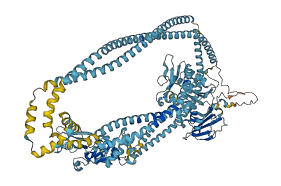
The autoinhibited protein was predicted that may have potential autoinhibitory elements via cis-regPred.
Autoinhibitory domains (AIDs)
Target domain |
|
Relief mechanism |
|
Assay |
cis-regPred |
Accessory elements
No accessory elements
Autoinhibited structure

Activated structure
21 variants for Q08204
| Variant ID(s) | Position | Change | Description | Diseaes Association | Provenance |
|---|---|---|---|---|---|
| s15-260341 | 140 | I>V | No | SGRP | |
| s15-260427 | 168 | Q>H | No | SGRP | |
| s15-260585 | 221 | N>S | No | SGRP | |
| s15-260608 | 229 | L>F | No | SGRP | |
| s15-260614 | 231 | F>V | No | SGRP | |
| s15-260678 | 252 | S>C | No | SGRP | |
| s15-261119 | 399 | E>G | No | SGRP | |
| s15-261314 | 464 | E>A | No | SGRP | |
| s15-261554 | 544 | T>I | No | SGRP | |
| s15-261557 | 545 | T>N | No | SGRP | |
| s15-261563 | 547 | P>L | No | SGRP | |
| s15-261584 | 554 | R>K | No | SGRP | |
| s15-261589 | 556 | L>V | No | SGRP | |
| s15-261841 | 640 | I>F | No | SGRP | |
| s15-261916 | 665 | N>D | No | SGRP | |
| s15-261928 | 669 | E>Q | No | SGRP | |
| s15-261980 | 686 | G>V | No | SGRP | |
| s15-262028 | 702 | N>S | No | SGRP | |
| s15-262168 | 749 | D>N | No | SGRP | |
| s15-262453 | 844 | T>A | No | SGRP | |
| s15-263194 | 1091 | S>T | No | SGRP |
No associated diseases with Q08204
1 regional properties for Q08204
| Type | Name | Position | InterPro Accession |
|---|---|---|---|
| domain | RecF/RecN/SMC, N-terminal | 42 - 1048 | IPR003395 |
3 GO annotations of cellular component
| Name | Definition |
|---|---|
| chromosome, telomeric region | The end of a linear chromosome, required for the integrity and maintenance of the end. A chromosome telomere usually includes a region of telomerase-encoded repeats the length of which rarely exceeds 20 bp each and that permits the formation of a telomeric loop (T-loop). The telomeric repeat region is usually preceded by a sub-telomeric region that is gene-poor but rich in repetitive elements. Some telomeres only consist of the latter part (for eg. D. melanogaster telomeres). |
| nucleus | A membrane-bounded organelle of eukaryotic cells in which chromosomes are housed and replicated. In most cells, the nucleus contains all of the cell's chromosomes except the organellar chromosomes, and is the site of RNA synthesis and processing. In some species, or in specialized cell types, RNA metabolism or DNA replication may be absent. |
| Smc5-Smc6 complex | A conserved complex that contains a heterodimer of SMC proteins (Smc5p and Smc6p, or homologs thereof) and several other proteins, and is involved in DNA repair and maintaining cell cycle arrest following DNA damage. In S. cerevisiae, this is an octameric complex called Mms21-Smc5-Smc6 complex, with at least five of its subunits conserved in fission yeast and humans. |
4 GO annotations of molecular function
| Name | Definition |
|---|---|
| ATP binding | Binding to ATP, adenosine 5'-triphosphate, a universally important coenzyme and enzyme regulator. |
| ATP hydrolysis activity | Catalysis of the reaction: ATP + H2O = ADP + H+ phosphate. ATP hydrolysis is used in some reactions as an energy source, for example to catalyze a reaction or drive transport against a concentration gradient. |
| damaged DNA binding | Binding to damaged DNA. |
| single-stranded DNA binding | Binding to single-stranded DNA. |
7 GO annotations of biological process
| Name | Definition |
|---|---|
| chromosome separation | The cell cycle process in which paired chromosomes are detached from each other. Chromosome separation begins with the release of cohesin complexes from chromosomes; in budding yeast, this includes the cleavage of cohesin complexes along the chromosome arms, followed by the separation of the centromeric regions. Chromosome separation also includes formation of chromatid axes mediated by condensins, and ends with the disentangling of inter-sister catenation catalyzed by topoisomerase II (topo II). |
| DNA repair | The process of restoring DNA after damage. Genomes are subject to damage by chemical and physical agents in the environment (e.g. UV and ionizing radiations, chemical mutagens, fungal and bacterial toxins, etc.) and by free radicals or alkylating agents endogenously generated in metabolism. DNA is also damaged because of errors during its replication. A variety of different DNA repair pathways have been reported that include direct reversal, base excision repair, nucleotide excision repair, photoreactivation, bypass, double-strand break repair pathway, and mismatch repair pathway. |
| double-strand break repair via homologous recombination | The error-free repair of a double-strand break in DNA in which the broken DNA molecule is repaired using homologous sequences. A strand in the broken DNA searches for a homologous region in an intact chromosome to serve as the template for DNA synthesis. The restoration of two intact DNA molecules results in the exchange, reciprocal or nonreciprocal, of genetic material between the intact DNA molecule and the broken DNA molecule. |
| protein sumoylation | The process in which a SUMO protein (small ubiquitin-related modifier) is conjugated to a target protein via an isopeptide bond between the carboxy-terminus of SUMO with an epsilon-amino group of a lysine residue of the target protein. |
| recombinational repair | A DNA repair process that involves the exchange, reciprocal or nonreciprocal, of genetic material between the broken DNA molecule and a homologous DNA region. |
| regulation of telomere maintenance | Any process that modulates the frequency, rate or extent of a process that affects and monitors the activity of telomeric proteins and the length of telomeric DNA. |
| resolution of recombination intermediates | The cleavage and rejoining of intermediates, such as Holliday junctions, formed during DNA recombination to produce two intact molecules in which genetic material has been exchanged. |
| 10 | 20 | 30 | 40 | 50 | 60 |
| MTSLIDLGRY | VERTHHGEDT | EPRSKRVKIA | KPDLSSFQPG | SIIKIRLQDF | VTYTLTEFNL |
| 70 | 80 | 90 | 100 | 110 | 120 |
| SPSLNMIIGP | NGSGKSTFVC | AVCLGLAGKP | EYIGRSKKVE | DFIKNGQDVS | KIEITLKNSP |
| 130 | 140 | 150 | 160 | 170 | 180 |
| NVTDIEYIDA | RDETIKITRI | ITRSKRRSDY | LINDYQVSES | VVKTLVAQLN | IQLDNLCQFL |
| 190 | 200 | 210 | 220 | 230 | 240 |
| SQERVEEFAR | LKSVKLLVET | IRSIDASLLD | VLDELRELQG | NEQSLQKDLD | FKKAKIVHLR |
| 250 | 260 | 270 | 280 | 290 | 300 |
| QESDKLRKSV | ESLRDFQNKK | GEIELHSQLL | PYVKVKDHKE | KLNIYKEEYE | RAKANLRAIL |
| 310 | 320 | 330 | 340 | 350 | 360 |
| KDKKPFANTK | KTLENQVEEL | TEKCSLKTDE | FLKAKEKINE | IFEKLNTIRD | EVIKKKNQNE |
| 370 | 380 | 390 | 400 | 410 | 420 |
| YYRGRTKKLQ | ATIISTKEDF | LRSQEILAQT | HLPEKSVFED | IDIKRKEIIN | KEGEIRDLIS |
| 430 | 440 | 450 | 460 | 470 | 480 |
| EIDAKANAIN | HEMRSIQRQA | ESKTKSLTTT | DKIGILNQDQ | DLKEVRDAVL | MVREHPEMKD |
| 490 | 500 | 510 | 520 | 530 | 540 |
| KILEPPIMTV | SAINAQFAAY | LAQCVDYNTS | KALTVVDSDS | YKLFANPILD | KFKVNLRELS |
| 550 | 560 | 570 | 580 | 590 | 600 |
| SADTTPPVPA | ETVRDLGFEG | YLSDFITGDK | RVMKMLCQTS | KIHTIPVSRR | ELTPAQIKKL |
| 610 | 620 | 630 | 640 | 650 | 660 |
| ITPRPNGKIL | FKRIIHGNRL | VDIKQSAYGS | KQVFPTDVSI | KQTNFYQGSI | MSNEQKIRIE |
| 670 | 680 | 690 | 700 | 710 | 720 |
| NEIINLKNEY | NDRKSTLDAL | SNQKSGYRHE | LSELASKNDD | INREAHQLNE | IRKKYTMRKS |
| 730 | 740 | 750 | 760 | 770 | 780 |
| TIETLREKLD | QLKREARKDV | SQKIKDIDDQ | IQQLLLKQRH | LLSKMASSMK | SLKNCQKELI |
| 790 | 800 | 810 | 820 | 830 | 840 |
| STQILQFEAQ | NMDVSMNDVI | GFFNEREADL | KSQYEDKKKF | VKEMRDTPEF | QSWMREIRSY |
| 850 | 860 | 870 | 880 | 890 | 900 |
| DQDTKEKLNK | VAEKYEEEGN | FNLSFVQDVL | DKLESEIAMV | NHDESAVTIL | DQVTAELREL |
| 910 | 920 | 930 | 940 | 950 | 960 |
| EHTVPQQSKD | LETIKAKLKE | DHAVLEPKLD | DIVSKISARF | ARLFNNVGSA | GAVRLEKPKD |
| 970 | 980 | 990 | 1000 | 1010 | 1020 |
| YAEWKIEIMV | KFRDNAPLKK | LDSHTQSGGE | RAVSTVLYMI | ALQEFTSAPF | RVVDEINQGM |
| 1030 | 1040 | 1050 | 1060 | 1070 | 1080 |
| DSRNERIVHK | AMVENACAEN | TSQYFLITPK | LLTGLHYHEK | MRIHCVMAGS | WIPNPSEDPK |
| 1090 | |||||
| MIHFGETSNY | SFD |