Q8CFI2
Gene name |
Cdc34 (Ubch3, Ube2r1) |
Protein name |
Ubiquitin-conjugating enzyme E2 R1 |
Names |
(E3-independent) E2 ubiquitin-conjugating enzyme R1, E2 ubiquitin-conjugating enzyme R1, Ubiquitin-conjugating enzyme E2-32 kDa complementing, Ubiquitin-conjugating enzyme E2-CDC34, Ubiquitin-protein ligase R1 |
Species |
Mus musculus (Mouse) |
KEGG Pathway |
mmu:216150 |
EC number |
2.3.2.23: Aminoacyltransferases |
Protein Class |
|
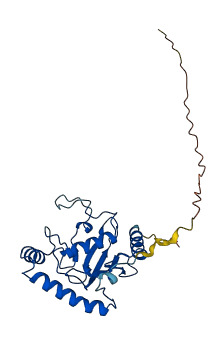
Descriptions
The autoinhibited protein was predicted that may have potential autoinhibitory elements via cis-regPred.
Autoinhibitory domains (AIDs)
Target domain |
|
Relief mechanism |
|
Assay |
cis-regPred |
Accessory elements
No accessory elements
Autoinhibited structure

Activated structure
1 structures for Q8CFI2
| Entry ID | Method | Resolution | Chain | Position | Source |
|---|---|---|---|---|---|
| AF-Q8CFI2-F1 | Predicted | AlphaFoldDB |
1 variants for Q8CFI2
| Variant ID(s) | Position | Change | Description | Diseaes Association | Provenance |
|---|---|---|---|---|---|
| rs3389108732 | 197 | P>S | No | EVA |
No associated diseases with Q8CFI2
Functions
| Description | ||
|---|---|---|
| EC Number | 2.3.2.23 | Aminoacyltransferases |
| Subcellular Localization |
|
|
| PANTHER Family | ||
| PANTHER Subfamily | ||
| PANTHER Protein Class | ||
| PANTHER Pathway Category | No pathway information available | |
2 GO annotations of cellular component
| Name | Definition |
|---|---|
| cytosol | The part of the cytoplasm that does not contain organelles but which does contain other particulate matter, such as protein complexes. |
| nuclear speck | A discrete extra-nucleolar subnuclear domain, 20-50 in number, in which splicing factors are seen to be localized by immunofluorescence microscopy. |
3 GO annotations of molecular function
| Name | Definition |
|---|---|
| ATP binding | Binding to ATP, adenosine 5'-triphosphate, a universally important coenzyme and enzyme regulator. |
| ubiquitin conjugating enzyme activity | Isoenergetic transfer of ubiquitin from one protein to another via the reaction X-ubiquitin + Y -> Y-ubiquitin + X, where both the X-ubiquitin and Y-ubiquitin linkages are thioester bonds between the C-terminal glycine of ubiquitin and a sulfhydryl side group of a cysteine residue. |
| ubiquitin-protein transferase activity | Catalysis of the transfer of ubiquitin from one protein to another via the reaction X-Ub + Y --> Y-Ub + X, where both X-Ub and Y-Ub are covalent linkages. |
12 GO annotations of biological process
| Name | Definition |
|---|---|
| cell cycle | The progression of biochemical and morphological phases and events that occur in a cell during successive cell replication or nuclear replication events. Canonically, the cell cycle comprises the replication and segregation of genetic material followed by the division of the cell, but in endocycles or syncytial cells nuclear replication or nuclear division may not be followed by cell division. |
| cellular response to interferon-beta | Any process that results in a change in state or activity of a cell (in terms of movement, secretion, enzyme production, gene expression, etc.) as a result of an interferon-beta stimulus. Interferon-beta is a type I interferon. |
| negative regulation of cAMP-mediated signaling | Any process which stops, prevents, or reduces the frequency, rate or extent of cAMP-mediated signaling. |
| positive regulation of inclusion body assembly | Any process that increases the rate, frequency, or extent of inclusion body assembly. Inclusion body assembly is the aggregation, arrangement and bonding together of a set of components to form an inclusion body. |
| positive regulation of neuron apoptotic process | Any process that activates or increases the frequency, rate or extent of cell death of neurons by apoptotic process. |
| proteasome-mediated ubiquitin-dependent protein catabolic process | The chemical reactions and pathways resulting in the breakdown of a protein or peptide by hydrolysis of its peptide bonds, initiated by the covalent attachment of ubiquitin, and mediated by the proteasome. |
| protein K48-linked ubiquitination | A protein ubiquitination process in which a polymer of ubiquitin, formed by linkages between lysine residues at position 48 of the ubiquitin monomers, is added to a protein. K48-linked ubiquitination targets the substrate protein for degradation. |
| protein monoubiquitination | Addition of a single ubiquitin group to a protein. |
| protein polyubiquitination | Addition of multiple ubiquitin groups to a protein, forming a ubiquitin chain. |
| protein ubiquitination | The process in which one or more ubiquitin groups are added to a protein. |
| response to growth factor | Any process that results in a change in state or activity of a cell or an organism (in terms of movement, secretion, enzyme production, gene expression, etc.) as a result of a growth factor stimulus. |
| ubiquitin-dependent protein catabolic process | The chemical reactions and pathways resulting in the breakdown of a protein or peptide by hydrolysis of its peptide bonds, initiated by the covalent attachment of a ubiquitin group, or multiple ubiquitin groups, to the protein. |
| 10 | 20 | 30 | 40 | 50 | 60 |
| MARPLVPSSQ | KALLLELKGL | QEEPVEGFRV | TLVDEGDLYN | WEVAIFGPPN | TYYEGGYFKA |
| 70 | 80 | 90 | 100 | 110 | 120 |
| RLKFPIDYPY | SPPAFRFLTK | MWHPNIYETG | DVCISILHPP | VDDPQSGELP | SERWNPTQNV |
| 130 | 140 | 150 | 160 | 170 | 180 |
| RTILLSVISL | LNEPNTFSPA | NVDASVMYRK | WKESKGKDRE | YTDIIRKQVL | GTKVDAERDG |
| 190 | 200 | 210 | 220 | 230 | |
| VKVPTTLAEY | CVKTKAPAPD | EGSDLFYDDY | YEDGEVEEAD | SCFGDEEDDS | GTEES |