Q8CAS9
Gene name |
Parp9 (Bal) |
Protein name |
Protein mono-ADP-ribosyltransferase PARP9 |
Names |
ADP-ribosyltransferase diphtheria toxin-like 9, ARTD9, B aggressive lymphoma protein homolog, Poly [ADP-ribose] polymerase 9, PARP-9 |
Species |
Mus musculus (Mouse) |
KEGG Pathway |
mmu:80285 |
EC number |
|
Protein Class |
|
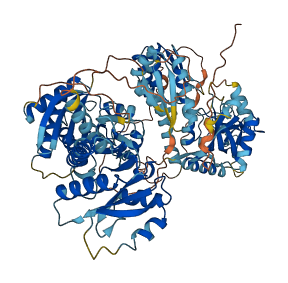
Descriptions
The autoinhibited protein was predicted that may have potential autoinhibitory elements via cis-regPred.
Autoinhibitory domains (AIDs)
Target domain |
|
Relief mechanism |
|
Assay |
cis-regPred |
Accessory elements
No accessory elements
Autoinhibited structure

Activated structure
1 structures for Q8CAS9
| Entry ID | Method | Resolution | Chain | Position | Source |
|---|---|---|---|---|---|
| AF-Q8CAS9-F1 | Predicted | AlphaFoldDB |
No variants for Q8CAS9
| Variant ID(s) | Position | Change | Description | Diseaes Association | Provenance |
|---|---|---|---|---|---|
| No variants for Q8CAS9 | |||||
No associated diseases with Q8CAS9
3 regional properties for Q8CAS9
| Type | Name | Position | InterPro Accession |
|---|---|---|---|
| domain | Macro domain | 109 - 298 | IPR002589-1 |
| domain | Macro domain | 313 - 492 | IPR002589-2 |
| domain | Poly(ADP-ribose) polymerase, catalytic domain | 635 - 853 | IPR012317 |
Functions
7 GO annotations of cellular component
| Name | Definition |
|---|---|
| cytoplasm | The contents of a cell excluding the plasma membrane and nucleus, but including other subcellular structures. |
| cytosol | The part of the cytoplasm that does not contain organelles but which does contain other particulate matter, such as protein complexes. |
| mitochondrion | A semiautonomous, self replicating organelle that occurs in varying numbers, shapes, and sizes in the cytoplasm of virtually all eukaryotic cells. It is notably the site of tissue respiration. |
| nucleoplasm | That part of the nuclear content other than the chromosomes or the nucleolus. |
| nucleus | A membrane-bounded organelle of eukaryotic cells in which chromosomes are housed and replicated. In most cells, the nucleus contains all of the cell's chromosomes except the organellar chromosomes, and is the site of RNA synthesis and processing. In some species, or in specialized cell types, RNA metabolism or DNA replication may be absent. |
| protein-containing complex | A stable assembly of two or more macromolecules, i.e. proteins, nucleic acids, carbohydrates or lipids, in which at least one component is a protein and the constituent parts function together. |
| site of DNA damage | A region of a chromosome at which DNA damage has occurred. DNA damage signaling and repair proteins accumulate at the lesion to respond to the damage and repair the DNA to form a continuous DNA helix. |
10 GO annotations of molecular function
| Name | Definition |
|---|---|
| ADP-D-ribose binding | Binding to ADP-D-ribose, an ADP-aldose having ribose as the aldose fragment. |
| enzyme binding | Binding to an enzyme, a protein with catalytic activity. |
| enzyme inhibitor activity | Binds to and stops, prevents or reduces the activity of an enzyme. |
| histone binding | Binding to a histone, any of a group of water-soluble proteins found in association with the DNA of eukaryotic or archaeal chromosomes. They are involved in the condensation and coiling of chromosomes during cell division and have also been implicated in gene regulation and DNA replication. They may be chemically modified (methylated, acetlyated and others) to regulate gene transcription. |
| NAD+ ADP-ribosyltransferase activity | Catalysis of the reaction: NAD+ + (ADP-D-ribosyl)(n)-acceptor = nicotinamide + (ADP-D-ribosyl)(n+1)-acceptor. |
| NAD+-protein ADP-ribosyltransferase activity | Catalysis of the reaction: amino acyl- + NAD+ = H+ + (ADP-D-ribosyl)-amino acyl- |
| NAD+-protein-C-terminal glycine ADP-ribosyltransferase activity | Catalysis of the reaction: -C-terminal glycine + NAD(+) = -C-terminal O-(ADP-D-ribosyl)-glycine + nicotinamide. |
| STAT family protein binding | Binding to a member of the signal transducers and activators of transcription (STAT) protein family. STATs are, as the name indicates, both signal transducers and transcription factors. STATs are activated by cytokines and some growth factors and thus control important biological processes including cell growth, cell differentiation, apoptosis and immune responses. |
| transcription corepressor activity | A transcription coregulator activity that represses or decreases the transcription of specific gene sets via binding to a DNA-bound DNA-binding transcription factor, either on its own or as part of a complex. Corepressors often act by altering chromatin structure and modifications. For example, one class of transcription corepressors modifies chromatin structure through covalent modification of histones. A second class remodels the conformation of chromatin in an ATP-dependent fashion. A third class modulates interactions of DNA-bound DNA-binding transcription factors with other transcription coregulators. |
| ubiquitin-like protein ligase binding | Binding to a ubiquitin-like protein ligase, such as ubiquitin-ligase. |
18 GO annotations of biological process
| Name | Definition |
|---|---|
| defense response to virus | Reactions triggered in response to the presence of a virus that act to protect the cell or organism. |
| double-strand break repair | The repair of double-strand breaks in DNA via homologous and nonhomologous mechanisms to reform a continuous DNA helix. |
| innate immune response | Innate immune responses are defense responses mediated by germline encoded components that directly recognize components of potential pathogens. |
| negative regulation of catalytic activity | Any process that stops or reduces the activity of an enzyme. |
| negative regulation of gene expression | Any process that decreases the frequency, rate or extent of gene expression. Gene expression is the process in which a gene's coding sequence is converted into a mature gene product (protein or RNA). |
| negative regulation of transcription by RNA polymerase II | Any process that stops, prevents, or reduces the frequency, rate or extent of transcription mediated by RNA polymerase II. |
| positive regulation of chromatin binding | Any process that increases the frequency, rate or extent of chromatin binding. Chromatin binding is the selective interaction with chromatin, the network of fibers of DNA, protein, and sometimes RNA, that make up the chromosomes of the eukaryotic nucleus during interphase. |
| positive regulation of defense response to virus by host | Any host process that results in the promotion of antiviral immune response mechanisms, thereby limiting viral replication. |
| positive regulation of DNA-templated transcription | Any process that activates or increases the frequency, rate or extent of cellular DNA-templated transcription. |
| positive regulation of double-strand break repair via nonhomologous end joining | Any process that activates or increases the frequency, rate or extent of double-strand break repair via nonhomologous end joining. |
| positive regulation of interferon-gamma-mediated signaling pathway | Any process that increases the rate, frequency or extent of an interferon-gamma-mediated signaling pathway. |
| positive regulation of protein localization to nucleus | Any process that activates or increases the frequency, rate or extent of protein localization to nucleus. |
| positive regulation of tyrosine phosphorylation of STAT protein | Any process that activates or increases the frequency, rate or extent of the introduction of a phosphate group to a tyrosine residue of a STAT (Signal Transducer and Activator of Transcription) protein. |
| post-transcriptional regulation of gene expression | Any process that modulates the frequency, rate or extent of gene expression after the production of an RNA transcript. |
| protein ADP-ribosylation | The transfer, from NAD, of ADP-ribose to protein amino acids. |
| protein mono-ADP-ribosylation | The transfer, from NAD, of a single (mono) ADP-ribose molecule to protein amino acids. |
| protein poly-ADP-ribosylation | The transfer of multiple ADP-ribose residues from NAD to a protein amino acid, forming a poly(ADP-ribose) chain. |
| regulation of response to interferon-gamma | Any process that modulates the rate, frequency or extent of a response to interferon-gamma. Response to interferon gamma is a change in state or activity of a cell or an organism (in terms of movement, secretion, enzyme production, gene expression, etc.) as a result of an interferon-gamma stimulus. |
3 homologous proteins in AiPD
| 10 | 20 | 30 | 40 | 50 | 60 |
| MAYYMDTWAA | APAERPGMIA | SLSLSFKKAF | AELFPQRRRG | HSEGDYPPLR | GSANNSLEEH |
| 70 | 80 | 90 | 100 | 110 | 120 |
| YRWQIPIKHN | VFEILKSNES | QLCEVLQNKF | GCISTLSCPT | LAGSSSPAQR | VFRRTLIPGI |
| 130 | 140 | 150 | 160 | 170 | 180 |
| ELSVWKDDLT | RHVVDAVVNA | ANENLLHGSG | LAGSLVKTGG | FEIQEESKRI | IANVGKISVG |
| 190 | 200 | 210 | 220 | 230 | 240 |
| GIAITGAGRL | PCHLIIHAVG | PRWTVTNSQT | AIELLKFAIR | NILDYVTKYD | LRIKTVAIPA |
| 250 | 260 | 270 | 280 | 290 | 300 |
| LSSGIFQFPL | DLCTSIILET | IRLYFQDKQM | FGNLREIHLV | SNEDPTVASF | KSASESILGR |
| 310 | 320 | 330 | 340 | 350 | 360 |
| DLSSWGGPET | DPASTMTLRI | GRGLTLQIVQ | GCIEMQTTDV | IVNSGYMQDF | KSGRVAQSIL |
| 370 | 380 | 390 | 400 | 410 | 420 |
| RQAGVEMEKE | LDKVNLSTDY | QEVWVTKGFK | LSCQYVFHVA | WHSQINKYQI | LKDAMKSCLE |
| 430 | 440 | 450 | 460 | 470 | 480 |
| KCLKPDINSI | SFPALGTGLM | DLKKSTAAQI | MFEEVFAFAK | EHKEKTLTVK | IVIFPVDVET |
| 490 | 500 | 510 | 520 | 530 | 540 |
| YKIFYAEMTK | RSNELNLSGN | SGALALQWSS | GEQRRGGLEA | GSPAINLMGV | KVGEMCEAQE |
| 550 | 560 | 570 | 580 | 590 | 600 |
| WIERLLVSLD | HHIIENNHIL | YLGKKEHDVL | SELQTSTRVS | ISETVSPRTA | TLEIKGPQAD |
| 610 | 620 | 630 | 640 | 650 | 660 |
| LIDAVMRIEC | MLCDVQEEVA | GKREKNLWSL | SGQGTNQQEK | LDKMEESYTF | QRYPASLTQE |
| 670 | 680 | 690 | 700 | 710 | 720 |
| LQDRKKQFEK | CGLWVVQVEQ | IDNKVLLAAF | QEKKKMMEER | TPKGSGSQRL | FQQVPHQFCN |
| 730 | 740 | 750 | 760 | 770 | 780 |
| TVCRVGFHRM | YSTSYNPVYG | AGIYFTKSLK | NLADKVKKTS | STDKLIYVFE | AEVLTGSFCQ |
| 790 | 800 | 810 | 820 | 830 | 840 |
| GNSSNIIPPP | LSPGALDVND | SVVDNVSSPE | TIVVFNGMQA | MPLYLWTCTQ | DRTFSQHPMW |
| 850 | 860 | ||||
| SQGYSSGPGM | VSSLQSWEWV | LNGSSV |