Q8C1B2
Gene name |
Tiparp |
Protein name |
Protein mono-ADP-ribosyltransferase TIPARP |
Names |
ADP-ribosyltransferase diphtheria toxin-like 14, ARTD14, TCDD-inducible poly [ADP-ribose] polymerase |
Species |
Mus musculus (Mouse) |
KEGG Pathway |
mmu:99929 |
EC number |
|
Protein Class |
|
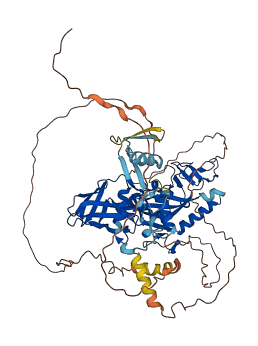
Descriptions
The autoinhibited protein was predicted that may have potential autoinhibitory elements via cis-regPred.
Autoinhibitory domains (AIDs)
Target domain |
|
Relief mechanism |
|
Assay |
cis-regPred |
Accessory elements
No accessory elements
Autoinhibited structure

Activated structure
1 structures for Q8C1B2
| Entry ID | Method | Resolution | Chain | Position | Source |
|---|---|---|---|---|---|
| AF-Q8C1B2-F1 | Predicted | AlphaFoldDB |
12 variants for Q8C1B2
| Variant ID(s) | Position | Change | Description | Diseaes Association | Provenance |
|---|---|---|---|---|---|
| rs31100593 | 8 | P>L | No | EVA | |
| rs30561629 | 30 | S>F | No | EVA | |
| rs3388628258 | 84 | S>N | No | EVA | |
| rs3388634123 | 113 | P>H | No | EVA | |
| rs226249713 | 179 | V>I | No | EVA | |
| rs3388622153 | 183 | M>L | No | EVA | |
| rs3388622123 | 225 | F>L | No | EVA | |
| rs3393103102 | 346 | T>S | No | EVA | |
| rs38330461 | 518 | M>L | No | EVA | |
| rs3388615093 | 556 | A>V | No | EVA | |
| rs3388632549 | 631 | I>N | No | EVA | |
| rs1132318472 | 651 | V>I | No | EVA |
No associated diseases with Q8C1B2
1 GO annotations of cellular component
| Name | Definition |
|---|---|
| nucleus | A membrane-bounded organelle of eukaryotic cells in which chromosomes are housed and replicated. In most cells, the nucleus contains all of the cell's chromosomes except the organellar chromosomes, and is the site of RNA synthesis and processing. In some species, or in specialized cell types, RNA metabolism or DNA replication may be absent. |
5 GO annotations of molecular function
| Name | Definition |
|---|---|
| cis-regulatory region sequence-specific DNA binding | Binding to a specific upstream regulatory DNA sequence (transcription factor recognition sequence or binding site) located in cis relative to the transcription start site (i.e., on the same strand of DNA) of a gene transcribed by some RNA polymerase. The proximal promoter is in cis with and relatively close to the core promoter. |
| metal ion binding | Binding to a metal ion. |
| NAD+ ADP-ribosyltransferase activity | Catalysis of the reaction: NAD+ + (ADP-D-ribosyl)(n)-acceptor = nicotinamide + (ADP-D-ribosyl)(n+1)-acceptor. |
| NAD+- protein-cysteine ADP-ribosyltransferase activity | Catalysis of the reaction: L-cysteinyl- + NAD(+) = H(+) + nicotinamide + S-(ADP-D-ribosyl)-L-cysteinyl- |
| NAD+-protein ADP-ribosyltransferase activity | Catalysis of the reaction: amino acyl- + NAD+ = H+ + (ADP-D-ribosyl)-amino acyl- |
19 GO annotations of biological process
| Name | Definition |
|---|---|
| androgen metabolic process | The chemical reactions and pathways involving androgens, C19 steroid hormones that can stimulate the development of male sexual characteristics. |
| cellular response to organic cyclic compound | Any process that results in a change in state or activity of a cell (in terms of movement, secretion, enzyme production, gene expression, etc.) as a result of an organic cyclic compound stimulus. |
| estrogen metabolic process | The chemical reactions and pathways involving estrogens, C18 steroid hormones that can stimulate the development of female sexual characteristics. Also found in plants. |
| face morphogenesis | The process in which the anatomical structures of the face are generated and organized. The face is the ventral division of the head. |
| female gonad development | The process whose specific outcome is the progression of the female gonad over time, from its formation to the mature structure. |
| hemopoiesis | The process whose specific outcome is the progression of the myeloid and lymphoid derived organ/tissue systems of the blood and other parts of the body over time, from formation to the mature structure. The site of hemopoiesis is variable during development, but occurs primarily in bone marrow or kidney in many adult vertebrates. |
| kidney development | The process whose specific outcome is the progression of the kidney over time, from its formation to the mature structure. The kidney is an organ that filters the blood and/or excretes the end products of body metabolism in the form of urine. |
| negative regulation of gene expression | Any process that decreases the frequency, rate or extent of gene expression. Gene expression is the process in which a gene's coding sequence is converted into a mature gene product (protein or RNA). |
| nitrogen compound metabolic process | The chemical reactions and pathways involving organic or inorganic compounds that contain nitrogen. |
| platelet-derived growth factor receptor signaling pathway | The series of molecular signals initiated by a ligand binding to a platelet-derived growth factor receptor on the surface of a target cell, and ending with the regulation of a downstream cellular process, e.g. transcription. |
| positive regulation of protein catabolic process | Any process that activates or increases the frequency, rate or extent of the chemical reactions and pathways resulting in the breakdown of a protein by the destruction of the native, active configuration, with or without the hydrolysis of peptide bonds. |
| post-embryonic development | The process whose specific outcome is the progression of the organism over time, from the completion of embryonic development to the mature structure. See embryonic development. |
| protein ADP-ribosylation | The transfer, from NAD, of ADP-ribose to protein amino acids. |
| protein auto-ADP-ribosylation | The ADP-ribosylation by a protein of one or more of its own amino acid residues, or residues on an identical protein. |
| protein mono-ADP-ribosylation | The transfer, from NAD, of a single (mono) ADP-ribose molecule to protein amino acids. |
| roof of mouth development | The biological process whose specific outcome is the progression of the roof of the mouth from an initial condition to its mature state. This process begins with the formation of the structure and ends with the mature structure. The roof of the mouth is the partition that separates the nasal and oral cavities. |
| skeletal system morphogenesis | The process in which the anatomical structures of the skeleton are generated and organized. |
| smooth muscle tissue development | The process whose specific outcome is the progression of smooth muscle over time, from its formation to the mature structure. |
| vasculogenesis | The differentiation of endothelial cells from progenitor cells during blood vessel development, and the de novo formation of blood vessels and tubes. |
3 homologous proteins in AiPD
| 10 | 20 | 30 | 40 | 50 | 60 |
| MEVETTEPEP | DCVVQPPSPS | DDFSCQMRIS | EKISPLKTCF | KKKQEQKRLG | TGTLRSLRPI |
| 70 | 80 | 90 | 100 | 110 | 120 |
| LNTLLESGSL | DGVFRARDQN | RDESSLHEHI | VKKPLEINPS | CPPAENSMPV | LIPDGTNVEG |
| 130 | 140 | 150 | 160 | 170 | 180 |
| QLPEAHPSTD | APEQGVPIQD | HSFPPETISG | TVADSTTGHF | QTDLLHPVSG | DVPTSPDCVD |
| 190 | 200 | 210 | 220 | 230 | 240 |
| KVMDYVPGAF | QDNSFTIQYI | LDTSDKLSTE | LFQDKSEEAS | LELVFELVNQ | LQYHTHQENG |
| 250 | 260 | 270 | 280 | 290 | 300 |
| IEICMDFLQG | TCIYGRDCLK | HHTVLPYHWQ | IKRTTTQKWQ | SVSNDSQEHL | ERFYCNPEND |
| 310 | 320 | 330 | 340 | 350 | 360 |
| RMRMKYGGQD | FWADLNAMTV | FETTEFDQLR | RLSTPPCSNS | NSIYHTFWKF | FCRDHFGWRE |
| 370 | 380 | 390 | 400 | 410 | 420 |
| YPESVVRLIE | EANSRGLKEV | RFMMWNNHYI | LHNSFFRREI | KRRPLFRSCF | ILIPYLQTLG |
| 430 | 440 | 450 | 460 | 470 | 480 |
| GVPTQASLPL | EATSSQIICP | DGVTSANFYP | ETWVYMHPSQ | DFIQVPVSAE | DKSYRIIYNL |
| 490 | 500 | 510 | 520 | 530 | 540 |
| FHKTVPEFKY | RILQILRVQN | QFLWEKYKRK | KEYMNRKMSG | RDRIINERHL | FHGTSQDVVD |
| 550 | 560 | 570 | 580 | 590 | 600 |
| GICKHNFDPR | VCGKHATMFG | QGSYFAKKAS | YSHNFSKKSS | KGVHFMFLAK | VLTGRYTMGS |
| 610 | 620 | 630 | 640 | 650 | |
| HGMRRPPPVN | PGSVTSDLYD | SCVDNFFEPQ | IFVIFNDDQS | YPYFVIQYEE | VSNTVSI |