Q8C0M8
Gene name |
Dnai1 (Dnaic1) |
Protein name |
Dynein axonemal intermediate chain 1 |
Names |
Axonemal dynein intermediate chain 1 |
Species |
Mus musculus (Mouse) |
KEGG Pathway |
mmu:68922 |
EC number |
|
Protein Class |
|
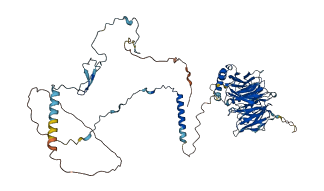
Descriptions
The autoinhibited protein was predicted that may have potential autoinhibitory elements via cis-regPred.
Autoinhibitory domains (AIDs)
Target domain |
|
Relief mechanism |
|
Assay |
cis-regPred |
Accessory elements
No accessory elements
Autoinhibited structure

Activated structure
1 structures for Q8C0M8
| Entry ID | Method | Resolution | Chain | Position | Source |
|---|---|---|---|---|---|
| AF-Q8C0M8-F1 | Predicted | AlphaFoldDB |
34 variants for Q8C0M8
| Variant ID(s) | Position | Change | Description | Diseaes Association | Provenance |
|---|---|---|---|---|---|
| rs218629486 | 11 | I>V | No | EVA | |
| rs3388667471 | 43 | R>L | No | EVA | |
| rs3388671615 | 78 | S>N | No | EVA | |
| rs3388679607 | 108 | S>L | No | EVA | |
| rs3388679078 | 110 | E>D | No | EVA | |
| rs229034043 | 129 | K>R | No | EVA | |
| rs3388675483 | 151 | A>T | No | EVA | |
| rs3388676920 | 154 | E>* | No | EVA | |
| rs3388680158 | 159 | S>G | No | EVA | |
| rs3388673470 | 165 | A>T | No | EVA | |
| rs3388675542 | 169 | T>K | No | EVA | |
| rs3388682387 | 189 | L>P | No | EVA | |
| rs3388671566 | 192 | Q>E | No | EVA | |
| rs3388680186 | 214 | M>K | No | EVA | |
| rs3394170977 | 300 | A>V | No | EVA | |
| rs227627648 | 309 | T>A | No | EVA | |
| rs3388680201 | 380 | M>I | No | EVA | |
| rs28269547 | 392 | V>M | No | EVA | |
| rs3388680171 | 406 | D>E | No | EVA | |
| rs3388673468 | 412 | Y>D | No | EVA | |
| rs3394152299 | 436 | V>A | No | EVA | |
| rs3394223115 | 436 | V>L | No | EVA | |
| rs3388681584 | 451 | N>I | No | EVA | |
| rs3388667541 | 469 | S>R | No | EVA | |
| rs239688745 | 476 | I>V | No | EVA | |
| rs3388681524 | 481 | T>S | No | EVA | |
| rs3388673498 | 493 | Q>H | No | EVA | |
| rs3394166019 | 513 | F>* | No | EVA | |
| rs3388676499 | 531 | S>N | No | EVA | |
| rs28269532 | 538 | D>E | No | EVA | |
| rs3388681540 | 614 | A>G | No | EVA | |
| rs3388681563 | 619 | E>D | No | EVA | |
| rs3388679000 | 626 | V>L | No | EVA | |
| rs3388676524 | 701 | T>I | No | EVA |
No associated diseases with Q8C0M8
No regional properties for Q8C0M8
| Type | Name | Position | InterPro Accession |
|---|---|---|---|
| No domain, repeats, and functional sites for Q8C0M8 | |||
7 GO annotations of cellular component
| Name | Definition |
|---|---|
| 9+2 motile cilium | A motile cilium where the axoneme has a ring of nine outer microtubule doublets plus two central microtubules (and is therefore called a 9+2 axoneme). |
| centrosome | A structure comprised of a core structure (in most organisms, a pair of centrioles) and peripheral material from which a microtubule-based structure, such as a spindle apparatus, is organized. Centrosomes occur close to the nucleus during interphase in many eukaryotic cells, though in animal cells it changes continually during the cell-division cycle. |
| cilium | A specialized eukaryotic organelle that consists of a filiform extrusion of the cell surface and of some cytoplasmic parts. Each cilium is largely bounded by an extrusion of the cytoplasmic (plasma) membrane, and contains a regular longitudinal array of microtubules, anchored to a basal body. |
| cytoplasm | The contents of a cell excluding the plasma membrane and nucleus, but including other subcellular structures. |
| extracellular region | The space external to the outermost structure of a cell. For cells without external protective or external encapsulating structures this refers to space outside of the plasma membrane. This term covers the host cell environment outside an intracellular parasite. |
| microtubule | Any of the long, generally straight, hollow tubes of internal diameter 12-15 nm and external diameter 24 nm found in a wide variety of eukaryotic cells; each consists (usually) of 13 protofilaments of polymeric tubulin, staggered in such a manner that the tubulin monomers are arranged in a helical pattern on the microtubular surface, and with the alpha/beta axes of the tubulin subunits parallel to the long axis of the tubule; exist in equilibrium with pool of tubulin monomers and can be rapidly assembled or disassembled in response to physiological stimuli; concerned with force generation, e.g. in the spindle. |
| outer dynein arm | Outer arm structure present on the outer doublet microtubules of ciliary and flagellar axonemes. Outer dynein arms contain 2-3 heavy chains, two or more intermediate chains and a cluster of 4-8 light chains. Inner and outer dynein arms have different functions in the generation of microtubule-based motility. |
2 GO annotations of molecular function
| Name | Definition |
|---|---|
| dynein heavy chain binding | Binding to a heavy chain of the dynein complex. |
| dynein light chain binding | Binding to a light chain of the dynein complex. |
8 GO annotations of biological process
| Name | Definition |
|---|---|
| cilium movement | The directed, self-propelled movement of a cilium. |
| determination of left/right symmetry | The establishment of an organism's body plan or part of an organism with respect to the left and right halves. The pattern can either be symmetric, such that the halves are mirror images, or asymmetric where the pattern deviates from this symmetry. |
| epithelial cilium movement involved in extracellular fluid movement | The directed, self-propelled movement of cilia of epithelial cells. Depending on the type of cell, there may be one or many cilia per cell. This movement is usually coordinated between many epithelial cells, and serves to move extracellular fluid. |
| flagellated sperm motility | The directed, self-propelled movement of a cilium (aka flagellum) that contributes to the movement of a flagellated sperm. |
| heart development | The process whose specific outcome is the progression of the heart over time, from its formation to the mature structure. The heart is a hollow, muscular organ, which, by contracting rhythmically, keeps up the circulation of the blood. |
| insulin receptor signaling pathway | The series of molecular signals generated as a consequence of the insulin receptor binding to insulin. |
| microtubule-based movement | A microtubule-based process that results in the movement of organelles, other microtubules, or other cellular components. Examples include motor-driven movement along microtubules and movement driven by polymerization or depolymerization of microtubules. |
| outer dynein arm assembly | The aggregation, arrangement and bonding together of a set of components to form an axonemal dynein outer arm, an outer arm structure present on the outer doublet microtubules of ciliary and flagellar axonemes. |
5 homologous proteins in AiPD
| UniProt AC | Gene Name | Protein Name | Species | Evidence Code |
|---|---|---|---|---|
| O14576 | DYNC1I1 | Cytoplasmic dynein 1 intermediate chain 1 | Homo sapiens (Human) | PR |
| Q9UI46 | DNAI1 | Dynein axonemal intermediate chain 1 | Homo sapiens (Human) | PR |
| O88485 | Dync1i1 | Cytoplasmic dynein 1 intermediate chain 1 | Mus musculus (Mouse) | PR |
| Q63100 | Dync1i1 | Cytoplasmic dynein 1 intermediate chain 1 | Rattus norvegicus (Rat) | PR |
| Q5XIL8 | Dnai1 | Dynein axonemal intermediate chain 1 | Rattus norvegicus (Rat) | PR |
| 10 | 20 | 30 | 40 | 50 | 60 |
| MPSKQIRKQS | ISVTRGARRR | DEDSGTDVGE | GTDEWSQSKA | TVRPPDQLEL | TDAELKEEFT |
| 70 | 80 | 90 | 100 | 110 | 120 |
| RILTANNPHA | PQNIVRYSFK | EGTYKLIGFV | NQMAVHFSQV | GNLIPKDSDE | GRRQHYRDEM |
| 130 | 140 | 150 | 160 | 170 | 180 |
| VAGSQESIKV | VTSEAENLEE | EEEPKEGEGE | AEAEAEAGSQ | TDIPAAAETT | EKVIEEELMA |
| 190 | 200 | 210 | 220 | 230 | 240 |
| PVQPKERKLT | NQFNFSERAS | QTFNNPLRDR | ECQMEPPPRT | NFSATANQWE | IYDAYVDELE |
| 250 | 260 | 270 | 280 | 290 | 300 |
| KQEKTKEKEK | AKTPVAKKTE | KMAMRKLTSM | ESQSDDITKV | TQAAKIVERM | VNQNTYDDVA |
| 310 | 320 | 330 | 340 | 350 | 360 |
| QDFKYYEDTA | DEYRDQEGTL | LPLWKFQNDK | AKRLAVTALC | WNPKYKDLFA | VGHGSYDFMK |
| 370 | 380 | 390 | 400 | 410 | 420 |
| QSRGMLLLYS | MKNPSFPEYM | FSSESGIMCL | DVHVDHPYLV | VVGYYDGNVA | IYNLKKPHSQ |
| 430 | 440 | 450 | 460 | 470 | 480 |
| PCFRSTSKSG | KHTDPVWQVK | WQKDDMDHNL | NFFSVSSDGR | IVSWTLVKSE | LVHIDIIKLK |
| 490 | 500 | 510 | 520 | 530 | 540 |
| TEGSTTEIPE | GLQLHTVGCG | TAFDFHKEID | YMFLVGTEEG | KIYKCSKSYS | SQFLDTYDAH |
| 550 | 560 | 570 | 580 | 590 | 600 |
| NMAVDAVLWN | PYHTKVFMSC | SSDWTVKIWD | HTIKTPMFIY | DLNSAVGDVA | WAPYSSTVFA |
| 610 | 620 | 630 | 640 | 650 | 660 |
| AVTTDGKAHV | FDLAVNKYEA | ICNQPVVAKK | KNKITHVQFN | PIHPIIIVGD | DRGHIICLKL |
| 670 | 680 | 690 | 700 | ||
| SPNLRKMPKE | KKGQEVQKGP | AVEIAKLDKL | LNLVREVKTK | T |