Q63100
Gene name |
Dync1i1 (Dnci1, Dncic1) |
Protein name |
Cytoplasmic dynein 1 intermediate chain 1 |
Names |
Cytoplasmic dynein intermediate chain 1, Dynein intermediate chain 1, cytosolic, DH IC-1 |
Species |
Rattus norvegicus (Rat) |
KEGG Pathway |
rno:29564 |
EC number |
|
Protein Class |
|
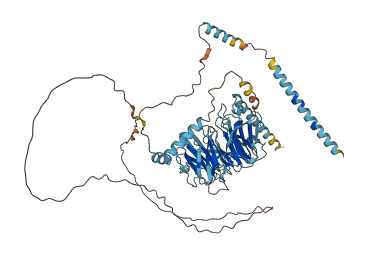
Descriptions
The autoinhibited protein was predicted that may have potential autoinhibitory elements via cis-regPred.
Autoinhibitory domains (AIDs)
Target domain |
|
Relief mechanism |
|
Assay |
cis-regPred |
Accessory elements
No accessory elements
Autoinhibited structure

Activated structure
1 structures for Q63100
| Entry ID | Method | Resolution | Chain | Position | Source |
|---|---|---|---|---|---|
| AF-Q63100-F1 | Predicted | AlphaFoldDB |
No variants for Q63100
| Variant ID(s) | Position | Change | Description | Diseaes Association | Provenance |
|---|---|---|---|---|---|
| No variants for Q63100 | |||||
No associated diseases with Q63100
4 regional properties for Q63100
| Type | Name | Position | InterPro Accession |
|---|---|---|---|
| domain | Peptidyl-prolyl cis-trans isomerase, PpiC-type | 173 - 274 | IPR000297-1 |
| domain | Peptidyl-prolyl cis-trans isomerase, PpiC-type | 283 - 383 | IPR000297-2 |
| domain | SurA N-terminal | 27 - 143 | IPR015391 |
| conserved_site | Peptidyl-prolyl cis-trans isomerase, PpiC-type, conserved site | 322 - 343 | IPR023058 |
11 GO annotations of cellular component
| Name | Definition |
|---|---|
| axon cytoplasm | Any cytoplasm that is part of a axon. |
| cytoplasm | The contents of a cell excluding the plasma membrane and nucleus, but including other subcellular structures. |
| cytoplasmic dynein complex | Any dynein complex with a homodimeric dynein heavy chain core that catalyzes movement along a microtubule. Cytoplasmic dynein complexes participate in many cytoplasmic transport activities in eukaryotes, such as mRNA localization, intermediate filament transport, nuclear envelope breakdown, apoptosis, transport of centrosomal proteins, mitotic spindle assembly, virus transport, kinetochore functions, and movement of signaling and spindle checkpoint proteins. Some complexes participate in intraflagellar transport. Subunits associated with the dynein heavy chain mediate association between dynein heavy chain and cargoes, and may include light chains and light intermediate chains. |
| cytoplasmic ribonucleoprotein granule | A ribonucleoprotein granule located in the cytoplasm. |
| kinetochore | A multisubunit complex that is located at the centromeric region of DNA and provides an attachment point for the spindle microtubules. |
| microtubule | Any of the long, generally straight, hollow tubes of internal diameter 12-15 nm and external diameter 24 nm found in a wide variety of eukaryotic cells; each consists (usually) of 13 protofilaments of polymeric tubulin, staggered in such a manner that the tubulin monomers are arranged in a helical pattern on the microtubular surface, and with the alpha/beta axes of the tubulin subunits parallel to the long axis of the tubule; exist in equilibrium with pool of tubulin monomers and can be rapidly assembled or disassembled in response to physiological stimuli; concerned with force generation, e.g. in the spindle. |
| nucleus | A membrane-bounded organelle of eukaryotic cells in which chromosomes are housed and replicated. In most cells, the nucleus contains all of the cell's chromosomes except the organellar chromosomes, and is the site of RNA synthesis and processing. In some species, or in specialized cell types, RNA metabolism or DNA replication may be absent. |
| perinuclear region of cytoplasm | Cytoplasm situated near, or occurring around, the nucleus. |
| recycling endosome | An organelle consisting of a network of tubules that functions in targeting molecules, such as receptors transporters and lipids, to the plasma membrane. |
| spindle pole | Either of the ends of a spindle, where spindle microtubules are organized; usually contains a microtubule organizing center and accessory molecules, spindle microtubules and astral microtubules. |
| vesicle | Any small, fluid-filled, spherical organelle enclosed by membrane. |
5 GO annotations of molecular function
| Name | Definition |
|---|---|
| dynein heavy chain binding | Binding to a heavy chain of the dynein complex. |
| dynein light chain binding | Binding to a light chain of the dynein complex. |
| microtubule binding | Binding to a microtubule, a filament composed of tubulin monomers. |
| microtubule motor activity | A motor activity that generates movement along a microtubule, driven by ATP hydrolysis. |
| spectrin binding | Binding to spectrin, a protein that is the major constituent of the erythrocyte cytoskeletal network. It associates with band 4.1 (see band protein) and actin to form the cytoskeletal superstructure of the erythrocyte plasma membrane. It is composed of nonhomologous chains, alpha and beta, which aggregate side-to-side in an antiparallel fashion to form dimers, tetramers, and higher polymers. |
4 GO annotations of biological process
| Name | Definition |
|---|---|
| brain development | The process whose specific outcome is the progression of the brain over time, from its formation to the mature structure. Brain development begins with patterning events in the neural tube and ends with the mature structure that is the center of thought and emotion. The brain is responsible for the coordination and control of bodily activities and the interpretation of information from the senses (sight, hearing, smell, etc.). |
| microtubule-based movement | A microtubule-based process that results in the movement of organelles, other microtubules, or other cellular components. Examples include motor-driven movement along microtubules and movement driven by polymerization or depolymerization of microtubules. |
| transport along microtubule | The movement of organelles or other particles from one location in the cell to another along microtubules, driven by motor activity. |
| vesicle transport along microtubule | The directed movement of a vesicle along a microtubule, mediated by motor proteins. This process begins with the attachment of a vesicle to a microtubule, and ends when the vesicle reaches its final destination. |
5 homologous proteins in AiPD
| UniProt AC | Gene Name | Protein Name | Species | Evidence Code |
|---|---|---|---|---|
| Q9UI46 | DNAI1 | Dynein axonemal intermediate chain 1 | Homo sapiens (Human) | PR |
| O14576 | DYNC1I1 | Cytoplasmic dynein 1 intermediate chain 1 | Homo sapiens (Human) | PR |
| Q8C0M8 | Dnai1 | Dynein axonemal intermediate chain 1 | Mus musculus (Mouse) | PR |
| O88485 | Dync1i1 | Cytoplasmic dynein 1 intermediate chain 1 | Mus musculus (Mouse) | PR |
| Q5XIL8 | Dnai1 | Dynein axonemal intermediate chain 1 | Rattus norvegicus (Rat) | PR |
| 10 | 20 | 30 | 40 | 50 | 60 |
| MSDKSDLKAE | LERKKQRLAQ | IREEKKRKEE | ERKKKEADMQ | QKKEPVPDDS | DLDRKRRETE |
| 70 | 80 | 90 | 100 | 110 | 120 |
| ALLQSIGISP | EPPLVQPLHF | LTWDTCYFHY | LVPTPMSPSS | KSVSTPSEAG | SQDDLGPLTR |
| 130 | 140 | 150 | 160 | 170 | 180 |
| TLQWDTDPSV | LQLQSDSELG | RRLNKLGVSK | VTQVDFLPRE | VVSYSKETQT | PLATHQSEED |
| 190 | 200 | 210 | 220 | 230 | 240 |
| EEDEEMVEPK | VGHDSELENQ | DKKQETKEAP | PRELTEEEKQ | QILHSEEFLI | FFDRTIRVIE |
| 250 | 260 | 270 | 280 | 290 | 300 |
| RALAEDSDIF | FDYSGRELEE | KDGDVQAGAN | LSFNRQFYDE | HWSKHRVVTC | MDWSLQYPEL |
| 310 | 320 | 330 | 340 | 350 | 360 |
| MVASYSNNED | APHEPDGVAL | VWNMKFKKTT | PEYVFHCQSS | VMSVCFARFH | PNLVVGGTYS |
| 370 | 380 | 390 | 400 | 410 | 420 |
| GQIVLWDNRS | HRRTPVQRTP | LSAAAHTHPV | YCVNVVGTQN | AHNLITVSTD | GKMCSWSLDM |
| 430 | 440 | 450 | 460 | 470 | 480 |
| LSTPQESMEL | VYNKSKPVAV | TGMAFPTGDV | NNFVVGSEEG | TVYTACRHGS | KAGIGEVFEG |
| 490 | 500 | 510 | 520 | 530 | 540 |
| HQGPVTGINC | HMAVGPIDFS | HLFVTSSFDW | TVKLWTTKHN | KPLYSFEDNA | DYVYDVMWSP |
| 550 | 560 | 570 | 580 | 590 | 600 |
| VHPALFACVD | GMGRLDLWNL | NSDTEVPTAS | VAIEGAYALN | RVRWAQGGKE | VAVGDSEGRI |
| 610 | 620 | 630 | 640 | ||
| WIYDVGELAV | PHNDEWTRFA | RTLVEIRANR | ADSEEEGAVE | LAA |