Q8BVF2
Gene name |
Pdcl3 (Viaf1) |
Protein name |
Phosducin-like protein 3 |
Names |
Viral IAP-associated factor 1, VIAF-1 |
Species |
Mus musculus (Mouse) |
KEGG Pathway |
mmu:68833 |
EC number |
|
Protein Class |
|
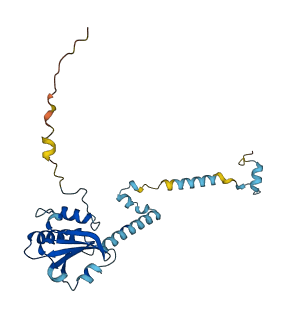
Descriptions
The autoinhibited protein was predicted that may have potential autoinhibitory elements via cis-regPred.
Autoinhibitory domains (AIDs)
Target domain |
|
Relief mechanism |
|
Assay |
cis-regPred |
Accessory elements
No accessory elements
Autoinhibited structure

Activated structure
1 structures for Q8BVF2
| Entry ID | Method | Resolution | Chain | Position | Source |
|---|---|---|---|---|---|
| AF-Q8BVF2-F1 | Predicted | AlphaFoldDB |
19 variants for Q8BVF2
| Variant ID(s) | Position | Change | Description | Diseaes Association | Provenance |
|---|---|---|---|---|---|
| rs3388465508 | 15 | R>C | No | EVA | |
| rs3388465054 | 20 | L>P | No | EVA | |
| rs233471129 | 33 | E>A | No | EVA | |
| rs241798801 | 48 | T>A | No | EVA | |
| rs238658586 | 63 | E>A | No | EVA | |
| rs3388464957 | 70 | R>Q | No | EVA | |
| rs3388465763 | 71 | A>G | No | EVA | |
| rs3389855007 | 81 | A>P | No | EVA | |
| rs3389840840 | 82 | E>A | No | EVA | |
| rs3389877091 | 83 | W>R | No | EVA | |
| rs3388465170 | 98 | I>N | No | EVA | |
| rs3388465072 | 106 | E>* | No | EVA | |
| rs3388465143 | 115 | W>R | No | EVA | |
| rs3389854995 | 116 | V>E | No | EVA | |
| rs3388464813 | 135 | L>M | No | EVA | |
| rs3388465493 | 202 | S>* | No | EVA | |
| rs3388465368 | 203 | G>E | No | EVA | |
| rs4222294 | 208 | A>T | No | EVA | |
| rs4222295 | 216 | P>L | No | EVA |
No associated diseases with Q8BVF2
1 regional properties for Q8BVF2
| Type | Name | Position | InterPro Accession |
|---|---|---|---|
| domain | Phosducin, thioredoxin-like domain | 27 - 181 | IPR024253 |
7 GO annotations of cellular component
| Name | Definition |
|---|---|
| cytoplasm | The contents of a cell excluding the plasma membrane and nucleus, but including other subcellular structures. |
| cytosol | The part of the cytoplasm that does not contain organelles but which does contain other particulate matter, such as protein complexes. |
| endoplasmic reticulum | The irregular network of unit membranes, visible only by electron microscopy, that occurs in the cytoplasm of many eukaryotic cells. The membranes form a complex meshwork of tubular channels, which are often expanded into slitlike cavities called cisternae. The ER takes two forms, rough (or granular), with ribosomes adhering to the outer surface, and smooth (with no ribosomes attached). |
| nucleoplasm | That part of the nuclear content other than the chromosomes or the nucleolus. |
| perinuclear region of cytoplasm | Cytoplasm situated near, or occurring around, the nucleus. |
| perinucleolar compartment | The perinucleolar compartment (PNC) is a subnuclear structure associated with, but structurally distinct from, the nucleolus. The PNC contains large amounts of the heterogeneous nuclear ribonucleoprotein complex (hnRNP) called hnRNP 1 (PTB). Many RNA binding proteins as well as RNA polymerase III transcripts are highly enriched in this compartment. PTB and pol III transcripts are required for the integrity of the PNC. |
| protein-containing complex | A stable assembly of two or more macromolecules, i.e. proteins, nucleic acids, carbohydrates or lipids, in which at least one component is a protein and the constituent parts function together. |
2 GO annotations of molecular function
| Name | Definition |
|---|---|
| protein folding chaperone | Binding to a protein or a protein-containing complex to assist the protein folding process. |
| vascular endothelial growth factor receptor 2 binding | Binding to a vascular endothelial growth factor receptor 2. |
13 GO annotations of biological process
| Name | Definition |
|---|---|
| actin cytoskeleton organization | A process that is carried out at the cellular level which results in the assembly, arrangement of constituent parts, or disassembly of cytoskeletal structures comprising actin filaments and their associated proteins. |
| angiogenesis | Blood vessel formation when new vessels emerge from the proliferation of pre-existing blood vessels. |
| apoptotic process | A programmed cell death process which begins when a cell receives an internal (e.g. DNA damage) or external signal (e.g. an extracellular death ligand), and proceeds through a series of biochemical events (signaling pathway phase) which trigger an execution phase. The execution phase is the last step of an apoptotic process, and is typically characterized by rounding-up of the cell, retraction of pseudopodes, reduction of cellular volume (pyknosis), chromatin condensation, nuclear fragmentation (karyorrhexis), plasma membrane blebbing and fragmentation of the cell into apoptotic bodies. When the execution phase is completed, the cell has died. |
| cellular response to heat | Any process that results in a change in state or activity of a cell (in terms of movement, secretion, enzyme production, gene expression, etc.) as a result of a heat stimulus, a temperature stimulus above the optimal temperature for that organism. |
| chaperone-mediated protein folding | The process of inhibiting aggregation and assisting in the covalent and noncovalent assembly of single chain polypeptides or multisubunit complexes into the correct tertiary structure that is dependent on interaction with a chaperone. |
| negative regulation of chaperone-mediated protein folding | Any process that stops, prevents or reduces the frequency, rate or extent of chaperone-mediated protein folding. |
| negative regulation of ubiquitin-dependent protein catabolic process | Any process that stops, prevents, or reduces the frequency, rate or extent of ubiquitin-dependent protein catabolic process. |
| positive regulation of angiogenesis | Any process that activates or increases angiogenesis. |
| positive regulation of endothelial cell proliferation | Any process that activates or increases the rate or extent of endothelial cell proliferation. |
| positive regulation of gene expression | Any process that increases the frequency, rate or extent of gene expression. Gene expression is the process in which a gene's coding sequence is converted into a mature gene product (protein or RNA). |
| protein folding | The process of assisting in the covalent and noncovalent assembly of single chain polypeptides or multisubunit complexes into the correct tertiary structure. |
| protein stabilization | Any process involved in maintaining the structure and integrity of a protein and preventing it from degradation or aggregation. |
| regulation of peptidyl-tyrosine phosphorylation | Any process that modulates the frequency, rate or extent of the phosphorylation of peptidyl-tyrosine. |
4 homologous proteins in AiPD
| 10 | 20 | 30 | 40 | 50 | 60 |
| MQDPNADTEW | NDILRKKGIL | PPKESLKELE | EEEAEKEEQL | LQQSVVKTYE | DMTLEELEEN |
| 70 | 80 | 90 | 100 | 110 | 120 |
| EDEFSEEDER | AIEMYRQQRL | AEWKATQLKN | KFGEVLEISG | KDYVQEVTKA | GEGLWVILHL |
| 130 | 140 | 150 | 160 | 170 | 180 |
| YKQGIPLCSL | INHHLSGLAR | KFPDVKFIKA | ISTTCIPNYP | DRNLPTVFVY | REGDIKAQFI |
| 190 | 200 | 210 | 220 | 230 | |
| GPLVFGGMNL | TIDELEWKLS | ESGAIKTALE | ENPKKPIQDL | LLSSVRGPVP | MRRDSDSEDD |