Q8BKT7
Gene name |
Thoc5 (Fmip, Kiaa0983) |
Protein name |
THO complex subunit 5 homolog |
Names |
Fms-interacting protein, FMIP |
Species |
Mus musculus (Mouse) |
KEGG Pathway |
mmu:107829 |
EC number |
|
Protein Class |
|
Descriptions
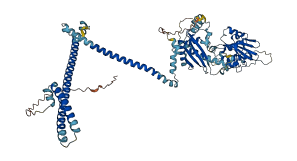
The autoinhibited protein was predicted that may have potential autoinhibitory elements via cis-regPred.
Autoinhibitory domains (AIDs)
Target domain |
|
Relief mechanism |
|
Assay |
cis-regPred |
Accessory elements
No accessory elements
Autoinhibited structure

Activated structure
1 structures for Q8BKT7
| Entry ID | Method | Resolution | Chain | Position | Source |
|---|---|---|---|---|---|
| AF-Q8BKT7-F1 | Predicted | AlphaFoldDB |
No variants for Q8BKT7
| Variant ID(s) | Position | Change | Description | Diseaes Association | Provenance |
|---|---|---|---|---|---|
| No variants for Q8BKT7 | |||||
No associated diseases with Q8BKT7
No regional properties for Q8BKT7
| Type | Name | Position | InterPro Accession |
|---|---|---|---|
| No domain, repeats, and functional sites for Q8BKT7 | |||
7 GO annotations of cellular component
| Name | Definition |
|---|---|
| chromosome, telomeric region | The end of a linear chromosome, required for the integrity and maintenance of the end. A chromosome telomere usually includes a region of telomerase-encoded repeats the length of which rarely exceeds 20 bp each and that permits the formation of a telomeric loop (T-loop). The telomeric repeat region is usually preceded by a sub-telomeric region that is gene-poor but rich in repetitive elements. Some telomeres only consist of the latter part (for eg. D. melanogaster telomeres). |
| cytoplasm | The contents of a cell excluding the plasma membrane and nucleus, but including other subcellular structures. |
| nucleoplasm | That part of the nuclear content other than the chromosomes or the nucleolus. |
| nucleus | A membrane-bounded organelle of eukaryotic cells in which chromosomes are housed and replicated. In most cells, the nucleus contains all of the cell's chromosomes except the organellar chromosomes, and is the site of RNA synthesis and processing. In some species, or in specialized cell types, RNA metabolism or DNA replication may be absent. |
| THO complex | The THO complex is a nuclear complex that is required for transcription elongation through genes containing tandemly repeated DNA sequences. The THO complex is also part of the TREX (TRanscription EXport) complex that is involved in coupling transcription to export of mRNAs to the cytoplasm. In S. cerevisiae, it is composed of four subunits: Hpr1p, Tho2p, Thp1p, and Mft1p, while the human complex is composed of 7 subunits. |
| THO complex part of transcription export complex | The THO complex when it is part of the TREX (TRanscription EXport) complex that is involved in coupling transcription to export of mRNAs to the cytoplasm. In S. cerevisiae, it is composed of four subunits: Hpr1, Tho2, Thp1, and Mft1, while the human complex is composed of 7 subunits. |
| transcription export complex | The transcription export (TREX) complex couples transcription elongation by RNA polymerase II to mRNA export. The complex associates with the polymerase and travels with it along the length of the transcribed gene. TREX is composed of the THO transcription elongation complex as well as other proteins that couple THO to mRNA export proteins. The TREX complex is known to be found in a wide range of eukaryotes, including S. cerevisiae and metazoans. |
1 GO annotations of molecular function
| Name | Definition |
|---|---|
| mRNA binding | Binding to messenger RNA (mRNA), an intermediate molecule between DNA and protein. mRNA includes UTR and coding sequences, but does not contain introns. |
15 GO annotations of biological process
| Name | Definition |
|---|---|
| blastocyst development | The process whose specific outcome is the progression of the blastocyst over time, from its formation to the mature structure. The mammalian blastocyst is a hollow ball of cells containing two cell types, the inner cell mass and the trophectoderm. |
| cell morphogenesis | The developmental process in which the size or shape of a cell is generated and organized. |
| monocyte differentiation | The process in which a relatively unspecialized myeloid precursor cell acquires the specialized features of a monocyte. |
| mRNA export from nucleus | The directed movement of mRNA from the nucleus to the cytoplasm. |
| mRNA processing | Any process involved in the conversion of a primary mRNA transcript into one or more mature mRNA(s) prior to translation into polypeptide. |
| negative regulation of DNA damage checkpoint | Any process that stops, prevents, or reduces the frequency, rate or extent of a DNA damage checkpoint. |
| negative regulation of macrophage differentiation | Any process that stops, prevents, or reduces the frequency, rate or extent of macrophage differentiation. |
| positive regulation of DNA-templated transcription, elongation | Any process that activates or increases the frequency, rate or extent of transcription elongation, the extension of an RNA molecule after transcription initiation and promoter clearance by the addition of ribonucleotides catalyzed by a DNA-dependent RNA polymerase. |
| primitive hemopoiesis | A first transient wave of blood cell production that, in vertebrates, gives rise to erythrocytes (red blood cells) and myeloid cells. |
| regulation of gene expression | Any process that modulates the frequency, rate or extent of gene expression. Gene expression is the process in which a gene's coding sequence is converted into a mature gene product (protein or RNA). |
| regulation of mRNA export from nucleus | Any process that modulates the frequency, rate or extent of the directed movement of mRNA from the nucleus to the cytoplasm. |
| regulation of stem cell division | Any process that modulates the frequency, rate or extent of stem cell division. |
| RNA splicing | The process of removing sections of the primary RNA transcript to remove sequences not present in the mature form of the RNA and joining the remaining sections to form the mature form of the RNA. |
| stem cell division | The self-renewing division of a stem cell. A stem cell is an undifferentiated cell, in the embryo or adult, that can undergo unlimited division and give rise to one or several different cell types. |
| viral mRNA export from host cell nucleus | The directed movement of intronless viral mRNA from the host nucleus to the cytoplasm for translation. |
3 homologous proteins in AiPD
| 10 | 20 | 30 | 40 | 50 | 60 |
| MSSESSKKRK | PKVIRSDGTP | TEGKRNRSDT | EQEGKYYSEE | AEVDLRDPGR | DYELYKYTCQ |
| 70 | 80 | 90 | 100 | 110 | 120 |
| ELQRLMAEIQ | DLKSKGSKDV | AIEIEERRIQ | SCVHFMTLKK | LNRLAHIRLK | KGRDQTHEAK |
| 130 | 140 | 150 | 160 | 170 | 180 |
| QKVDAYHLQL | QNLLYEVMHL | QKEITKCLEF | KSKHEEIDLV | SLEEFYSEAP | PSISKAEITM |
| 190 | 200 | 210 | 220 | 230 | 240 |
| GDPHQQTLAR | LDWELEQRKR | LAEKYRECLS | NKEKILKEIE | VKRDYLSSLQ | PRLNSIMQAS |
| 250 | 260 | 270 | 280 | 290 | 300 |
| LPVQEYLFMP | FDQAHKQYET | ARHLPPPLYV | LFVQATAYGQ | ACDKTLSVAI | EGSVDEAKAL |
| 310 | 320 | 330 | 340 | 350 | 360 |
| FKPPEDSQDD | ESDSDAEEEQ | TTKRRRPTLG | VQLDDKRKEM | LKRHPLSVLL | DLKCKDNSVL |
| 370 | 380 | 390 | 400 | 410 | 420 |
| HLTFYYLMNL | NIMTVKAKVT | TAVELITPIS | AGDLLSPDSV | LSCLYPGDHG | KKTPNPANQY |
| 430 | 440 | 450 | 460 | 470 | 480 |
| QFDKVGILTL | RDYVLELGHP | YLWVQKLGGL | HFPKEQPQQT | VMPDHSQSAS | HMETTMKLLK |
| 490 | 500 | 510 | 520 | 530 | 540 |
| TRVQSRLALH | KQFASLEHGI | VPVTSDCQDL | FPAKVVSRLV | KWVIITHEDY | MELHFTKDIV |
| 550 | 560 | 570 | 580 | 590 | 600 |
| EAGLAGDTNL | YYLALIERGT | AKLQAAVVLN | PGYSSIPPVF | RLCLNWKGEK | TNSNDDNIRA |
| 610 | 620 | 630 | 640 | 650 | 660 |
| MESEVNVCYK | ELCGPRPSHQ | LLTNQLQRLC | VLLDVYLETE | SHDDSFEGPK | EFPQEKMCLR |
| 670 | 680 | ||||
| LFRGPSRMKP | FKYNHPQGFF | SHR |