Q8BHE3
Gene name |
Atcay |
Protein name |
Caytaxin |
Names |
|
Species |
Mus musculus (Mouse) |
KEGG Pathway |
mmu:16467 |
EC number |
|
Protein Class |
|
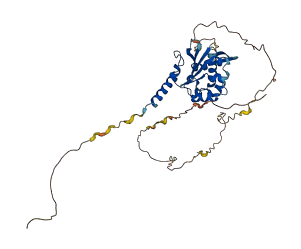
Descriptions
The autoinhibited protein was predicted that may have potential autoinhibitory elements via cis-regPred.
Autoinhibitory domains (AIDs)
Target domain |
|
Relief mechanism |
|
Assay |
cis-regPred |
Accessory elements
No accessory elements
Autoinhibited structure

Activated structure
1 structures for Q8BHE3
| Entry ID | Method | Resolution | Chain | Position | Source |
|---|---|---|---|---|---|
| AF-Q8BHE3-F1 | Predicted | AlphaFoldDB |
15 variants for Q8BHE3
| Variant ID(s) | Position | Change | Description | Diseaes Association | Provenance |
|---|---|---|---|---|---|
| rs3389104080 | 34 | V>* | No | EVA | |
| rs3389122308 | 83 | D>G | No | EVA | |
| rs3389110281 | 96 | D>Y | No | EVA | |
| rs3389127579 | 135 | A>V | No | EVA | |
| rs3389116209 | 137 | L>M | No | EVA | |
| rs3389091330 | 148 | A>T | No | EVA | |
| rs3389127645 | 171 | I>T | No | EVA | |
| rs3389118688 | 194 | F>L | No | EVA | |
| rs3389116156 | 200 | P>Q | No | EVA | |
| rs3389125192 | 203 | S>I | No | EVA | |
| rs3389122252 | 204 | S>P | No | EVA | |
| rs3389118727 | 222 | L>P | No | EVA | |
| rs3389117344 | 310 | P>S | No | EVA | |
| rs3389117391 | 351 | P>VSDG* | No | EVA | |
| rs3389122255 | 353 | T>I | No | EVA |
1 associated diseases with Q8BHE3
Without disease ID
1 regional properties for Q8BHE3
| Type | Name | Position | InterPro Accession |
|---|---|---|---|
| domain | CRAL-TRIO lipid binding domain | 171 - 328 | IPR001251 |
11 GO annotations of cellular component
| Name | Definition |
|---|---|
| anchoring junction | A cell junction that mechanically attaches a cell (and its cytoskeleton) to neighboring cells or to the extracellular matrix. |
| axon | The long process of a neuron that conducts nerve impulses, usually away from the cell body to the terminals and varicosities, which are sites of storage and release of neurotransmitter. |
| cytoplasm | The contents of a cell excluding the plasma membrane and nucleus, but including other subcellular structures. |
| dendrite | A neuron projection that has a short, tapering, morphology. Dendrites receive and integrate signals from other neurons or from sensory stimuli, and conduct nerve impulses towards the axon or the cell body. In most neurons, the impulse is conveyed from dendrites to axon via the cell body, but in some types of unipolar neuron, the impulse does not travel via the cell body. |
| growth cone | The migrating motile tip of a growing neuron projection, where actin accumulates, and the actin cytoskeleton is the most dynamic. |
| mitochondrial membrane | Either of the lipid bilayers that surround the mitochondrion and form the mitochondrial envelope. |
| neuron projection | A prolongation or process extending from a nerve cell, e.g. an axon or dendrite. |
| neuron projection terminus | The specialized, terminal region of a neuron projection such as an axon or a dendrite. |
| perinuclear region of cytoplasm | Cytoplasm situated near, or occurring around, the nucleus. |
| presynapse | The part of a synapse that is part of the presynaptic cell. |
| synapse | The junction between an axon of one neuron and a dendrite of another neuron, a muscle fiber or a glial cell. As the axon approaches the synapse it enlarges into a specialized structure, the presynaptic terminal bouton, which contains mitochondria and synaptic vesicles. At the tip of the terminal bouton is the presynaptic membrane; facing it, and separated from it by a minute cleft (the synaptic cleft) is a specialized area of membrane on the receiving cell, known as the postsynaptic membrane. In response to the arrival of nerve impulses, the presynaptic terminal bouton secretes molecules of neurotransmitters into the synaptic cleft. These diffuse across the cleft and transmit the signal to the postsynaptic membrane. |
1 GO annotations of molecular function
| Name | Definition |
|---|---|
| kinesin binding | Interacting selectively and non-covalently and stoichiometrically with kinesin, a member of a superfamily of microtubule-based motor proteins that perform force-generating tasks such as organelle transport and chromosome segregation. |
5 GO annotations of biological process
| Name | Definition |
|---|---|
| apoptotic process | A programmed cell death process which begins when a cell receives an internal (e.g. DNA damage) or external signal (e.g. an extracellular death ligand), and proceeds through a series of biochemical events (signaling pathway phase) which trigger an execution phase. The execution phase is the last step of an apoptotic process, and is typically characterized by rounding-up of the cell, retraction of pseudopodes, reduction of cellular volume (pyknosis), chromatin condensation, nuclear fragmentation (karyorrhexis), plasma membrane blebbing and fragmentation of the cell into apoptotic bodies. When the execution phase is completed, the cell has died. |
| mitochondrion distribution | Any process that establishes the spatial arrangement of mitochondria between and within cells. |
| negative regulation of glutamate metabolic process | Any process that stops, prevents, or reduces the frequency, rate or extent of glutamate metabolic process. |
| neuron projection development | The process whose specific outcome is the progression of a neuron projection over time, from its formation to the mature structure. A neuron projection is any process extending from a neural cell, such as axons or dendrites (collectively called neurites). |
| regulation of protein localization | Any process that modulates the frequency, rate or extent of any process in which a protein is transported to, or maintained in, a specific location. |
3 homologous proteins in AiPD
| 10 | 20 | 30 | 40 | 50 | 60 |
| MGTTEATLRM | ENVDVRDEWQ | DEDLPRPLPE | DTGVERLGGA | VEDSSSPPST | LNLSGAHRKR |
| 70 | 80 | 90 | 100 | 110 | 120 |
| KTLVAPEINI | SLDQSEGSLL | SDDFLDTPDD | LDINVDDIET | PDETDSLEFL | GNGNELEWED |
| 130 | 140 | 150 | 160 | 170 | 180 |
| DTPVATAKNM | PGDSADLFGD | GSAEDGSAAN | GRLWRTVIIG | EQEHRIDLHM | IRPYMKVVTH |
| 190 | 200 | 210 | 220 | 230 | 240 |
| GGYYGEGLNA | IIVFAACFLP | DSSSPDYHYI | MENLFLYVIS | SLELLVAEDY | MIVYLNGATP |
| 250 | 260 | 270 | 280 | 290 | 300 |
| RRRMPGIGWL | KKCYHMIDRR | LRKNLKSLII | VHPSWFIRTV | LAISRPFISV | KFISKIQYVH |
| 310 | 320 | 330 | 340 | 350 | 360 |
| SLEELERLIP | MEHVQLPDCV | LQYEEQRLRA | KRESTRPPQP | EFLLPRSEEK | PETVEEEDRA |
| 370 | |||||
| AEATEDQETS | MS |