O54940
Gene name |
Bnip2 (Nip2l) |
Protein name |
BCL2/adenovirus E1B 19 kDa protein-interacting protein 2 |
Names |
|
Species |
Mus musculus (Mouse) |
KEGG Pathway |
mmu:12175 |
EC number |
|
Protein Class |
|
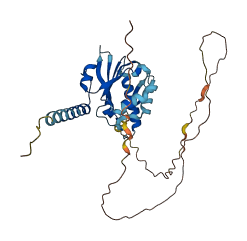
Descriptions
The autoinhibited protein was predicted that may have potential autoinhibitory elements via cis-regPred.
Autoinhibitory domains (AIDs)
Target domain |
|
Relief mechanism |
|
Assay |
cis-regPred |
Accessory elements
No accessory elements
Autoinhibited structure

Activated structure
1 structures for O54940
| Entry ID | Method | Resolution | Chain | Position | Source |
|---|---|---|---|---|---|
| AF-O54940-F1 | Predicted | AlphaFoldDB |
7 variants for O54940
| Variant ID(s) | Position | Change | Description | Diseaes Association | Provenance |
|---|---|---|---|---|---|
| rs3389057535 | 7 | K>E | No | EVA | |
| rs3389056698 | 8 | E>G | No | EVA | |
| rs3389060866 | 11 | Q>H | No | EVA | |
| rs264056338 | 125 | G>D | No | EVA | |
| rs3389056653 | 172 | V>F | No | EVA | |
| rs3389053871 | 184 | R>I | No | EVA | |
| rs3389043977 | 324 | S>C | No | EVA |
No associated diseases with O54940
8 GO annotations of cellular component
| Name | Definition |
|---|---|
| centriole | A cellular organelle, found close to the nucleus in many eukaryotic cells, consisting of a small cylinder with microtubular walls, 300-500 nm long and 150-250 nm in diameter. It contains nine short, parallel, peripheral microtubular fibrils, each fibril consisting of one complete microtubule fused to two incomplete microtubules. Cells usually have two centrioles, lying at right angles to each other. At division, each pair of centrioles generates another pair and the twin pairs form the pole of the mitotic spindle. |
| cytoplasm | The contents of a cell excluding the plasma membrane and nucleus, but including other subcellular structures. |
| cytosol | The part of the cytoplasm that does not contain organelles but which does contain other particulate matter, such as protein complexes. |
| intracellular membrane-bounded organelle | Organized structure of distinctive morphology and function, bounded by a single or double lipid bilayer membrane and occurring within the cell. Includes the nucleus, mitochondria, plastids, vacuoles, and vesicles. Excludes the plasma membrane. |
| nuclear envelope | The double lipid bilayer enclosing the nucleus and separating its contents from the rest of the cytoplasm; includes the intermembrane space, a gap of width 20-40 nm (also called the perinuclear space). |
| nucleolus | A small, dense body one or more of which are present in the nucleus of eukaryotic cells. It is rich in RNA and protein, is not bounded by a limiting membrane, and is not seen during mitosis. Its prime function is the transcription of the nucleolar DNA into 45S ribosomal-precursor RNA, the processing of this RNA into 5.8S, 18S, and 28S components of ribosomal RNA, and the association of these components with 5S RNA and proteins synthesized outside the nucleolus. This association results in the formation of ribonucleoprotein precursors; these pass into the cytoplasm and mature into the 40S and 60S subunits of the ribosome. |
| perinuclear region of cytoplasm | Cytoplasm situated near, or occurring around, the nucleus. |
| spindle pole centrosome | A centrosome from which one pole of a mitotic or meiotic spindle is organized. |
No GO annotations of molecular function
| Name | Definition |
|---|---|
| No GO annotations for molecular function |
7 GO annotations of biological process
| Name | Definition |
|---|---|
| apoptotic process | A programmed cell death process which begins when a cell receives an internal (e.g. DNA damage) or external signal (e.g. an extracellular death ligand), and proceeds through a series of biochemical events (signaling pathway phase) which trigger an execution phase. The execution phase is the last step of an apoptotic process, and is typically characterized by rounding-up of the cell, retraction of pseudopodes, reduction of cellular volume (pyknosis), chromatin condensation, nuclear fragmentation (karyorrhexis), plasma membrane blebbing and fragmentation of the cell into apoptotic bodies. When the execution phase is completed, the cell has died. |
| blastocyst development | The process whose specific outcome is the progression of the blastocyst over time, from its formation to the mature structure. The mammalian blastocyst is a hollow ball of cells containing two cell types, the inner cell mass and the trophectoderm. |
| centrosome cycle | The cell cycle process in which centrosome duplication and separation takes place. The centrosome cycle can operate with a considerable degree of independence from other processes of the cell cycle. |
| positive regulation of MAPK cascade | Any process that activates or increases the frequency, rate or extent of signal transduction mediated by the MAPK cascade. |
| positive regulation of neuron differentiation | Any process that activates or increases the frequency, rate or extent of neuron differentiation. |
| positive regulation of small GTPase mediated signal transduction | Any process that activates or increases the frequency, rate or extent of small GTPase mediated signal transduction. |
| striated muscle cell differentiation | The process in which a relatively unspecialized cell acquires specialized features of a striated muscle cell; striated muscle fibers are divided by transverse bands into striations, and cardiac and voluntary muscle are types of striated muscle. |
| 10 | 20 | 30 | 40 | 50 | 60 |
| MEGVELKEEW | QDEDFPIPLP | EDDSIEADTL | DGTDPDRQPG | SLEVNGNKVR | KKLMAPDISL |
| 70 | 80 | 90 | 100 | 110 | 120 |
| TLDPGEDSLW | SDDLDEAGEV | DLEGLDTPSE | NSDEFEWEDD | LPKPKTTEVI | RKGSITEYTA |
| 130 | 140 | 150 | 160 | 170 | 180 |
| TEEKGDGRRW | RMFRIGEQDH | RVDMKAIEPY | KKVISHGGYY | GDGLNAIVVF | AVCFMPESGQ |
| 190 | 200 | 210 | 220 | 230 | 240 |
| PNYRYLMDNL | FKYVIGTLEL | LVAENYMIIY | LNGATTRRKM | PSLGWLRRCY | QQIDRRLRKN |
| 250 | 260 | 270 | 280 | 290 | 300 |
| LKSLIIVHPS | WFIRTLLAVT | RPFISSKFSQ | KIRYVFNLAE | LAELVPMEYV | GIPECIKQYE |
| 310 | 320 | ||||
| EEKFKKRQKR | VDQELNGKQE | PPKSEQ |