Q8BH82
Gene name |
Napepld |
Protein name |
N-acyl-phosphatidylethanolamine-hydrolyzing phospholipase D |
Names |
N-acyl phosphatidylethanolamine phospholipase D, NAPE-PLD, NAPE-hydrolyzing phospholipase D |
Species |
Mus musculus (Mouse) |
KEGG Pathway |
mmu:242864 |
EC number |
3.1.4.54: Phosphoric diester hydrolases |
Protein Class |
|
Descriptions
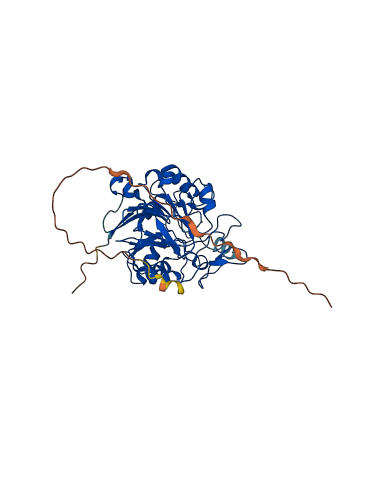
The autoinhibited protein was predicted that may have potential autoinhibitory elements via cis-regPred.
Autoinhibitory domains (AIDs)
Target domain |
|
Relief mechanism |
|
Assay |
cis-regPred |
Accessory elements
No accessory elements
Autoinhibited structure

Activated structure
1 structures for Q8BH82
| Entry ID | Method | Resolution | Chain | Position | Source |
|---|---|---|---|---|---|
| AF-Q8BH82-F1 | Predicted | AlphaFoldDB |
11 variants for Q8BH82
| Variant ID(s) | Position | Change | Description | Diseaes Association | Provenance |
|---|---|---|---|---|---|
| rs215775229 | 29 | Q>R | No | EVA | |
| rs3388745705 | 57 | S>P | No | EVA | |
| rs3388741504 | 214 | G>V | No | EVA | |
| rs3388745450 | 234 | E>Q | No | EVA | |
| rs3388735668 | 257 | R>G | No | EVA | |
| rs3388750867 | 291 | F>C | No | EVA | |
| rs3388731299 | 316 | F>C | No | EVA | |
| rs3388741462 | 351 | N>K | No | EVA | |
| rs3388750893 | 362 | N>S | No | EVA | |
| rs864270326 | 374 | D>E | No | EVA | |
| rs231388268 | 391 | R>K | No | EVA |
No associated diseases with Q8BH82
1 regional properties for Q8BH82
| Type | Name | Position | InterPro Accession |
|---|---|---|---|
| domain | Metallo-beta-lactamase | 144 - 344 | IPR001279 |
Functions
| Description | ||
|---|---|---|
| EC Number | 3.1.4.54 | Phosphoric diester hydrolases |
| Subcellular Localization |
|
|
| PANTHER Family | ||
| PANTHER Subfamily | ||
| PANTHER Protein Class | ||
| PANTHER Pathway Category | No pathway information available | |
8 GO annotations of cellular component
| Name | Definition |
|---|---|
| cytoplasm | The contents of a cell excluding the plasma membrane and nucleus, but including other subcellular structures. |
| early endosome | A membrane-bounded organelle that receives incoming material from primary endocytic vesicles that have been generated by clathrin-dependent and clathrin-independent endocytosis; vesicles fuse with the early endosome to deliver cargo for sorting into recycling or degradation pathways. |
| early endosome membrane | The lipid bilayer surrounding an early endosome. |
| Golgi apparatus | A membrane-bound cytoplasmic organelle of the endomembrane system that further processes the core oligosaccharides (e.g. N-glycans) added to proteins in the endoplasmic reticulum and packages them into membrane-bound vesicles. The Golgi apparatus operates at the intersection of the secretory, lysosomal, and endocytic pathways. |
| Golgi membrane | The lipid bilayer surrounding any of the compartments of the Golgi apparatus. |
| membrane-bounded organelle | Organized structure of distinctive morphology and function, bounded by a single or double lipid bilayer membrane. Includes the nucleus, mitochondria, plastids, vacuoles, and vesicles. Excludes the plasma membrane. |
| nuclear envelope | The double lipid bilayer enclosing the nucleus and separating its contents from the rest of the cytoplasm; includes the intermembrane space, a gap of width 20-40 nm (also called the perinuclear space). |
| nucleoplasm | That part of the nuclear content other than the chromosomes or the nucleolus. |
6 GO annotations of molecular function
| Name | Definition |
|---|---|
| bile acid binding | Binding to a bile acid, a steroid carboxylic acids occurring in bile. |
| identical protein binding | Binding to an identical protein or proteins. |
| N-acetylphosphatidylethanolamine-hydrolysing phospholipase activity | Catalysis of the reaction: H2O + an N-acylphosphatidylethanolamine = H+ + an N-acylethanolamine + a 1,2-diacyl-sn-glycerol 3-phosphate. |
| N-acylphosphatidylethanolamine-specific phospholipase D activity | Catalysis of the release of N-acylethanolamine from N-acyl-phosphatidylethanolamine (NAPE) to generate N-acylethanolamine (NAE). |
| phospholipase activity | Catalysis of the hydrolysis of a glycerophospholipid. |
| zinc ion binding | Binding to a zinc ion (Zn). |
9 GO annotations of biological process
| Name | Definition |
|---|---|
| host-mediated regulation of intestinal microbiota composition | The biological process involved in maintaining the steady-state number of cells within a population of free-living cells such as the bacteria in the gut. |
| N-acylethanolamine metabolic process | The chemical reactions and pathways involving N-acylethanolamines. An N-acylethanolamine is an ethanolamine substituted at nitrogen by an acyl group. |
| N-acylphosphatidylethanolamine metabolic process | The chemical reactions and pathways involving N-acylphosphatidylethanolamines. An N-acylphosphatidylethanolamine is a phosphatidylethanolamine substituted at nitrogen by an acyl group. |
| negative regulation of eating behavior | Any process that stops, prevents or reduces the frequency, rate or extent of eating behavior. |
| phospholipid catabolic process | The chemical reactions and pathways resulting in the breakdown of phospholipids, any lipid containing phosphoric acid as a mono- or diester. |
| phospholipid metabolic process | The chemical reactions and pathways involving phospholipids, any lipid containing phosphoric acid as a mono- or diester. |
| positive regulation of brown fat cell differentiation | Any process that increases the rate, frequency, or extent of brown fat cell differentiation. Brown fat cell differentiation is the process in which a relatively unspecialized cell acquires specialized features of a brown adipocyte, an animal connective tissue cell involved in adaptive thermogenesis. Brown adipocytes contain multiple small droplets of triglycerides and a high number of mitochondria. |
| positive regulation of inflammatory response | Any process that activates or increases the frequency, rate or extent of the inflammatory response. |
| temperature homeostasis | A homeostatic process in which an organism modulates its internal body temperature. |
4 homologous proteins in AiPD
| UniProt AC | Gene Name | Protein Name | Species | Evidence Code |
|---|---|---|---|---|
| Q02883 | FMP30 | N-acyl-phosphatidylethanolamine-hydrolyzing phospholipase D, mitochondrial | Saccharomyces cerevisiae (strain ATCC 204508 / S288c) (Baker's yeast) | PR |
| Q58CN9 | NAPEPLD | N-acyl-phosphatidylethanolamine-hydrolyzing phospholipase D | Bos taurus (Bovine) | PR |
| Q6IQ20 | NAPEPLD | N-acyl-phosphatidylethanolamine-hydrolyzing phospholipase D | Homo sapiens (Human) | PR |
| Q769K2 | Napepld | N-acyl-phosphatidylethanolamine-hydrolyzing phospholipase D | Rattus norvegicus (Rat) | PR |
| 10 | 20 | 30 | 40 | 50 | 60 |
| MDEYEDSQSP | APSYQYPKET | LRKRQNSVQN | SGGSVSSRFS | RKSFKLDYRL | EEDVTKSKKG |
| 70 | 80 | 90 | 100 | 110 | 120 |
| KDGRFVNPWP | TWKNISIPNV | LRWLIMEKNH | SGVPGSKEEL | DKELPVLKPY | FVSDPEDAGV |
| 130 | 140 | 150 | 160 | 170 | 180 |
| REAGLRVTWL | GHATLMVEMD | ELIFLTDPMF | SSRASPSQYM | GPKRFRRPPC | TISELPTIDA |
| 190 | 200 | 210 | 220 | 230 | 240 |
| VLISHNHYDH | LDYGSVLALN | ERFGSELRWF | VPLGLLDWMQ | KCGCENVIEL | DWWEENCVPG |
| 250 | 260 | 270 | 280 | 290 | 300 |
| HDKVTFVFTP | SQHWCKRTLL | DDNKVLWGSW | SVLGPWSRFF | FAGDTGYCPA | FEEIGKRFGP |
| 310 | 320 | 330 | 340 | 350 | 360 |
| FDLAAIPIGA | YEPRWFMKYQ | HADPEDAVRI | HIDLQTKRSV | AIHWGTFALA | NEHYLEPPVK |
| 370 | 380 | 390 | |||
| LNEALERYGL | SCEDFFILKH | GESRYLNTDD | RAFEET |