Q769K2
Gene name |
Napepld |
Protein name |
N-acyl-phosphatidylethanolamine-hydrolyzing phospholipase D |
Names |
N-acyl phosphatidylethanolamine phospholipase D, NAPE-PLD, NAPE-hydrolyzing phospholipase D |
Species |
Rattus norvegicus (Rat) |
KEGG Pathway |
rno:296757 |
EC number |
3.1.4.54: Phosphoric diester hydrolases |
Protein Class |
|
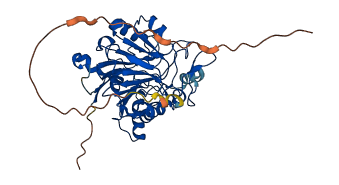
Descriptions
The autoinhibited protein was predicted that may have potential autoinhibitory elements via cis-regPred.
Autoinhibitory domains (AIDs)
Target domain |
|
Relief mechanism |
|
Assay |
cis-regPred |
Accessory elements
No accessory elements
Autoinhibited structure

Activated structure
1 structures for Q769K2
| Entry ID | Method | Resolution | Chain | Position | Source |
|---|---|---|---|---|---|
| AF-Q769K2-F1 | Predicted | AlphaFoldDB |
No variants for Q769K2
| Variant ID(s) | Position | Change | Description | Diseaes Association | Provenance |
|---|---|---|---|---|---|
| No variants for Q769K2 | |||||
No associated diseases with Q769K2
1 regional properties for Q769K2
| Type | Name | Position | InterPro Accession |
|---|---|---|---|
| domain | Metallo-beta-lactamase | 144 - 344 | IPR001279 |
Functions
| Description | ||
|---|---|---|
| EC Number | 3.1.4.54 | Phosphoric diester hydrolases |
| Subcellular Localization |
|
|
| PANTHER Family | ||
| PANTHER Subfamily | ||
| PANTHER Protein Class | ||
| PANTHER Pathway Category | No pathway information available | |
8 GO annotations of cellular component
| Name | Definition |
|---|---|
| cytoplasm | The contents of a cell excluding the plasma membrane and nucleus, but including other subcellular structures. |
| early endosome | A membrane-bounded organelle that receives incoming material from primary endocytic vesicles that have been generated by clathrin-dependent and clathrin-independent endocytosis; vesicles fuse with the early endosome to deliver cargo for sorting into recycling or degradation pathways. |
| early endosome membrane | The lipid bilayer surrounding an early endosome. |
| Golgi apparatus | A membrane-bound cytoplasmic organelle of the endomembrane system that further processes the core oligosaccharides (e.g. N-glycans) added to proteins in the endoplasmic reticulum and packages them into membrane-bound vesicles. The Golgi apparatus operates at the intersection of the secretory, lysosomal, and endocytic pathways. |
| Golgi membrane | The lipid bilayer surrounding any of the compartments of the Golgi apparatus. |
| membrane-bounded organelle | Organized structure of distinctive morphology and function, bounded by a single or double lipid bilayer membrane. Includes the nucleus, mitochondria, plastids, vacuoles, and vesicles. Excludes the plasma membrane. |
| nuclear envelope | The double lipid bilayer enclosing the nucleus and separating its contents from the rest of the cytoplasm; includes the intermembrane space, a gap of width 20-40 nm (also called the perinuclear space). |
| nucleoplasm | That part of the nuclear content other than the chromosomes or the nucleolus. |
6 GO annotations of molecular function
| Name | Definition |
|---|---|
| bile acid binding | Binding to a bile acid, a steroid carboxylic acids occurring in bile. |
| identical protein binding | Binding to an identical protein or proteins. |
| N-acetylphosphatidylethanolamine-hydrolysing phospholipase activity | Catalysis of the reaction: H2O + an N-acylphosphatidylethanolamine = H+ + an N-acylethanolamine + a 1,2-diacyl-sn-glycerol 3-phosphate. |
| N-acylphosphatidylethanolamine-specific phospholipase D activity | Catalysis of the release of N-acylethanolamine from N-acyl-phosphatidylethanolamine (NAPE) to generate N-acylethanolamine (NAE). |
| phospholipase activity | Catalysis of the hydrolysis of a glycerophospholipid. |
| zinc ion binding | Binding to a zinc ion (Zn). |
11 GO annotations of biological process
| Name | Definition |
|---|---|
| aging | A developmental process that is a deterioration and loss of function over time. Aging includes loss of functions such as resistance to disease, homeostasis, and fertility, as well as wear and tear. Aging includes cellular senescence, but is more inclusive. May precede death and may succeed developmental maturation (GO:0021700). |
| host-mediated regulation of intestinal microbiota composition | The biological process involved in maintaining the steady-state number of cells within a population of free-living cells such as the bacteria in the gut. |
| N-acylethanolamine metabolic process | The chemical reactions and pathways involving N-acylethanolamines. An N-acylethanolamine is an ethanolamine substituted at nitrogen by an acyl group. |
| N-acylphosphatidylethanolamine metabolic process | The chemical reactions and pathways involving N-acylphosphatidylethanolamines. An N-acylphosphatidylethanolamine is a phosphatidylethanolamine substituted at nitrogen by an acyl group. |
| negative regulation of eating behavior | Any process that stops, prevents or reduces the frequency, rate or extent of eating behavior. |
| phospholipid catabolic process | The chemical reactions and pathways resulting in the breakdown of phospholipids, any lipid containing phosphoric acid as a mono- or diester. |
| phospholipid metabolic process | The chemical reactions and pathways involving phospholipids, any lipid containing phosphoric acid as a mono- or diester. |
| positive regulation of brown fat cell differentiation | Any process that increases the rate, frequency, or extent of brown fat cell differentiation. Brown fat cell differentiation is the process in which a relatively unspecialized cell acquires specialized features of a brown adipocyte, an animal connective tissue cell involved in adaptive thermogenesis. Brown adipocytes contain multiple small droplets of triglycerides and a high number of mitochondria. |
| positive regulation of inflammatory response | Any process that activates or increases the frequency, rate or extent of the inflammatory response. |
| response to isolation stress | Any process that results in a change in state or activity of a cell or an organism (in terms of movement, secretion, enzyme production, gene expression, etc.) as a result of a lack of contact with other members of the same species. |
| temperature homeostasis | A homeostatic process in which an organism modulates its internal body temperature. |
4 homologous proteins in AiPD
| UniProt AC | Gene Name | Protein Name | Species | Evidence Code |
|---|---|---|---|---|
| Q02883 | FMP30 | N-acyl-phosphatidylethanolamine-hydrolyzing phospholipase D, mitochondrial | Saccharomyces cerevisiae (strain ATCC 204508 / S288c) (Baker's yeast) | PR |
| Q58CN9 | NAPEPLD | N-acyl-phosphatidylethanolamine-hydrolyzing phospholipase D | Bos taurus (Bovine) | PR |
| Q6IQ20 | NAPEPLD | N-acyl-phosphatidylethanolamine-hydrolyzing phospholipase D | Homo sapiens (Human) | PR |
| Q8BH82 | Napepld | N-acyl-phosphatidylethanolamine-hydrolyzing phospholipase D | Mus musculus (Mouse) | PR |
| 10 | 20 | 30 | 40 | 50 | 60 |
| MDENENSQSP | APSHQYPKET | LRKRQNSVQN | SGGSESSRLS | RKSFKLDYRL | EEDVTKSKKG |
| 70 | 80 | 90 | 100 | 110 | 120 |
| KDGRFVNPWP | TWKNVSIPNV | LRWLIMEKDH | SSVPGSKEEL | DKELPVLKPY | FISDPEEAGV |
| 130 | 140 | 150 | 160 | 170 | 180 |
| REAGLRVTWL | GHATLMVEMD | ELILLTDPMF | SSRASPSQYM | GPKRFRRPPC | TISELPPIDA |
| 190 | 200 | 210 | 220 | 230 | 240 |
| VLISHNHYDH | LDYGSVLALN | ERFGSELRWF | VPLGLLDWMQ | KCGCENVIEL | DWWEENCVPG |
| 250 | 260 | 270 | 280 | 290 | 300 |
| HDKVTFVFTP | SQHWCKRTLL | DDNKVLWGSW | SVLGPWNRFF | FAGDTGYCPA | FEEIGKRFGP |
| 310 | 320 | 330 | 340 | 350 | 360 |
| FDLAAIPIGA | YEPRWFMKYQ | HADPEDAVRI | HIDVQAKRSV | AIHWGTFALA | NEHYLEPPVK |
| 370 | 380 | 390 | |||
| LNEALERYGL | KSEDFFILKH | GESRYLNTDD | KAFEET |