Q7YR43
Gene name |
DDR1 (EDDR1) |
Protein name |
Epithelial discoidin domain-containing receptor 1 |
Names |
Epithelial discoidin domain receptor 1 , EC 2.7.10.1 , CD167 antigen-like family member A , Discoidin receptor tyrosine kinase , Tyrosine kinase DDR , CD antigen CD167a |
Species |
Homo sapiens (Human) |
KEGG Pathway |
ptr:462548 |
EC number |
|
Protein Class |
|
Descriptions
Autoinhibitory domains (AIDs)
Target domain |
606-901 (Protein kinase domain) |
Relief mechanism |
PTM |
Assay |
|
Accessory elements
779-804 (Activation loop from InterPro)
Target domain |
606-901 (Protein kinase domain) |
Relief mechanism |
|
Assay |
|
779-804 (Activation loop from InterPro)
Target domain |
606-901 (Protein kinase domain) |
Relief mechanism |
|
Assay |
|
References
- Yeon JH et al. (2016) "Systems-wide Identification of cis-Regulatory Elements in Proteins", Cell systems, 2, 89-100
- Sammon D et al. (2020) "Two-step release of kinase autoinhibition in discoidin domain receptor 1", Proceedings of the National Academy of Sciences of the United States of America, 117, 22051-22060
- Fu HL et al. (2014) "Glycosylation at Asn211 regulates the activation state of the discoidin domain receptor 1 (DDR1)", The Journal of biological chemistry, 289, 9275-87
Autoinhibited structure

Activated structure
1 structures for Q7YR43
| Entry ID | Method | Resolution | Chain | Position | Source |
|---|---|---|---|---|---|
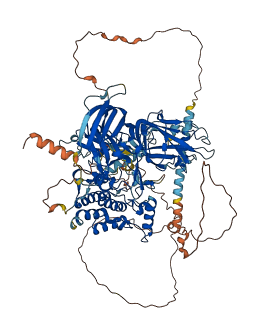
| AF-Q7YR43-F1 | Predicted | AlphaFoldDB |
No variants for Q7YR43
| Variant ID(s) | Position | Change | Description | Diseaes Association | Provenance |
|---|---|---|---|---|---|
| No variants for Q7YR43 | |||||
2 associated diseases with Q7YR43
[MIM: 124900]: Deafness, autosomal dominant 1, with or without thrombocytopenia (DFNA1)
A form of non-syndromic sensorineural hearing loss. Sensorineural deafness results from damage to the neural receptors of the inner ear, the nerve pathways to the brain, or the area of the brain that receives sound information. Patients may have mild thrombocytopenia and enlarged platelets, although most of DFNA1 affected individuals do not have significant bleeding tendencies. {ECO:0000269|PubMed:22938506, ECO:0000269|PubMed:26912466, ECO:0000269|PubMed:27808407, ECO:0000269|PubMed:9360932}. Note=The disease is caused by variants affecting the gene represented in this entry.
[MIM: 616632]: Seizures, cortical blindness, and microcephaly syndrome (SCBMS)
A severe autosomal recessive neurodevelopmental disorder characterized by microcephaly, early-onset seizures, severely delayed psychomotor development, short stature, and cortical blindness. {ECO:0000269|PubMed:24781755, ECO:0000269|PubMed:26463574}. Note=The disease is caused by variants affecting the gene represented in this entry.
Without disease ID
- A form of non-syndromic sensorineural hearing loss. Sensorineural deafness results from damage to the neural receptors of the inner ear, the nerve pathways to the brain, or the area of the brain that receives sound information. Patients may have mild thrombocytopenia and enlarged platelets, although most of DFNA1 affected individuals do not have significant bleeding tendencies. {ECO:0000269|PubMed:22938506, ECO:0000269|PubMed:26912466, ECO:0000269|PubMed:27808407, ECO:0000269|PubMed:9360932}. Note=The disease is caused by variants affecting the gene represented in this entry.
- A severe autosomal recessive neurodevelopmental disorder characterized by microcephaly, early-onset seizures, severely delayed psychomotor development, short stature, and cortical blindness. {ECO:0000269|PubMed:24781755, ECO:0000269|PubMed:26463574}. Note=The disease is caused by variants affecting the gene represented in this entry.
9 regional properties for Q7YR43
| Type | Name | Position | InterPro Accession |
|---|---|---|---|
| domain | ABC transporter-like, ATP-binding domain | 645 - 869 | IPR003439-1 |
| domain | ABC transporter-like, ATP-binding domain | 1294 - 1528 | IPR003439-2 |
| domain | AAA+ ATPase domain | 671 - 846 | IPR003593-1 |
| domain | AAA+ ATPase domain | 1320 - 1505 | IPR003593-2 |
| domain | ABC transporter type 1, transmembrane domain | 327 - 609 | IPR011527-1 |
| domain | ABC transporter type 1, transmembrane domain | 976 - 1257 | IPR011527-2 |
| conserved_site | ABC transporter-like, conserved site | 769 - 783 | IPR017871-1 |
| conserved_site | ABC transporter-like, conserved site | 1431 - 1445 | IPR017871-2 |
| conserved_site | Aldo/keto reductase, conserved site | 302 - 317 | IPR018170 |
Functions
2 GO annotations of cellular component
| Name | Definition |
|---|---|
| plasma membrane | The membrane surrounding a cell that separates the cell from its external environment. It consists of a phospholipid bilayer and associated proteins. |
| receptor complex | Any protein complex that undergoes combination with a hormone, neurotransmitter, drug or intracellular messenger to initiate a change in cell function. |
4 GO annotations of molecular function
| Name | Definition |
|---|---|
| ATP binding | Binding to ATP, adenosine 5'-triphosphate, a universally important coenzyme and enzyme regulator. |
| collagen binding | Binding to collagen, a group of fibrous proteins of very high tensile strength that form the main component of connective tissue in animals. Collagen is highly enriched in glycine (some regions are 33% glycine) and proline, occurring predominantly as 3-hydroxyproline (about 20%). |
| metal ion binding | Binding to a metal ion. |
| protein tyrosine kinase collagen receptor activity | Combining with collagen and transmitting the signal from one side of the membrane to the other to initiate a change in cell activity by catalysis of the reaction |
9 GO annotations of biological process
| Name | Definition |
|---|---|
| collagen-activated tyrosine kinase receptor signaling pathway | The series of molecular signals initiated by collagen binding to its receptor on the surface of a target cell where the receptor possesses tyrosine kinase activity, and ending with the regulation of a downstream cellular process, e.g. transcription. |
| female pregnancy | The set of physiological processes that allow an embryo or foetus to develop within the body of a female animal. It covers the time from fertilization of a female ovum by a male spermatozoon until birth. |
| lactation | The regulated release of milk from the mammary glands and the period of time that a mother lactates to feed her young. |
| peptidyl-tyrosine autophosphorylation | The phosphorylation by a protein of one or more of its own tyrosine amino acid residues, or a tyrosine residue on an identical protein. |
| positive regulation of neuron projection development | Any process that increases the rate, frequency or extent of neuron projection development. Neuron projection development is the process whose specific outcome is the progression of a neuron projection over time, from its formation to the mature structure. A neuron projection is any process extending from a neural cell, such as axons or dendrites (collectively called neurites). |
| regulation of extracellular matrix disassembly | Any process that modulates the rate, frequency or extent of extracellular matrix disassembly. Extracellular matrix disassembly is a process that results in the breakdown of the extracellular matrix. |
| smooth muscle cell migration | The orderly movement of a smooth muscle cell from one site to another, often during the development of a multicellular organism. |
| smooth muscle cell-matrix adhesion | The binding of a smooth muscle cell to the extracellular matrix via adhesion molecules. |
| wound healing, spreading of cells | The migration of a cell along or through a wound gap that contributes to the reestablishment of a continuous surface. |
9 homologous proteins in AiPD
| UniProt AC | Gene Name | Protein Name | Species | Evidence Code |
|---|---|---|---|---|
| Q5F3X2 | DDR1 | receptor protein-tyrosine kinase | Gallus gallus (Chicken) | SS |
| Q5IS37 | NTRK3 | NT-3 growth factor receptor | Pan troglodytes (Chimpanzee) | SS |
| Q16832 | DDR2 | Discoidin domain-containing receptor 2 | Homo sapiens (Human) | SS |
| Q08345 | DDR1 | Epithelial discoidin domain-containing receptor 1 | Homo sapiens (Human) | EV |
| Q62371 | Ddr2 | Discoidin domain-containing receptor 2 | Mus musculus (Mouse) | SS |
| Q03146 | Ddr1 | Epithelial discoidin domain-containing receptor 1 | Mus musculus (Mouse) | SS |
| Q63474 | Ddr1 | Epithelial discoidin domain-containing receptor 1 | Rattus norvegicus (Rat) | SS |
| Q95ZV7 | ddr-2 | Discoidin domain-containing receptor tyrosine kinase B | Caenorhabditis elegans | PR |
| E7F3X9 | ddr1 | receptor protein-tyrosine kinase | Danio rerio (Zebrafish) (Brachydanio rerio) | SS |
| 10 | 20 | 30 | 40 | 50 | 60 |
| MEPPGGSLGP | GRGTRDKKKG | RSPDELPSAG | GDGGKSKKFT | LKRLMADELE | RFTSMRIKKE |
| 70 | 80 | 90 | 100 | 110 | 120 |
| KEKPNSAHRN | SSASYGDDPT | AQSLQDVSDE | QVLVLFEQML | LDMNLNEEKQ | QPLREKDIII |
| 130 | 140 | 150 | 160 | 170 | 180 |
| KREMVSQYLY | TSKAGMSQKE | SSKSAMMYIQ | ELRSGLRDMP | LLSCLESLRV | SLNNNPVSWV |
| 190 | 200 | 210 | 220 | 230 | 240 |
| QTFGAEGLAS | LLDILKRLHD | EKEETAGSYD | SRNKHEIIRC | LKAFMNNKFG | IKTMLETEEG |
| 250 | 260 | 270 | 280 | 290 | 300 |
| ILLLVRAMDP | AVPNMMIDAA | KLLSALCILP | QPEDMNERVL | EAMTERAEMD | EVERFQPLLD |
| 310 | 320 | 330 | 340 | 350 | 360 |
| GLKSGTTIAL | KVGCLQLINA | LITPAEELDF | RVHIRSELMR | LGLHQVLQDL | REIENEDMRV |
| 370 | 380 | 390 | 400 | 410 | 420 |
| QLNVFDEQGE | EDSYDLKGRL | DDIRMEMDDF | NEVFQILLNT | VKDSKAEPHF | LSILQHLLLV |
| 430 | 440 | 450 | 460 | 470 | 480 |
| RNDYEARPQY | YKLIEECISQ | IVLHKNGADP | DFKCRHLQIE | IEGLIDQMID | KTKVEKSEAK |
| 490 | 500 | 510 | 520 | 530 | 540 |
| AAELEKKLDS | ELTARHELQV | EMKKMESDFE | QKLQDLQGEK | DALHSEKQQI | ATEKQDLEAE |
| 550 | 560 | 570 | 580 | 590 | 600 |
| VSQLTGEVAK | LTKELEDAKK | EMASLSAAAI | TVPPSVPSRA | PVPPAPPLPG | DSGTIIPPPP |
| 610 | 620 | 630 | 640 | 650 | 660 |
| APGDSTTPPP | PPPPPPPPPP | LPGGVCISSP | PSLPGGTAIS | PPPPLSGDAT | IPPPPPLPEG |
| 670 | 680 | 690 | 700 | 710 | 720 |
| VGIPSPSSLP | GGTAIPPPPP | LPGSARIPPP | PPPLPGSAGI | PPPPPPLPGE | AGMPPPPPPL |
| 730 | 740 | 750 | 760 | 770 | 780 |
| PGGPGIPPPP | PFPGGPGIPP | PPPGMGMPPP | PPFGFGVPAA | PVLPFGLTPK | KLYKPEVQLR |
| 790 | 800 | 810 | 820 | 830 | 840 |
| RPNWSKLVAE | DLSQDCFWTK | VKEDRFENNE | LFAKLTLTFS | AQTKTSKAKK | DQEGGEEKKS |
| 850 | 860 | 870 | 880 | 890 | 900 |
| VQKKKVKELK | VLDSKTAQNL | SIFLGSFRMP | YQEIKNVILE | VNEAVLTESM | IQNLIKQMPE |
| 910 | 920 | 930 | 940 | 950 | 960 |
| PEQLKMLSEL | KDEYDDLAES | EQFGVVMGTV | PRLRPRLNAI | LFKLQFSEQV | ENIKPEIVSV |
| 970 | 980 | 990 | 1000 | 1010 | 1020 |
| TAACEELRKS | ESFSNLLEIT | LLVGNYMNAG | SRNAGAFGFN | ISFLCKLRDT | KSTDQKMTLL |
| 1030 | 1040 | 1050 | 1060 | 1070 | 1080 |
| HFLAELCEND | YPDVLKFPDE | LAHVEKASRV | SAENLQKNLD | QMKKQISDVE | RDVQNFPAAT |
| 1090 | 1100 | 1110 | 1120 | 1130 | 1140 |
| DEKDKFVEKM | TSFVKDAQEQ | YNKLRMMHSN | METLYKELGE | YFLFDPKKLS | VEEFFMDLHN |
| 1150 | 1160 | 1170 | 1180 | 1190 | 1200 |
| FRNMFLQAVK | ENQKRRETEE | KMRRAKLAKE | KAEKERLEKQ | QKREQLIDMN | AEGDETGVMD |
| 1210 | 1220 | 1230 | 1240 | 1250 | 1260 |
| SLLEALQSGA | AFRRKRGPRQ | ANRKAGCAVT | SLLASELTKD | DAMAAVPAKV | SKNSETFPTI |
| 1270 | |||||
| LEEAKELVGR | AS |