Q7TQD2
Gene name |
Tppp |
Protein name |
Tubulin polymerization-promoting protein |
Names |
TPPP, 25 kDa brain-specific protein, TPPP/p25, p25-alpha |
Species |
Mus musculus (Mouse) |
KEGG Pathway |
mmu:72948 |
EC number |
|
Protein Class |
|
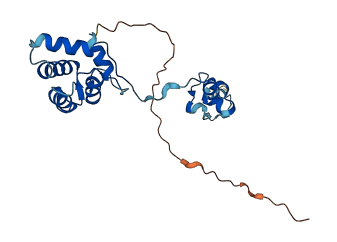
Descriptions
The autoinhibited protein was predicted that may have potential autoinhibitory elements via cis-regPred.
Autoinhibitory domains (AIDs)
Target domain |
|
Relief mechanism |
|
Assay |
cis-regPred |
Accessory elements
No accessory elements
Autoinhibited structure

Activated structure
1 structures for Q7TQD2
| Entry ID | Method | Resolution | Chain | Position | Source |
|---|---|---|---|---|---|
| AF-Q7TQD2-F1 | Predicted | AlphaFoldDB |
15 variants for Q7TQD2
| Variant ID(s) | Position | Change | Description | Diseaes Association | Provenance |
|---|---|---|---|---|---|
| rs3404656654 | 44 | A>S | No | EVA | |
| rs3389289144 | 74 | N>I | No | EVA | |
| rs3389295779 | 85 | I>N | No | EVA | |
| rs3389309181 | 90 | V>M | No | EVA | |
| rs3389276707 | 103 | K>E | No | EVA | |
| rs3389219881 | 113 | E>K | No | EVA | |
| rs3389250604 | 116 | Q>L | No | EVA | |
| rs3389258727 | 144 | E>* | No | EVA | |
| rs3389295621 | 167 | D>H | No | EVA | |
| rs3389285718 | 170 | K>N | No | EVA | |
| rs3389276615 | 178 | R>H | No | EVA | |
| rs3389267894 | 180 | D>V | No | EVA | |
| rs3389304600 | 187 | G>R | No | EVA | |
| rs3389258708 | 194 | L>Q | No | EVA | |
| rs3389258721 | 197 | E>K | No | EVA |
No associated diseases with Q7TQD2
No regional properties for Q7TQD2
| Type | Name | Position | InterPro Accession |
|---|---|---|---|
| No domain, repeats, and functional sites for Q7TQD2 | |||
Functions
10 GO annotations of cellular component
| Name | Definition |
|---|---|
| cytoplasm | The contents of a cell excluding the plasma membrane and nucleus, but including other subcellular structures. |
| cytosol | The part of the cytoplasm that does not contain organelles but which does contain other particulate matter, such as protein complexes. |
| microtubule | Any of the long, generally straight, hollow tubes of internal diameter 12-15 nm and external diameter 24 nm found in a wide variety of eukaryotic cells; each consists (usually) of 13 protofilaments of polymeric tubulin, staggered in such a manner that the tubulin monomers are arranged in a helical pattern on the microtubular surface, and with the alpha/beta axes of the tubulin subunits parallel to the long axis of the tubule; exist in equilibrium with pool of tubulin monomers and can be rapidly assembled or disassembled in response to physiological stimuli; concerned with force generation, e.g. in the spindle. |
| microtubule bundle | An arrangement of closely apposed microtubules running parallel to each other. |
| mitochondrion | A semiautonomous, self replicating organelle that occurs in varying numbers, shapes, and sizes in the cytoplasm of virtually all eukaryotic cells. It is notably the site of tissue respiration. |
| mitotic spindle | A spindle that forms as part of mitosis. Mitotic and meiotic spindles contain distinctive complements of proteins associated with microtubules. |
| myelin sheath | An electrically insulating fatty layer that surrounds the axons of many neurons. It is an outgrowth of glial cells: Schwann cells supply the myelin for peripheral neurons while oligodendrocytes supply it to those of the central nervous system. |
| nucleus | A membrane-bounded organelle of eukaryotic cells in which chromosomes are housed and replicated. In most cells, the nucleus contains all of the cell's chromosomes except the organellar chromosomes, and is the site of RNA synthesis and processing. In some species, or in specialized cell types, RNA metabolism or DNA replication may be absent. |
| perinuclear region of cytoplasm | Cytoplasm situated near, or occurring around, the nucleus. |
| postsynaptic Golgi apparatus | The network of the Golgi apparatus structures located within the postsynapse. |
5 GO annotations of molecular function
| Name | Definition |
|---|---|
| GTPase activity | Catalysis of the reaction: GTP + H2O = GDP + H+ + phosphate. |
| magnesium ion binding | Binding to a magnesium (Mg) ion. |
| microtubule binding | Binding to a microtubule, a filament composed of tubulin monomers. |
| protein homodimerization activity | Binding to an identical protein to form a homodimer. |
| tubulin binding | Binding to monomeric or multimeric forms of tubulin, including microtubules. |
13 GO annotations of biological process
| Name | Definition |
|---|---|
| astral microtubule organization | A process that is carried out at the cellular level which results in the assembly, arrangement of constituent parts, or disassembly of astral microtubules, any of the spindle microtubules that radiate in all directions from the spindle poles. |
| cell division | The process resulting in division and partitioning of components of a cell to form more cells; may or may not be accompanied by the physical separation of a cell into distinct, individually membrane-bounded daughter cells. |
| microtubule bundle formation | A process that results in a parallel arrangement of microtubules. |
| microtubule nucleation by microtubule organizing center | The 'de novo' formation of a microtubule, mediated by the microtubule organizing center. |
| microtubule polymerization | The addition of tubulin heterodimers to one or both ends of a microtubule. |
| myelin assembly | The process in which the wraps of cell membrane that constitute myelin are laid down around an axon in the central or peripheral nervous system. |
| negative regulation of tubulin deacetylation | Any process that stops, prevents or reduces the frequency, rate or extent of tubulin deacetylation. |
| oligodendrocyte development | The process aimed at the progression of an oligodendrocyte over time, from initial commitment of the cell to a specific fate, to the fully functional differentiated cell. An oligodendrocyte is a type of glial cell involved in myelinating the axons in the central nervous system. |
| oligodendrocyte differentiation | The process in which a relatively unspecialized cell acquires the specialized features of an oligodendrocyte. An oligodendrocyte is a type of glial cell involved in myelinating the axons of neurons in the central nervous system. |
| positive regulation of myelination | Any process that activates or increases the frequency, rate or extent of the formation of a myelin sheath around nerve axons. |
| positive regulation of protein polymerization | Any process that activates or increases the frequency, rate or extent of the process of creating protein polymers. |
| positive regulation of protein-containing complex assembly | Any process that activates or increases the frequency, rate or extent of protein complex assembly. |
| regulation of microtubule cytoskeleton organization | Any process that modulates the frequency, rate or extent of the formation, arrangement of constituent parts, or disassembly of cytoskeletal structures comprising microtubules and their associated proteins. |
| 10 | 20 | 30 | 40 | 50 | 60 |
| MADSKAKPAK | AANKTPPKSP | GDPARAAKRL | SLESEGANEG | ATAAPELSAL | EEAFRRFAVH |
| 70 | 80 | 90 | 100 | 110 | 120 |
| GDTRATGKEM | HGKNWSKLCK | DCHVIDGKNV | TVTDVDIVFS | KIKGKSCRTI | TFEQFQEALE |
| 130 | 140 | 150 | 160 | 170 | 180 |
| ELAKKRFKDK | SSEEAVREVH | RLIEGRAPVI | SGVTKAVSSP | TVSRLTDTSK | FTGSHKERFD |
| 190 | 200 | 210 | |||
| QSGKGKGKAG | RVDLVDESGY | VPGYKHAGTY | DQKVQGGK |