Q7TPK1
Gene name |
Uhrf1 (Ac2-121) |
Protein name |
E3 ubiquitin-protein ligase UHRF1 |
Names |
Liver regeneration-related protein LRRG126, RING-type E3 ubiquitin transferase UHRF1, Ubiquitin-like PHD and RING finger domain-containing protein 1, Ubiquitin-like-containing PHD and RING finger domains protein 1 |
Species |
Rattus norvegicus (Rat) |
KEGG Pathway |
rno:316129 |
EC number |
2.3.2.27: Aminoacyltransferases |
Protein Class |
|
Descriptions
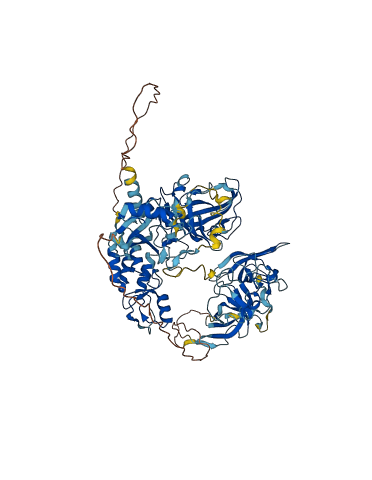
The autoinhibited protein was predicted that may have potential autoinhibitory elements via cis-regPred.
Autoinhibitory domains (AIDs)
Target domain |
|
Relief mechanism |
|
Assay |
cis-regPred |
Accessory elements
No accessory elements
Autoinhibited structure

Activated structure
1 structures for Q7TPK1
| Entry ID | Method | Resolution | Chain | Position | Source |
|---|---|---|---|---|---|
| AF-Q7TPK1-F1 | Predicted | AlphaFoldDB |
No variants for Q7TPK1
| Variant ID(s) | Position | Change | Description | Diseaes Association | Provenance |
|---|---|---|---|---|---|
| No variants for Q7TPK1 | |||||
No associated diseases with Q7TPK1
9 regional properties for Q7TPK1
| Type | Name | Position | InterPro Accession |
|---|---|---|---|
| domain | Ubiquitin-like domain | 1 - 78 | IPR000626 |
| domain | Zinc finger, RING-type | 315 - 360 | IPR001841-1 |
| domain | Zinc finger, RING-type | 705 - 744 | IPR001841-2 |
| domain | Zinc finger, PHD-type | 314 - 361 | IPR001965 |
| domain | SRA-YDG | 411 - 582 | IPR003105 |
| conserved_site | Zinc finger, RING-type, conserved site | 720 - 729 | IPR017907 |
| domain | Zinc finger, PHD-finger | 296 - 363 | IPR019787 |
| domain | UHRF1, tandem tudor domain | 129 - 280 | IPR021991 |
| domain | E3 ubiquitin-protein ligase UHRF1, ubiquitin-like domain | 1 - 74 | IPR047406 |
Functions
| Description | ||
|---|---|---|
| EC Number | 2.3.2.27 | Aminoacyltransferases |
| Subcellular Localization |
|
|
| PANTHER Family | ||
| PANTHER Subfamily | ||
| PANTHER Protein Class | ||
| PANTHER Pathway Category | No pathway information available | |
8 GO annotations of cellular component
| Name | Definition |
|---|---|
| chromatin | The ordered and organized complex of DNA, protein, and sometimes RNA, that forms the chromosome. |
| cytoplasmic vesicle | A vesicle found in the cytoplasm of a cell. |
| euchromatin | A dispersed and relatively uncompacted form of chromatin that is in a transcription-competent conformation. |
| heterochromatin | A compact and highly condensed form of chromatin that is refractory to transcription. |
| nuclear matrix | The dense fibrillar network lying on the inner side of the nuclear membrane. |
| nucleus | A membrane-bounded organelle of eukaryotic cells in which chromosomes are housed and replicated. In most cells, the nucleus contains all of the cell's chromosomes except the organellar chromosomes, and is the site of RNA synthesis and processing. In some species, or in specialized cell types, RNA metabolism or DNA replication may be absent. |
| plasma membrane | The membrane surrounding a cell that separates the cell from its external environment. It consists of a phospholipid bilayer and associated proteins. |
| replication fork | The Y-shaped region of a replicating DNA molecule, resulting from the separation of the DNA strands and in which the synthesis of new strands takes place. Also includes associated protein complexes. |
9 GO annotations of molecular function
| Name | Definition |
|---|---|
| cis-regulatory region sequence-specific DNA binding | Binding to a specific upstream regulatory DNA sequence (transcription factor recognition sequence or binding site) located in cis relative to the transcription start site (i.e., on the same strand of DNA) of a gene transcribed by some RNA polymerase. The proximal promoter is in cis with and relatively close to the core promoter. |
| hemi-methylated DNA-binding | Binding to double-stranded hemi-methylated DNA at replication foci (one strand methylated, while the other strand is unmethylated). Methylation of cytosine or adenine in DNA is an important mechanism for establishing stable heritable epigenetic marks. |
| histone binding | Binding to a histone, any of a group of water-soluble proteins found in association with the DNA of eukaryotic or archaeal chromosomes. They are involved in the condensation and coiling of chromosomes during cell division and have also been implicated in gene regulation and DNA replication. They may be chemically modified (methylated, acetlyated and others) to regulate gene transcription. |
| identical protein binding | Binding to an identical protein or proteins. |
| methyl-CpG binding | Binding to a methylated cytosine/guanine dinucleotide. |
| methylated histone binding | Binding to a histone in which a residue has been modified by methylation. |
| ubiquitin protein ligase activity | Catalysis of the transfer of ubiquitin to a substrate protein via the reaction X-ubiquitin + S -> X + S-ubiquitin, where X is either an E2 or E3 enzyme, the X-ubiquitin linkage is a thioester bond, and the S-ubiquitin linkage is an amide bond: an isopeptide bond between the C-terminal glycine of ubiquitin and the epsilon-amino group of lysine residues in the substrate or, in the linear extension of ubiquitin chains, a peptide bond the between the C-terminal glycine and N-terminal methionine of ubiquitin residues. |
| ubiquitin-protein transferase activity | Catalysis of the transfer of ubiquitin from one protein to another via the reaction X-Ub + Y --> Y-Ub + X, where both X-Ub and Y-Ub are covalent linkages. |
| zinc ion binding | Binding to a zinc ion (Zn). |
13 GO annotations of biological process
| Name | Definition |
|---|---|
| cell cycle | The progression of biochemical and morphological phases and events that occur in a cell during successive cell replication or nuclear replication events. Canonically, the cell cycle comprises the replication and segregation of genetic material followed by the division of the cell, but in endocycles or syncytial cells nuclear replication or nuclear division may not be followed by cell division. |
| chromatin organization | The assembly or remodeling of chromatin composed of DNA complexed with histones, other associated proteins, and sometimes RNA. |
| DNA repair | The process of restoring DNA after damage. Genomes are subject to damage by chemical and physical agents in the environment (e.g. UV and ionizing radiations, chemical mutagens, fungal and bacterial toxins, etc.) and by free radicals or alkylating agents endogenously generated in metabolism. DNA is also damaged because of errors during its replication. A variety of different DNA repair pathways have been reported that include direct reversal, base excision repair, nucleotide excision repair, photoreactivation, bypass, double-strand break repair pathway, and mismatch repair pathway. |
| histone monoubiquitination | The modification of histones by addition of a single ubiquitin group. |
| histone ubiquitination | The modification of histones by addition of ubiquitin groups. |
| maintenance of DNA methylation | Any process involved in maintaining the methylation state of a nucleotide sequence. |
| negative regulation of transcription by RNA polymerase II | Any process that stops, prevents, or reduces the frequency, rate or extent of transcription mediated by RNA polymerase II. |
| positive regulation of protein metabolic process | Any process that activates or increases the frequency, rate or extent of the chemical reactions and pathways involving a protein. |
| protein autoubiquitination | The ubiquitination by a protein of one or more of its own amino acid residues, or residues on an identical protein. Ubiquitination occurs on the lysine residue by formation of an isopeptide crosslink. |
| protein ubiquitination | The process in which one or more ubiquitin groups are added to a protein. |
| regulation of epithelial cell proliferation | Any process that modulates the frequency, rate or extent of epithelial cell proliferation. |
| response to peptide hormone | Any process that results in a change in state or activity of a cell or an organism (in terms of movement, secretion, enzyme production, gene expression, etc.) as a result of a peptide hormone stimulus. A peptide hormone is any of a class of peptides that are secreted into the blood stream and have endocrine functions in living animals. |
| ubiquitin-dependent protein catabolic process | The chemical reactions and pathways resulting in the breakdown of a protein or peptide by hydrolysis of its peptide bonds, initiated by the covalent attachment of a ubiquitin group, or multiple ubiquitin groups, to the protein. |
| 10 | 20 | 30 | 40 | 50 | 60 |
| MWIQVRTMDG | KETHTVNSLS | RLTKVQELRK | KIEELFHVEP | QLQRLFYRGK | QMEDGHTLFD |
| 70 | 80 | 90 | 100 | 110 | 120 |
| YDVRLNDTIQ | LLVRQSLALP | LSTKERDSEL | SDSDSGYGVG | HSESDKSSTH | GEGTADGDDK |
| 130 | 140 | 150 | 160 | 170 | 180 |
| TVWEDTDLGL | YKVNEYVDVR | DNIFGAWFEA | QVVQVQKKAL | SEEEPCSSSA | IMAPEDDIMY |
| 190 | 200 | 210 | 220 | 230 | 240 |
| HIKYDDYPEH | GVDIVKAKNV | RARARTVIPW | EDLEVGQVVM | ANYNVDYPRK | RGFWYDVEIC |
| 250 | 260 | 270 | 280 | 290 | 300 |
| RKRQTRTARE | LYGNVMLLND | SQLNNCRIIF | VDEVLKIELP | NERSPLIGSP | SRRKSGPSCQ |
| 310 | 320 | 330 | 340 | 350 | 360 |
| YCKDDENKPC | RKCACHICGG | REAPEKQVLC | DECDMAFHLY | CLQPPLTCVP | PEPEWYCPSC |
| 370 | 380 | 390 | 400 | 410 | 420 |
| RTDSSEVVQA | GEKLKKSKKK | AKMASATSSS | RRDWGKGMAC | VGRTTECTIV | PANHFGPIPG |
| 430 | 440 | 450 | 460 | 470 | 480 |
| VPVGTMWRFR | VQVSESGVHR | PHVAGIHGRS | NDGAYSLVLA | GGYEDDVDNG | NFFTYTGSGG |
| 490 | 500 | 510 | 520 | 530 | 540 |
| RDLSGNKRTA | GQSSDQKLTN | NNRALALNCH | SPINEKGAEA | EDWRQGKPVR | VVRNMKGGKH |
| 550 | 560 | 570 | 580 | 590 | 600 |
| SKYAPAEGNR | YDGIYKVVKY | WPEKGKSGFI | VWRYLLRRDD | TEPEPWTREG | KDRTRQLGLT |
| 610 | 620 | 630 | 640 | 650 | 660 |
| MQYPEGYLEA | LANKEKNRKR | PAKALEQGPS | SSKIGKSKRK | STGPATTSPR | VSKKSKLEPY |
| 670 | 680 | 690 | 700 | 710 | 720 |
| TLPLQQANLI | KEDKGNAKLW | DDVLSSLQDG | PYQIFLSKVK | EAFQCICCQE | LVFRPVTTVC |
| 730 | 740 | 750 | 760 | 770 | |
| QHNVCKDCLD | RSFRAQVFSC | PACRYDLDHS | SPTRVNQPLQ | TILNQLFPGY | GSGR |