Q6YV23
Gene name |
CARA (Os02g0708100, LOC_Os02g47850, OSJNBb0060O16.25) |
Protein name |
Carbamoyl-phosphate synthase small chain, chloroplastic |
Names |
Carbamoyl-phosphate synthetase glutamine chain |
Species |
Oryza sativa subsp japonica (Rice) |
KEGG Pathway |
osa:4330474 |
EC number |
6.3.5.5: Carbon--nitrogen ligases with glutamine as amido-N-donor |
Protein Class |
|
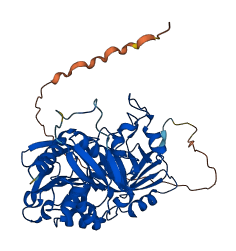
Descriptions
The autoinhibited protein was predicted that may have potential autoinhibitory elements via cis-regPred.
Autoinhibitory domains (AIDs)
Target domain |
|
Relief mechanism |
|
Assay |
cis-regPred |
Accessory elements
No accessory elements
Autoinhibited structure

Activated structure
1 structures for Q6YV23
| Entry ID | Method | Resolution | Chain | Position | Source |
|---|---|---|---|---|---|
| AF-Q6YV23-F1 | Predicted | AlphaFoldDB |
No variants for Q6YV23
| Variant ID(s) | Position | Change | Description | Diseaes Association | Provenance |
|---|---|---|---|---|---|
| No variants for Q6YV23 | |||||
No associated diseases with Q6YV23
5 regional properties for Q6YV23
| Type | Name | Position | InterPro Accession |
|---|---|---|---|
| domain | TolB, N-terminal | 23 - 122 | IPR007195 |
| repeat | WD40-like beta propeller | 199 - 223 | IPR011659-1 |
| repeat | WD40-like beta propeller | 237 - 272 | IPR011659-2 |
| repeat | WD40-like beta propeller | 282 - 315 | IPR011659-3 |
| repeat | WD40-like beta propeller | 377 - 398 | IPR011659-4 |
Functions
| Description | ||
|---|---|---|
| EC Number | 6.3.5.5 | Carbon--nitrogen ligases with glutamine as amido-N-donor |
| Subcellular Localization |
|
|
| PANTHER Family | ||
| PANTHER Subfamily | ||
| PANTHER Protein Class | ||
| PANTHER Pathway Category | No pathway information available | |
3 GO annotations of cellular component
| Name | Definition |
|---|---|
| carbamoyl-phosphate synthase complex | A protein complex that catalyzes the formation of carbamoyl phosphate; comprises a small subunit that binds and cleaves glutamine, and a large subunit that accepts the ammonia group cleaved from glutamine, binds all of the remaining substrates and effectors, and carries out all of the other catalytic events. |
| chloroplast | A chlorophyll-containing plastid with thylakoids organized into grana and frets, or stroma thylakoids, and embedded in a stroma. |
| cytoplasm | The contents of a cell excluding the plasma membrane and nucleus, but including other subcellular structures. |
2 GO annotations of molecular function
| Name | Definition |
|---|---|
| ATP binding | Binding to ATP, adenosine 5'-triphosphate, a universally important coenzyme and enzyme regulator. |
| carbamoyl-phosphate synthase (glutamine-hydrolyzing) activity | Catalysis of the reaction: 2 ATP + L-glutamine + CO2 + H2O = 2 ADP + phosphate + glutamate + carbamoyl phosphate. |
5 GO annotations of biological process
| Name | Definition |
|---|---|
| 'de novo' pyrimidine nucleobase biosynthetic process | The chemical reactions and pathways resulting in the formation of pyrimidine nucleobases, 1,3-diazine, organic nitrogenous bases, beginning with the synthesis of a pyrimidine ring from simpler precursors. |
| 'de novo' UMP biosynthetic process | The chemical reactions and pathways resulting in the formation of UMP, uridine monophosphate, starting with the synthesis of (S)-dihydroorotate from bicarbonate; UMP biosynthesis may either occur via reduction by quinone, NAD(+) or oxygen. |
| arginine biosynthetic process | The chemical reactions and pathways resulting in the formation of arginine, 2-amino-5-(carbamimidamido)pentanoic acid. |
| glutamine metabolic process | The chemical reactions and pathways involving glutamine, 2-amino-4-carbamoylbutanoic acid. |
| nitrogen compound metabolic process | The chemical reactions and pathways involving organic or inorganic compounds that contain nitrogen. |
3 homologous proteins in AiPD
| UniProt AC | Gene Name | Protein Name | Species | Evidence Code |
|---|---|---|---|---|
| B9EXM2 | CARB | Carbamoyl-phosphate synthase large chain, chloroplastic | Oryza sativa subsp japonica (Rice) | PR |
| P49077 | PYRB | Aspartate carbamoyltransferase, chloroplastic | Arabidopsis thaliana (Mouse-ear cress) | PR |
| Q9LVW7 | CARA | Carbamoyl-phosphate synthase small chain, chloroplastic | Arabidopsis thaliana (Mouse-ear cress) | PR |
| 10 | 20 | 30 | 40 | 50 | 60 |
| MAAPPATASA | PSLRPSAASP | RAAAARSVAV | PSGPRTVGPR | RDGGRFLGVR | AAKAVSGVQS |
| 70 | 80 | 90 | 100 | 110 | 120 |
| GTVVDDGVQR | PWKLSDARLV | LEDGSVWKAK | SFGASGTQVG | EVVFNTSLTG | YQEILTDPSY |
| 130 | 140 | 150 | 160 | 170 | 180 |
| AGQFVLMTNP | HIGNTGVNPD | DEESNRCFLA | GLIIRNLSIC | TSNWRCTETL | EEYLMKRNIM |
| 190 | 200 | 210 | 220 | 230 | 240 |
| GIYDVDTRAI | TRRLREDGSL | IGVLSTDQSR | TDDELLEMAK | NWKIVGVDLI | SGVTCDAPYE |
| 250 | 260 | 270 | 280 | 290 | 300 |
| WSDKTDSEWE | FKKGQSTESF | HVVAYDFGIK | HNILRRLTSY | GCKITVVPAN | WPASEVLNLK |
| 310 | 320 | 330 | 340 | 350 | 360 |
| PDGVFFSNGP | GDPAAVPYAV | KTVQEIIGKV | PVFGICMGHQ | LIGQALGGKT | FKMKFGHHGG |
| 370 | 380 | 390 | 400 | 410 | 420 |
| NHPVCDLRSG | RVDISAQNHN | YAVDPESLPE | GVKVTHINLN | DNSCAGLQYP | KMKLLSLQYH |
| 430 | 440 | ||||
| PESSPGPHDS | DLAFGEFIEM | MKNNRL |