Q6P6T5
Gene name |
Ocln |
Protein name |
Occludin |
Names |
|
Species |
Rattus norvegicus (Rat) |
KEGG Pathway |
rno:83497 |
EC number |
|
Protein Class |
|
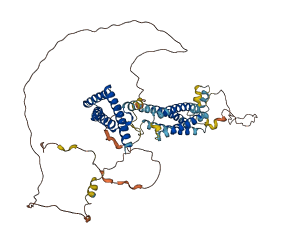
Descriptions
The autoinhibited protein was predicted that may have potential autoinhibitory elements via cis-regPred.
Autoinhibitory domains (AIDs)
Target domain |
|
Relief mechanism |
|
Assay |
cis-regPred |
Accessory elements
No accessory elements
Autoinhibited structure

Activated structure
1 structures for Q6P6T5
| Entry ID | Method | Resolution | Chain | Position | Source |
|---|---|---|---|---|---|
| AF-Q6P6T5-F1 | Predicted | AlphaFoldDB |
2 variants for Q6P6T5
| Variant ID(s) | Position | Change | Description | Diseaes Association | Provenance |
|---|---|---|---|---|---|
| rs8155309 | 276 | K>R | No | EVA | |
| rs198579874 | 308 | M>I | No | EVA |
No associated diseases with Q6P6T5
No regional properties for Q6P6T5
| Type | Name | Position | InterPro Accession |
|---|---|---|---|
| No domain, repeats, and functional sites for Q6P6T5 | |||
12 GO annotations of cellular component
| Name | Definition |
|---|---|
| apical plasma membrane | The region of the plasma membrane located at the apical end of the cell. |
| apicolateral plasma membrane | The apical end of the lateral plasma membrane of epithelial cells. |
| bicellular tight junction | An occluding cell-cell junction that is composed of a branching network of sealing strands that completely encircles the apical end of each cell in an epithelial sheet; the outer leaflets of the two interacting plasma membranes are seen to be tightly apposed where sealing strands are present. Each sealing strand is composed of a long row of transmembrane adhesion proteins embedded in each of the two interacting plasma membranes. |
| cell-cell junction | A cell junction that forms a connection between two or more cells of an organism; excludes direct cytoplasmic intercellular bridges, such as ring canals in insects. |
| cytoplasmic vesicle | A vesicle found in the cytoplasm of a cell. |
| endocytic vesicle | A membrane-bounded intracellular vesicle formed by invagination of the plasma membrane around an extracellular substance. Endocytic vesicles fuse with early endosomes to deliver the cargo for further sorting. |
| integral component of membrane | The component of a membrane consisting of the gene products and protein complexes having at least some part of their peptide sequence embedded in the hydrophobic region of the membrane. |
| lateral plasma membrane | The portion of the plasma membrane at the lateral side of the cell. In epithelial cells, lateral plasma membranes are on the sides of cells which lie at the interface of adjacent cells. |
| lysosomal membrane | The lipid bilayer surrounding the lysosome and separating its contents from the cell cytoplasm. |
| plasma membrane | The membrane surrounding a cell that separates the cell from its external environment. It consists of a phospholipid bilayer and associated proteins. |
| protein-containing complex | A stable assembly of two or more macromolecules, i.e. proteins, nucleic acids, carbohydrates or lipids, in which at least one component is a protein and the constituent parts function together. |
| tight junction | A cell-cell junction that seals cells together in an epithelium in a way that prevents even small molecules from leaking from one side of the sheet to the other. |
1 GO annotations of molecular function
| Name | Definition |
|---|---|
| protein domain specific binding | Binding to a specific domain of a protein. |
12 GO annotations of biological process
| Name | Definition |
|---|---|
| bicellular tight junction assembly | The aggregation, arrangement and bonding together of a set of components to form a tight junction, an occluding cell-cell junction that is composed of a branching network of sealing strands that completely encircles the apical end of each cell in an epithelial sheet. |
| cell-cell junction organization | A process that is carried out at the cellular level which results in the assembly, arrangement of constituent parts, or disassembly of a cell-cell junction. A cell-cell junction is a specialized region of connection between two cells. |
| cellular response to tumor necrosis factor | Any process that results in a change in state or activity of a cell (in terms of movement, secretion, enzyme production, gene expression, etc.) as a result of a tumor necrosis factor stimulus. |
| negative regulation of gene expression | Any process that decreases the frequency, rate or extent of gene expression. Gene expression is the process in which a gene's coding sequence is converted into a mature gene product (protein or RNA). |
| negative regulation of protein phosphorylation | Any process that stops, prevents or reduces the rate of addition of phosphate groups to amino acids within a protein. |
| positive regulation of blood-brain barrier permeability | Any process that increases blood-brain barrier permeability, the quality of the blood-brain barrier that allows for a controlled passage of substances (e.g. macromolecules, small molecules, ions) into and out of the brain. |
| positive regulation of gene expression | Any process that increases the frequency, rate or extent of gene expression. Gene expression is the process in which a gene's coding sequence is converted into a mature gene product (protein or RNA). |
| positive regulation of glucose import | Any process that activates or increases the frequency, rate or extent of the import of the hexose monosaccharide glucose into a cell or organelle. |
| regulation of glucose transmembrane transport | Any process that modulates the frequency, rate or extent of glucose transport across a membrane. Glucose transport is the directed movement of the hexose monosaccharide glucose into, out of or within a cell, or between cells, by means of some agent such as a transporter or pore. |
| response to Gram-positive bacterium | Any process that results in a change in state or activity of a cell or an organism (in terms of movement, secretion, enzyme production, gene expression, etc.) as a result of a stimulus from a Gram-positive bacterium. |
| response to interleukin-18 | Any process that results in a change in state or activity of a cell or an organism (in terms of movement, secretion, enzyme production, gene expression, etc.) as a result of an interleukin-18 stimulus. |
| tight junction organization | A process that is carried out at the cellular level which results in the assembly, arrangement of constituent parts, or disassembly of a tight junction. A tight junction seals cells together in an epithelium in a way that prevents even small molecules from leaking from one side of the sheet to the other. |
4 homologous proteins in AiPD
| 10 | 20 | 30 | 40 | 50 | 60 |
| MSVRPFESPP | PYRPDEFKPN | HYAPSNDMYG | GEMHVRPMLS | QPAYSFYPED | EILHFYKWTS |
| 70 | 80 | 90 | 100 | 110 | 120 |
| PPGVIRILSM | LVIVMCIAVF | ACVASTLAWD | RAYGTGIFGG | SMNYPYGSGF | GSYGGGFGGY |
| 130 | 140 | 150 | 160 | 170 | 180 |
| GYGYGYGYGG | YTDPRAAKGF | LLAMAAFCFI | ASLVIFVTSV | IRSGMSRTRR | YYLIVIIVSA |
| 190 | 200 | 210 | 220 | 230 | 240 |
| ILGIMVFIAT | IVYIMGVNPT | AQASGSMYGS | QIYTICSQFY | TPGGTGLYVD | QYLYHYCVVD |
| 250 | 260 | 270 | 280 | 290 | 300 |
| PQEAIAIVLG | FMIIVAFALI | IVFAVKTRRK | MDRYDKSNIL | WDKEHIYDEQ | PPNVEEWVKN |
| 310 | 320 | 330 | 340 | 350 | 360 |
| VSAGTQDMPP | PPSDYAERVD | SPMAYSSNGK | VNGKRSYPDS | LYKSPPLVPE | VAQEIPLTLS |
| 370 | 380 | 390 | 400 | 410 | 420 |
| VDDFRQPRYS | SNDNLETPSK | RTPTKGKAGK | AKRTDPDHYE | TDYTTGGESC | DELEEDWLRE |
| 430 | 440 | 450 | 460 | 470 | 480 |
| YPPITSDQQR | QLYKRNFDAG | LQEYKSLLAE | LDEVNKELSR | LDRELDDYRE | ESEEYMAAAD |
| 490 | 500 | 510 | 520 | ||
| EYNRLKQVKG | SADYKSKKNY | CKQLKSKLSH | IKRMVGDYDR | RKT |