Q6NZQ8
Gene name |
Marchf1 (March1) |
Protein name |
E3 ubiquitin-protein ligase MARCHF1 |
Names |
Membrane-associated RING finger protein 1, Membrane-associated RING-CH protein I, MARCH-I, RING-type E3 ubiquitin transferase MARCHF1 |
Species |
Mus musculus (Mouse) |
KEGG Pathway |
mmu:72925 |
EC number |
2.3.2.27: Aminoacyltransferases |
Protein Class |
|
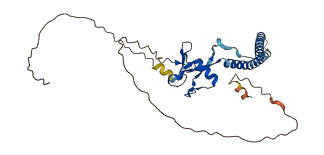
Descriptions
The autoinhibited protein was predicted that may have potential autoinhibitory elements via cis-regPred.
Autoinhibitory domains (AIDs)
Target domain |
|
Relief mechanism |
|
Assay |
cis-regPred |
Accessory elements
No accessory elements
Autoinhibited structure

Activated structure
1 structures for Q6NZQ8
| Entry ID | Method | Resolution | Chain | Position | Source |
|---|---|---|---|---|---|
| AF-Q6NZQ8-F1 | Predicted | AlphaFoldDB |
7 variants for Q6NZQ8
| Variant ID(s) | Position | Change | Description | Diseaes Association | Provenance |
|---|---|---|---|---|---|
| rs3388985525 | 86 | E>* | No | EVA | |
| rs3388982283 | 104 | R>C | No | EVA | |
| rs3388955835 | 198 | W>G | No | EVA | |
| rs3388989309 | 251 | N>T | No | EVA | |
| rs3388972214 | 257 | N>T | No | EVA | |
| rs3399399959 | 259 | E>G | No | EVA | |
| rs1135032890 | 269 | P>S | No | EVA |
No associated diseases with Q6NZQ8
No regional properties for Q6NZQ8
| Type | Name | Position | InterPro Accession |
|---|---|---|---|
| No domain, repeats, and functional sites for Q6NZQ8 | |||
Functions
| Description | ||
|---|---|---|
| EC Number | 2.3.2.27 | Aminoacyltransferases |
| Subcellular Localization |
|
|
| PANTHER Family | ||
| PANTHER Subfamily | ||
| PANTHER Protein Class | ||
| PANTHER Pathway Category | No pathway information available | |
13 GO annotations of cellular component
| Name | Definition |
|---|---|
| cytoplasm | The contents of a cell excluding the plasma membrane and nucleus, but including other subcellular structures. |
| early endosome membrane | The lipid bilayer surrounding an early endosome. |
| endoplasmic reticulum | The irregular network of unit membranes, visible only by electron microscopy, that occurs in the cytoplasm of many eukaryotic cells. The membranes form a complex meshwork of tubular channels, which are often expanded into slitlike cavities called cisternae. The ER takes two forms, rough (or granular), with ribosomes adhering to the outer surface, and smooth (with no ribosomes attached). |
| endoplasmic reticulum membrane | The lipid bilayer surrounding the endoplasmic reticulum. |
| endosome | A vacuole to which materials ingested by endocytosis are delivered. |
| Golgi apparatus | A membrane-bound cytoplasmic organelle of the endomembrane system that further processes the core oligosaccharides (e.g. N-glycans) added to proteins in the endoplasmic reticulum and packages them into membrane-bound vesicles. The Golgi apparatus operates at the intersection of the secretory, lysosomal, and endocytic pathways. |
| integral component of membrane | The component of a membrane consisting of the gene products and protein complexes having at least some part of their peptide sequence embedded in the hydrophobic region of the membrane. |
| intracellular membrane-bounded organelle | Organized structure of distinctive morphology and function, bounded by a single or double lipid bilayer membrane and occurring within the cell. Includes the nucleus, mitochondria, plastids, vacuoles, and vesicles. Excludes the plasma membrane. |
| late endosome membrane | The lipid bilayer surrounding a late endosome. |
| lysosomal membrane | The lipid bilayer surrounding the lysosome and separating its contents from the cell cytoplasm. |
| lysosome | A small lytic vacuole that has cell cycle-independent morphology found in most animal cells and that contains a variety of hydrolases, most of which have their maximal activities in the pH range 5-6. The contained enzymes display latency if properly isolated. About 40 different lysosomal hydrolases are known and lysosomes have a great variety of morphologies and functions. |
| plasma membrane | The membrane surrounding a cell that separates the cell from its external environment. It consists of a phospholipid bilayer and associated proteins. |
| trans-Golgi network membrane | The lipid bilayer surrounding any of the compartments that make up the trans-Golgi network. |
4 GO annotations of molecular function
| Name | Definition |
|---|---|
| MHC protein binding | Binding to a major histocompatibility complex molecule; a set of molecules displayed on cell surfaces that are responsible for lymphocyte recognition and antigen presentation. |
| ubiquitin protein ligase activity | Catalysis of the transfer of ubiquitin to a substrate protein via the reaction X-ubiquitin + S -> X + S-ubiquitin, where X is either an E2 or E3 enzyme, the X-ubiquitin linkage is a thioester bond, and the S-ubiquitin linkage is an amide bond: an isopeptide bond between the C-terminal glycine of ubiquitin and the epsilon-amino group of lysine residues in the substrate or, in the linear extension of ubiquitin chains, a peptide bond the between the C-terminal glycine and N-terminal methionine of ubiquitin residues. |
| ubiquitin-protein transferase activity | Catalysis of the transfer of ubiquitin from one protein to another via the reaction X-Ub + Y --> Y-Ub + X, where both X-Ub and Y-Ub are covalent linkages. |
| zinc ion binding | Binding to a zinc ion (Zn). |
3 GO annotations of biological process
| Name | Definition |
|---|---|
| antigen processing and presentation of peptide antigen via MHC class II | The process in which an antigen-presenting cell expresses a peptide antigen on its cell surface in association with an MHC class II protein complex. The peptide antigen is typically, but not always, processed from a whole protein. |
| immune response | Any immune system process that functions in the calibrated response of an organism to a potential internal or invasive threat. |
| protein polyubiquitination | Addition of multiple ubiquitin groups to a protein, forming a ubiquitin chain. |
3 homologous proteins in AiPD
| UniProt AC | Gene Name | Protein Name | Species | Evidence Code |
|---|---|---|---|---|
| O60337 | MARCHF6 | E3 ubiquitin-protein ligase MARCHF6 | Homo sapiens (Human) | PR |
| Q6ZQ89 | Marchf6 | E3 ubiquitin-protein ligase MARCHF6 | Mus musculus (Mouse) | PR |
| Q28IK8 | marchf8 | E3 ubiquitin-protein ligase MARCHF8 | Xenopus tropicalis (Western clawed frog) (Silurana tropicalis) | PR |
| 10 | 20 | 30 | 40 | 50 | 60 |
| MLGWCEAIAR | NPHRIPNTTR | TPETSGDVAD | ASQTSTLNEK | SPGRSASRSS | NISKASSPTT |
| 70 | 80 | 90 | 100 | 110 | 120 |
| GTAPRSQSRL | SVCPSTQDIC | RICHCEGDEE | SPLITPCRCT | GTLRFVHQSC | LHQWIKSSDT |
| 130 | 140 | 150 | 160 | 170 | 180 |
| RCCELCKYDF | IMETKLKPLR | KWEKLQMTTS | ERRKIFCSVT | FHVIAVTCVV | WSLYVLIDRT |
| 190 | 200 | 210 | 220 | 230 | 240 |
| AEEIKQGNDN | GVLEWPFWTK | LVVVAIGFTG | GLVFMYVQCK | VYVQLWRRLK | AYNRVIFVQN |
| 250 | 260 | 270 | 280 | ||
| CPDTANKLEK | NFPCNVNTEI | KDAVVVPVPQ | TGSNTLPTAE | GAPPEVIPV |