Q28IK8
Gene name |
marchf8 (march8, TNeu072c23.1) |
Protein name |
E3 ubiquitin-protein ligase MARCHF8 |
Names |
Membrane-associated RING finger protein 8, Membrane-associated RING-CH protein VIII, MARCH-VIII, RING-type E3 ubiquitin transferase MARCHF8 |
Species |
Xenopus tropicalis (Western clawed frog) (Silurana tropicalis) |
KEGG Pathway |
xtr:448095 |
EC number |
2.3.2.27: Aminoacyltransferases |
Protein Class |
|
Descriptions
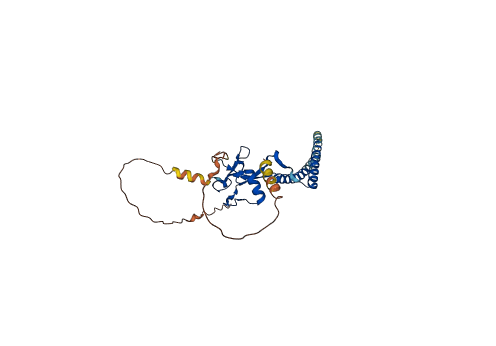
The autoinhibited protein was predicted that may have potential autoinhibitory elements via cis-regPred.
Autoinhibitory domains (AIDs)
Target domain |
|
Relief mechanism |
|
Assay |
cis-regPred |
Accessory elements
No accessory elements
Autoinhibited structure

Activated structure
1 structures for Q28IK8
| Entry ID | Method | Resolution | Chain | Position | Source |
|---|---|---|---|---|---|
| AF-Q28IK8-F1 | Predicted | AlphaFoldDB |
No variants for Q28IK8
| Variant ID(s) | Position | Change | Description | Diseaes Association | Provenance |
|---|---|---|---|---|---|
| No variants for Q28IK8 | |||||
No associated diseases with Q28IK8
Functions
| Description | ||
|---|---|---|
| EC Number | 2.3.2.27 | Aminoacyltransferases |
| Subcellular Localization |
|
|
| PANTHER Family | ||
| PANTHER Subfamily | ||
| PANTHER Protein Class | ||
| PANTHER Pathway Category | No pathway information available | |
7 GO annotations of cellular component
| Name | Definition |
|---|---|
| cytoplasm | The contents of a cell excluding the plasma membrane and nucleus, but including other subcellular structures. |
| early endosome membrane | The lipid bilayer surrounding an early endosome. |
| endosome | A vacuole to which materials ingested by endocytosis are delivered. |
| integral component of membrane | The component of a membrane consisting of the gene products and protein complexes having at least some part of their peptide sequence embedded in the hydrophobic region of the membrane. |
| late endosome membrane | The lipid bilayer surrounding a late endosome. |
| lysosomal membrane | The lipid bilayer surrounding the lysosome and separating its contents from the cell cytoplasm. |
| lysosome | A small lytic vacuole that has cell cycle-independent morphology found in most animal cells and that contains a variety of hydrolases, most of which have their maximal activities in the pH range 5-6. The contained enzymes display latency if properly isolated. About 40 different lysosomal hydrolases are known and lysosomes have a great variety of morphologies and functions. |
4 GO annotations of molecular function
| Name | Definition |
|---|---|
| MHC protein binding | Binding to a major histocompatibility complex molecule; a set of molecules displayed on cell surfaces that are responsible for lymphocyte recognition and antigen presentation. |
| ubiquitin protein ligase activity | Catalysis of the transfer of ubiquitin to a substrate protein via the reaction X-ubiquitin + S -> X + S-ubiquitin, where X is either an E2 or E3 enzyme, the X-ubiquitin linkage is a thioester bond, and the S-ubiquitin linkage is an amide bond: an isopeptide bond between the C-terminal glycine of ubiquitin and the epsilon-amino group of lysine residues in the substrate or, in the linear extension of ubiquitin chains, a peptide bond the between the C-terminal glycine and N-terminal methionine of ubiquitin residues. |
| ubiquitin-protein transferase activity | Catalysis of the transfer of ubiquitin from one protein to another via the reaction X-Ub + Y --> Y-Ub + X, where both X-Ub and Y-Ub are covalent linkages. |
| zinc ion binding | Binding to a zinc ion (Zn). |
3 GO annotations of biological process
| Name | Definition |
|---|---|
| antigen processing and presentation of peptide antigen via MHC class II | The process in which an antigen-presenting cell expresses a peptide antigen on its cell surface in association with an MHC class II protein complex. The peptide antigen is typically, but not always, processed from a whole protein. |
| immune response | Any immune system process that functions in the calibrated response of an organism to a potential internal or invasive threat. |
| protein polyubiquitination | Addition of multiple ubiquitin groups to a protein, forming a ubiquitin chain. |
3 homologous proteins in AiPD
| 10 | 20 | 30 | 40 | 50 | 60 |
| MHSCWKMKLQ | NEKTLGHSVS | RSSNISKAGS | PTSVSAPSSF | PRTSVTPSSQ | DICRICHCEG |
| 70 | 80 | 90 | 100 | 110 | 120 |
| DDESPLITPC | HCTGSLHFVH | QACLQQWIKS | SDTRCCELCK | FEFIMETKLK | PLRKWEKLQM |
| 130 | 140 | 150 | 160 | 170 | 180 |
| TASERRKIMC | SVTFHVIAIT | CVVWSLYVLI | DRTAEEIKMG | QNNGILEWPF | WTKLVVVAIG |
| 190 | 200 | 210 | 220 | 230 | 240 |
| FTGGLLFMYV | QCKVYVQLWK | RLKAYNRVIY | VQNCPETCKK | KIFEKSVIIE | PNLESKEALG |
| 250 | 260 | ||||
| IHHSDTNSSY | YTEPEDCGAA | ILQV |