Q6DRC3
Gene name |
cfap298 |
Protein name |
Cilia- and flagella-associated protein 298 |
Names |
Protein kurly |
Species |
Danio rerio (Zebrafish) (Brachydanio rerio) |
KEGG Pathway |
dre:792532 |
EC number |
|
Protein Class |
|
Descriptions
The autoinhibited protein was predicted that may have potential autoinhibitory elements via cis-regPred.
Autoinhibitory domains (AIDs)
Target domain |
|
Relief mechanism |
|
Assay |
cis-regPred |
Accessory elements
No accessory elements
Autoinhibited structure

Activated structure
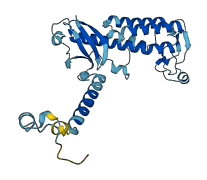
1 structures for Q6DRC3
| Entry ID | Method | Resolution | Chain | Position | Source |
|---|---|---|---|---|---|
| AF-Q6DRC3-F1 | Predicted | AlphaFoldDB |
No variants for Q6DRC3
| Variant ID(s) | Position | Change | Description | Diseaes Association | Provenance |
|---|---|---|---|---|---|
| No variants for Q6DRC3 | |||||
No associated diseases with Q6DRC3
No regional properties for Q6DRC3
| Type | Name | Position | InterPro Accession |
|---|---|---|---|
| No domain, repeats, and functional sites for Q6DRC3 | |||
4 GO annotations of cellular component
| Name | Definition |
|---|---|
| cilium | A specialized eukaryotic organelle that consists of a filiform extrusion of the cell surface and of some cytoplasmic parts. Each cilium is largely bounded by an extrusion of the cytoplasmic (plasma) membrane, and contains a regular longitudinal array of microtubules, anchored to a basal body. |
| cytoplasm | The contents of a cell excluding the plasma membrane and nucleus, but including other subcellular structures. |
| cytoskeleton | A cellular structure that forms the internal framework of eukaryotic and prokaryotic cells. The cytoskeleton includes intermediate filaments, microfilaments, microtubules, the microtrabecular lattice, and other structures characterized by a polymeric filamentous nature and long-range order within the cell. The various elements of the cytoskeleton not only serve in the maintenance of cellular shape but also have roles in other cellular functions, including cellular movement, cell division, endocytosis, and movement of organelles. |
| extracellular region | The space external to the outermost structure of a cell. For cells without external protective or external encapsulating structures this refers to space outside of the plasma membrane. This term covers the host cell environment outside an intracellular parasite. |
No GO annotations of molecular function
| Name | Definition |
|---|---|
| No GO annotations for molecular function |
7 GO annotations of biological process
| Name | Definition |
|---|---|
| cerebrospinal fluid circulation | The neurological system process driven by motile cilia on ependymal cells of the brain by which cerebrospinal fluid circulates from the sites of secretion to the sites of absorption. In ventricular cavities, the flow is unidirectional and rostrocaudal, in subarachnoid spaces, the flow is multi-directional. |
| cilium assembly | The assembly of a cilium, a specialized eukaryotic organelle that consists of a filiform extrusion of the cell surface. Each cilium is bounded by an extrusion of the cytoplasmic membrane, and contains a regular longitudinal array of microtubules, anchored basally in a centriole. |
| determination of left/right symmetry | The establishment of an organism's body plan or part of an organism with respect to the left and right halves. The pattern can either be symmetric, such that the halves are mirror images, or asymmetric where the pattern deviates from this symmetry. |
| motile cilium assembly | The aggregation, arrangement and bonding together of a set of components to form a motile cilium. |
| pronephros development | The process whose specific outcome is the progression of the pronephros over time, from its formation to the mature structure. In mammals, the pronephros is the first of the three embryonic kidneys to be established and exists only transiently. In lower vertebrates such as fish and amphibia, the pronephros is the fully functional embryonic kidney and is indispensable for larval life. |
| pronephros morphogenesis | The process in which the anatomical structures of the pronephros are generated and organized. In mammals, the pronephros is the first of the three embryonic kidneys to be established and exists only transiently. In lower vertebrates such as fish and amphibia, the pronephros is the fully functional embryonic kidney and is indispensable for larval life. |
| regulation of cilium movement | Any process that modulates the rate, frequency, or extent of cilium movement, the directed, self-propelled movement of a cilium. |
3 homologous proteins in AiPD
| UniProt AC | Gene Name | Protein Name | Species | Evidence Code |
|---|---|---|---|---|
| P57076 | CFAP298 | Cilia- and flagella-associated protein 298 | Homo sapiens (Human) | PR |
| Q8BL95 | Cfap298 | Cilia- and flagella-associated protein 298 | Mus musculus (Mouse) | PR |
| Q5U3Z0 | Cfap298 | Cilia- and flagella-associated protein 298 | Rattus norvegicus (Rat) | PR |
| 10 | 20 | 30 | 40 | 50 | 60 |
| MVQLHVKRGD | ESQFLFNTTV | DVQIETLTQQ | ICEIYNARLK | VDRICTEIPE | LADHGISLPP |
| 70 | 80 | 90 | 100 | 110 | 120 |
| NMQGLTDDQI | VELKLKDEWE | ERCIPSGGAE | FKKDEIGRRN | GHAPNEKMKD | VLRRTMEEAK |
| 130 | 140 | 150 | 160 | 170 | 180 |
| ALISKKQLQA | NVCVTMEMVK | EALDQLRGAV | MIVYPMGLPP | HDPIRMEIEN | QEDLTGTQAS |
| 190 | 200 | 210 | 220 | 230 | 240 |
| LQVITNEEAQ | LWWASKELHR | GKKLQDYIGK | NEKTKIIVKI | QKRGQGAPAR | EPVVSEDEQK |
| 250 | 260 | 270 | 280 | ||
| QMMLHYYKRQ | EELKKLEEAD | DDTHLQSEWS | DRQALKRQFQ | GLTNIKWGPR |