Q68FT9
Gene name |
Scly |
Protein name |
Selenocysteine lyase |
Names |
|
Species |
Rattus norvegicus (Rat) |
KEGG Pathway |
rno:363285 |
EC number |
4.4.1.16: Carbon-sulfur lyases |
Protein Class |
|
Descriptions
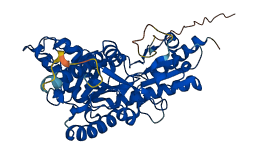
The autoinhibited protein was predicted that may have potential autoinhibitory elements via cis-regPred.
Autoinhibitory domains (AIDs)
Target domain |
|
Relief mechanism |
|
Assay |
cis-regPred |
Accessory elements
No accessory elements
Autoinhibited structure

Activated structure
4 structures for Q68FT9
| Entry ID | Method | Resolution | Chain | Position | Source |
|---|---|---|---|---|---|
| 3A9X | X-ray | 200 A | A/B | 1-432 | PDB |
| 3A9Y | X-ray | 185 A | A/B | 1-432 | PDB |
| 3A9Z | X-ray | 155 A | A/B | 1-432 | PDB |
| AF-Q68FT9-F1 | Predicted | AlphaFoldDB |
No variants for Q68FT9
| Variant ID(s) | Position | Change | Description | Diseaes Association | Provenance |
|---|---|---|---|---|---|
| No variants for Q68FT9 | |||||
No associated diseases with Q68FT9
1 regional properties for Q68FT9
| Type | Name | Position | InterPro Accession |
|---|---|---|---|
| domain | Aminotransferase class V domain | 20 - 416 | IPR000192 |
Functions
| Description | ||
|---|---|---|
| EC Number | 4.4.1.16 | Carbon-sulfur lyases |
| Subcellular Localization |
|
|
| PANTHER Family | ||
| PANTHER Subfamily | ||
| PANTHER Protein Class | ||
| PANTHER Pathway Category | No pathway information available | |
3 GO annotations of cellular component
| Name | Definition |
|---|---|
| catalytic complex | A protein complex which is capable of catalytic activity. |
| cytosol | The part of the cytoplasm that does not contain organelles but which does contain other particulate matter, such as protein complexes. |
| Golgi apparatus | A membrane-bound cytoplasmic organelle of the endomembrane system that further processes the core oligosaccharides (e.g. N-glycans) added to proteins in the endoplasmic reticulum and packages them into membrane-bound vesicles. The Golgi apparatus operates at the intersection of the secretory, lysosomal, and endocytic pathways. |
5 GO annotations of molecular function
| Name | Definition |
|---|---|
| amino acid binding | Binding to an amino acid, organic acids containing one or more amino substituents. |
| protein homodimerization activity | Binding to an identical protein to form a homodimer. |
| selenocysteine lyase activity | Catalysis of the reaction: L-selenocysteine + reduced acceptor = hydrogen selenide + L-alanine + acceptor. |
| transferase activity | Catalysis of the transfer of a group, e.g. a methyl group, glycosyl group, acyl group, phosphorus-containing, or other groups, from one compound (generally regarded as the donor) to another compound (generally regarded as the acceptor). Transferase is the systematic name for any enzyme of EC class 2. |
| vitamin B6 binding | Binding to a vitamin B6 compound: pyridoxal, pyridoxamine, pyridoxine, or the active form, pyridoxal phosphate. |
5 GO annotations of biological process
| Name | Definition |
|---|---|
| lipid metabolic process | The chemical reactions and pathways involving lipids, compounds soluble in an organic solvent but not, or sparingly, in an aqueous solvent. Includes fatty acids; neutral fats, other fatty-acid esters, and soaps; long-chain (fatty) alcohols and waxes; sphingoids and other long-chain bases; glycolipids, phospholipids and sphingolipids; and carotenes, polyprenols, sterols, terpenes and other isoprenoids. |
| negative regulation of cellular response to oxidative stress | Any process that stops, prevents or reduces the frequency, rate or extent of cellular response to oxidative stress. |
| response to insulin | Any process that results in a change in state or activity of a cell or an organism (in terms of movement, secretion, enzyme production, gene expression, etc.) as a result of an insulin stimulus. Insulin is a polypeptide hormone produced by the islets of Langerhans of the pancreas in mammals, and by the homologous organs of other organisms. |
| selenium compound metabolic process | The chemical reactions and pathways involving compounds that contain selenium, such as selenocysteine. |
| selenocysteine catabolic process | The chemical reactions and pathways resulting in the breakdown of selenocysteine, an essential component of glutathione peroxidase and some other proteins. |
3 homologous proteins in AiPD
| 10 | 20 | 30 | 40 | 50 | 60 |
| MDVARNGARG | SVESPPNRKV | YMDYNATTPL | EPEVIQAVTE | AMKEAWGNPS | SSYVAGRKAK |
| 70 | 80 | 90 | 100 | 110 | 120 |
| DIINTARASL | AKMIGGKPQD | IIFTSGGTES | NNLVIHSTVR | CFHEQQTLQG | RTVDQISPEE |
| 130 | 140 | 150 | 160 | 170 | 180 |
| GTRPHFITCT | VEHDSIRLPL | EHLVEDQVAE | VTFVPVSKVN | GQVEVEDILA | AVRPTTCLVT |
| 190 | 200 | 210 | 220 | 230 | 240 |
| IMLANNETGV | IMPISEISRR | IKALNQIRAA | SGLPRVLVHT | DAAQALGKRR | VDVEDLGVDF |
| 250 | 260 | 270 | 280 | 290 | 300 |
| LTIVGHKFYG | PRIGALYVRG | VGKLTPLYPM | LFGGGQERNF | RPGTENTPMI | AGLGKAADLV |
| 310 | 320 | 330 | 340 | 350 | 360 |
| SENCETYEAH | MRDIRDYLEE | RLEAEFGKRI | HLNSRFPGVE | RLPNTCNFSI | QGSQLRGYMV |
| 370 | 380 | 390 | 400 | 410 | 420 |
| LAQCQTLLAS | VGASCHSDHE | DRPSPVLLSC | GIPVDVARNA | VRLSVGRSTT | RAEVDLIVQD |
| 430 | |||||
| LKQAVNQLEG | PV |