Q62351
Gene name |
Tfrc (Trfr) |
Protein name |
Transferrin receptor protein 1 |
Names |
|
Species |
Mus musculus (Mouse) |
KEGG Pathway |
mmu:22042 |
EC number |
|
Protein Class |
|
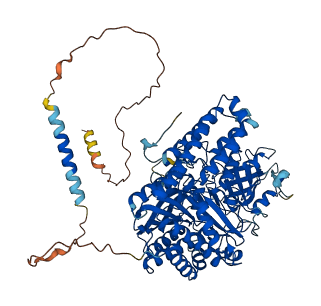
Descriptions
The autoinhibited protein was predicted that may have potential autoinhibitory elements via cis-regPred.
Autoinhibitory domains (AIDs)
Target domain |
|
Relief mechanism |
|
Assay |
cis-regPred |
Accessory elements
No accessory elements
Autoinhibited structure

Activated structure
1 structures for Q62351
| Entry ID | Method | Resolution | Chain | Position | Source |
|---|---|---|---|---|---|
| AF-Q62351-F1 | Predicted | AlphaFoldDB |
29 variants for Q62351
| Variant ID(s) | Position | Change | Description | Diseaes Association | Provenance |
|---|---|---|---|---|---|
| rs3407134390 | 78 | L>F | No | EVA | |
| rs3389360126 | 106 | E>V | No | EVA | |
| rs3389393123 | 196 | S>G | No | EVA | |
| rs3389405462 | 197 | S>T | No | EVA | |
| rs261617662 | 199 | G>D | No | EVA | |
| rs3389360162 | 204 | T>A | No | EVA | |
| rs3389405809 | 213 | D>Y | No | EVA | |
| rs3389419420 | 220 | G>A | No | EVA | |
| rs231298924 | 228 | T>A | No | EVA | |
| rs250782081 | 229 | E>D | No | EVA | |
| rs3389360124 | 307 | T>S | No | EVA | |
| rs3389405766 | 323 | F>I | No | EVA | |
| rs46927501 | 354 | S>N | No | EVA | |
| rs47731231 | 357 | A>T | No | EVA | |
| rs3406483175 | 371 | Q>* | No | EVA | |
| rs233535660 | 378 | I>T | No | EVA | |
| rs3389402156 | 384 | K>N | No | EVA | |
| rs3389372470 | 413 | A>T | No | EVA | |
| rs3389405782 | 436 | F>S | No | EVA | |
| rs3389421189 | 569 | L>V | No | EVA | |
| rs3389379274 | 598 | G>D | No | EVA | |
| rs3389360125 | 601 | I>S | No | EVA | |
| rs3389419388 | 602 | I>F | No | EVA | |
| rs3389410271 | 605 | T>N | No | EVA | |
| rs250947368 | 608 | V>I | No | EVA | |
| rs226815330 | 616 | M>V | No | EVA | |
| rs3389414972 | 637 | D>E | No | EVA | |
| rs3389421172 | 658 | R>I | No | EVA | |
| rs3389427505 | 679 | D>E | No | EVA |
No associated diseases with Q62351
23 GO annotations of cellular component
| Name | Definition |
|---|---|
| basolateral plasma membrane | The region of the plasma membrane that includes the basal end and sides of the cell. Often used in reference to animal polarized epithelial membranes, where the basal membrane is the part attached to the extracellular matrix, or in plant cells, where the basal membrane is defined with respect to the zygotic axis. |
| cell surface | The external part of the cell wall and/or plasma membrane. |
| clathrin-coated pit | A part of the endomembrane system in the form of an invagination of a membrane upon which a clathrin coat forms, and that can be converted by vesicle budding into a clathrin-coated vesicle. Coated pits form on the plasma membrane, where they are involved in receptor-mediated selective transport of many proteins and other macromolecules across the cell membrane, in the trans-Golgi network, and on some endosomes. |
| cytoplasm | The contents of a cell excluding the plasma membrane and nucleus, but including other subcellular structures. |
| cytoplasmic vesicle | A vesicle found in the cytoplasm of a cell. |
| early endosome | A membrane-bounded organelle that receives incoming material from primary endocytic vesicles that have been generated by clathrin-dependent and clathrin-independent endocytosis; vesicles fuse with the early endosome to deliver cargo for sorting into recycling or degradation pathways. |
| endosome | A vacuole to which materials ingested by endocytosis are delivered. |
| endosome membrane | The lipid bilayer surrounding an endosome. |
| external side of plasma membrane | The leaflet of the plasma membrane that faces away from the cytoplasm and any proteins embedded or anchored in it or attached to its surface. |
| extracellular exosome | A vesicle that is released into the extracellular region by fusion of the limiting endosomal membrane of a multivesicular body with the plasma membrane. Extracellular exosomes, also simply called exosomes, have a diameter of about 40-100 nm. |
| extracellular region | The space external to the outermost structure of a cell. For cells without external protective or external encapsulating structures this refers to space outside of the plasma membrane. This term covers the host cell environment outside an intracellular parasite. |
| extracellular space | That part of a multicellular organism outside the cells proper, usually taken to be outside the plasma membranes, and occupied by fluid. |
| HFE-transferrin receptor complex | A protein complex containing at least HFE and a transferrin receptor (either TFR1/TFRC or TFR2), proposed to play a role in the sensing of transferrin-bound Fe (Fe2-Tf) on the plasma membrane to regulate hepcidin transcription. |
| integral component of plasma membrane | The component of the plasma membrane consisting of the gene products and protein complexes having at least some part of their peptide sequence embedded in the hydrophobic region of the membrane. |
| intracellular membrane-bounded organelle | Organized structure of distinctive morphology and function, bounded by a single or double lipid bilayer membrane and occurring within the cell. Includes the nucleus, mitochondria, plastids, vacuoles, and vesicles. Excludes the plasma membrane. |
| melanosome | A tissue-specific, membrane-bounded cytoplasmic organelle within which melanin pigments are synthesized and stored. Melanosomes are synthesized in melanocyte cells. |
| membrane | A lipid bilayer along with all the proteins and protein complexes embedded in it an attached to it. |
| mitochondrion | A semiautonomous, self replicating organelle that occurs in varying numbers, shapes, and sizes in the cytoplasm of virtually all eukaryotic cells. It is notably the site of tissue respiration. |
| nucleus | A membrane-bounded organelle of eukaryotic cells in which chromosomes are housed and replicated. In most cells, the nucleus contains all of the cell's chromosomes except the organellar chromosomes, and is the site of RNA synthesis and processing. In some species, or in specialized cell types, RNA metabolism or DNA replication may be absent. |
| perinuclear region of cytoplasm | Cytoplasm situated near, or occurring around, the nucleus. |
| plasma membrane | The membrane surrounding a cell that separates the cell from its external environment. It consists of a phospholipid bilayer and associated proteins. |
| recycling endosome | An organelle consisting of a network of tubules that functions in targeting molecules, such as receptors transporters and lipids, to the plasma membrane. |
| recycling endosome membrane | The lipid bilayer surrounding a recycling endosome. |
9 GO annotations of molecular function
| Name | Definition |
|---|---|
| chaperone binding | Binding to a chaperone protein, a class of proteins that bind to nascent or unfolded polypeptides and ensure correct folding or transport. |
| double-stranded RNA binding | Binding to double-stranded RNA. |
| Hsp70 protein binding | Binding to a Hsp70 protein, heat shock proteins around 70kDa in size. |
| identical protein binding | Binding to an identical protein or proteins. |
| iron ion transmembrane transporter activity | Enables the transfer of iron (Fe) ions from one side of a membrane to the other. |
| protein homodimerization activity | Binding to an identical protein to form a homodimer. |
| protein kinase binding | Binding to a protein kinase, any enzyme that catalyzes the transfer of a phosphate group, usually from ATP, to a protein substrate. |
| protein-containing complex binding | Binding to a macromolecular complex. |
| transferrin receptor activity | Combining selectively with transferrin, and delivering transferrin into the cell via endocytosis. Transferrin is a major iron carrier protein in vertebrates. |
30 GO annotations of biological process
| Name | Definition |
|---|---|
| acute-phase response | An acute inflammatory response that involves non-antibody proteins whose concentrations in the plasma increase in response to infection or injury of homeothermic animals. |
| aging | A developmental process that is a deterioration and loss of function over time. Aging includes loss of functions such as resistance to disease, homeostasis, and fertility, as well as wear and tear. Aging includes cellular senescence, but is more inclusive. May precede death and may succeed developmental maturation (GO:0021700). |
| cellular iron ion homeostasis | Any process involved in the maintenance of an internal steady state of iron ions at the level of a cell. |
| cellular response to extracellular stimulus | Any process that results in a change in state or activity of a cell (in terms of movement, secretion, enzyme production, gene expression, etc.) as a result of an extracellular stimulus. |
| cellular response to iron ion | Any process that results in a change in state or activity of a cell (in terms of movement, secretion, enzyme production, gene expression, etc.) as a result of an iron ion stimulus. |
| cellular response to leukemia inhibitory factor | Any process that results in a change in state or activity of a cell (in terms of movement, secretion, enzyme production, gene expression, etc.) as a result of a leukemia inhibitory factor stimulus. |
| cellular response to xenobiotic stimulus | Any process that results in a change in state or activity of a cell (in terms of movement, secretion, enzyme production, gene expression, etc.) as a result of a stimulus from a xenobiotic, a compound foreign to the organism exposed to it. It may be synthesized by another organism (like ampicilin) or it can be a synthetic chemical. |
| intracellular signal transduction | The process in which a signal is passed on to downstream components within the cell, which become activated themselves to further propagate the signal and finally trigger a change in the function or state of the cell. |
| iron ion transport | The directed movement of iron (Fe) ions into, out of or within a cell, or between cells, by means of some agent such as a transporter or pore. |
| negative regulation of apoptotic process | Any process that stops, prevents, or reduces the frequency, rate or extent of cell death by apoptotic process. |
| negative regulation of mitochondrial fusion | Any process that decreases the frequency, rate or extent of merging of two or more mitochondria within a cell to form a single compartment. |
| osteoclast differentiation | The process in which a relatively unspecialized monocyte acquires the specialized features of an osteoclast. An osteoclast is a specialized phagocytic cell associated with the absorption and removal of the mineralized matrix of bone tissue. |
| positive regulation of B cell proliferation | Any process that activates or increases the rate or extent of B cell proliferation. |
| positive regulation of bone resorption | Any process that activates or increases the frequency, rate or extent of bone resorption. |
| positive regulation of gene expression | Any process that increases the frequency, rate or extent of gene expression. Gene expression is the process in which a gene's coding sequence is converted into a mature gene product (protein or RNA). |
| positive regulation of I-kappaB kinase/NF-kappaB signaling | Any process that activates or increases the frequency, rate or extent of I-kappaB kinase/NF-kappaB signaling. |
| positive regulation of isotype switching | Any process that activates or increases the frequency, rate or extent of isotype switching. |
| positive regulation of NF-kappaB transcription factor activity | Any process that activates or increases the frequency, rate or extent of activity of the transcription factor NF-kappaB. |
| positive regulation of peptidyl-serine phosphorylation | Any process that activates or increases the frequency, rate or extent of the phosphorylation of peptidyl-serine. |
| positive regulation of protein localization to nucleus | Any process that activates or increases the frequency, rate or extent of protein localization to nucleus. |
| positive regulation of protein phosphorylation | Any process that activates or increases the frequency, rate or extent of addition of phosphate groups to amino acids within a protein. |
| positive regulation of protein-containing complex assembly | Any process that activates or increases the frequency, rate or extent of protein complex assembly. |
| positive regulation of T cell proliferation | Any process that activates or increases the rate or extent of T cell proliferation. |
| receptor internalization | A receptor-mediated endocytosis process that results in the movement of receptors from the plasma membrane to the inside of the cell. The process begins when cell surface receptors are monoubiquitinated following ligand-induced activation. Receptors are subsequently taken up into endocytic vesicles from where they are either targeted to the lysosome or vacuole for degradation or recycled back to the plasma membrane. |
| response to copper ion | Any process that results in a change in state or activity of a cell or an organism (in terms of movement, secretion, enzyme production, gene expression, etc.) as a result of a copper ion stimulus. |
| response to hypoxia | Any process that results in a change in state or activity of a cell or an organism (in terms of movement, secretion, enzyme production, gene expression, etc.) as a result of a stimulus indicating lowered oxygen tension. Hypoxia, defined as a decline in O2 levels below normoxic levels of 20.8 - 20.95%, results in metabolic adaptation at both the cellular and organismal level. |
| response to manganese ion | Any process that results in a change in state or activity of a cell or an organism (in terms of movement, secretion, enzyme production, gene expression, etc.) as a result of a manganese ion stimulus. |
| response to nutrient | Any process that results in a change in state or activity of a cell or an organism (in terms of movement, secretion, enzyme production, gene expression, etc.) as a result of a nutrient stimulus. |
| response to retinoic acid | Any process that results in a change in state or activity of a cell or an organism (in terms of movement, secretion, enzyme production, gene expression, etc.) as a result of a retinoic acid stimulus. |
| transferrin transport | The directed movement of transferrin into, out of or within a cell, or between cells, by means of some agent such as a transporter or pore. |
3 homologous proteins in AiPD
| UniProt AC | Gene Name | Protein Name | Species | Evidence Code |
|---|---|---|---|---|
| Q9MYZ3 | TFRC | Transferrin receptor protein 1 | Felis catus (Cat) (Felis silvestris catus) | PR |
| Q9GLD3 | TFRC | Transferrin receptor protein 1 | Canis lupus familiaris (Dog) (Canis familiaris) | PR |
| Q2V905 | TFRC | Transferrin receptor protein 1 | Equus caballus (Horse) | PR |
| 10 | 20 | 30 | 40 | 50 | 60 |
| MMDQARSAFS | NLFGGEPLSY | TRFSLARQVD | GDNSHVEMKL | AADEEENADN | NMKASVRKPK |
| 70 | 80 | 90 | 100 | 110 | 120 |
| RFNGRLCFAA | IALVIFFLIG | FMSGYLGYCK | RVEQKEECVK | LAETEETDKS | ETMETEDVPT |
| 130 | 140 | 150 | 160 | 170 | 180 |
| SSRLYWADLK | TLLSEKLNSI | EFADTIKQLS | QNTYTPREAG | SQKDESLAYY | IENQFHEFKF |
| 190 | 200 | 210 | 220 | 230 | 240 |
| SKVWRDEHYV | KIQVKSSIGQ | NMVTIVQSNG | NLDPVESPEG | YVAFSKPTEV | SGKLVHANFG |
| 250 | 260 | 270 | 280 | 290 | 300 |
| TKKDFEELSY | SVNGSLVIVR | AGEITFAEKV | ANAQSFNAIG | VLIYMDKNKF | PVVEADLALF |
| 310 | 320 | 330 | 340 | 350 | 360 |
| GHAHLGTGDP | YTPGFPSFNH | TQFPPSQSSG | LPNIPVQTIS | RAAAEKLFGK | MEGSCPARWN |
| 370 | 380 | 390 | 400 | 410 | 420 |
| IDSSCKLELS | QNQNVKLIVK | NVLKERRILN | IFGVIKGYEE | PDRYVVVGAQ | RDALGAGVAA |
| 430 | 440 | 450 | 460 | 470 | 480 |
| KSSVGTGLLL | KLAQVFSDMI | SKDGFRPSRS | IIFASWTAGD | FGAVGATEWL | EGYLSSLHLK |
| 490 | 500 | 510 | 520 | 530 | 540 |
| AFTYINLDKV | VLGTSNFKVS | ASPLLYTLMG | KIMQDVKHPV | DGKSLYRDSN | WISKVEKLSF |
| 550 | 560 | 570 | 580 | 590 | 600 |
| DNAAYPFLAY | SGIPAVSFCF | CEDADYPYLG | TRLDTYEALT | QKVPQLNQMV | RTAAEVAGQL |
| 610 | 620 | 630 | 640 | 650 | 660 |
| IIKLTHDVEL | NLDYEMYNSK | LLSFMKDLNQ | FKTDIRDMGL | SLQWLYSARG | DYFRATSRLT |
| 670 | 680 | 690 | 700 | 710 | 720 |
| TDFHNAEKTN | RFVMREINDR | IMKVEYHFLS | PYVSPRESPF | RHIFWGSGSH | TLSALVENLK |
| 730 | 740 | 750 | 760 | ||
| LRQKNITAFN | ETLFRNQLAL | ATWTIQGVAN | ALSGDIWNID | NEF |