Q62296
Gene name |
Tead4 (Tcf13r1, Tef3, Tefr1) |
Protein name |
Transcriptional enhancer factor TEF-3 |
Names |
ETF-related factor 2, ETFR-2, TEA domain family member 4, TEAD-4, TEF-1-related factor 1, TEF-1-related factor FR-19, RTEF-1 |
Species |
Mus musculus (Mouse) |
KEGG Pathway |
mmu:21679 |
EC number |
|
Protein Class |
|
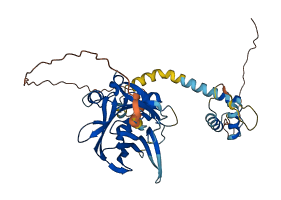
Descriptions
The autoinhibited protein was predicted that may have potential autoinhibitory elements via cis-regPred.
Autoinhibitory domains (AIDs)
Target domain |
|
Relief mechanism |
|
Assay |
cis-regPred |
Accessory elements
No accessory elements
Autoinhibited structure

Activated structure
8 structures for Q62296
| Entry ID | Method | Resolution | Chain | Position | Source |
|---|---|---|---|---|---|
| 3JUA | X-ray | 300 A | A/C/E/G | 210-427 | PDB |
| 4LN0 | X-ray | 290 A | A/B | 209-427 | PDB |
| 5GN0 | X-ray | 290 A | A/B/C/D | 210-427 | PDB |
| 5XJD | X-ray | 222 A | A/B | 210-427 | PDB |
| 5Z2Q | X-ray | 274 A | A/B | 210-427 | PDB |
| 6L9F | X-ray | 256 A | A/B | 209-427 | PDB |
| 6SBA | X-ray | 130 A | A | 209-427 | PDB |
| AF-Q62296-F1 | Predicted | AlphaFoldDB |
23 variants for Q62296
| Variant ID(s) | Position | Change | Description | Diseaes Association | Provenance |
|---|---|---|---|---|---|
| rs3397339754 | 10 | D>G | No | EVA | |
| rs3388844984 | 14 | G>E | No | EVA | |
| rs3388861090 | 20 | G>D | No | EVA | |
| rs3388860048 | 31 | D>G | No | EVA | |
| rs3388869321 | 34 | G>A | No | EVA | |
| rs3388844990 | 50 | I>F | No | EVA | |
| rs3397339804 | 50 | I>M | No | EVA | |
| rs3397347435 | 62 | T>P | No | EVA | |
| rs3388861356 | 81 | R>M | No | EVA | |
| rs3388856625 | 118 | K>E | No | EVA | |
| rs3388865890 | 125 | A>V | No | EVA | |
| rs3388865937 | 136 | A>T | No | EVA | |
| rs3388853322 | 173 | F>L | No | EVA | |
| rs3388839750 | 181 | Q>R | No | EVA | |
| rs3388865210 | 183 | P>L | No | EVA | |
| rs3397316067 | 189 | F>L | No | EVA | |
| rs3397105880 | 189 | F>S | No | EVA | |
| rs3397404769 | 191 | S>T | No | EVA | |
| rs3397338792 | 193 | A>E | No | EVA | |
| rs31787718 | 206 | P>L | No | EVA | |
| rs3397316066 | 238 | H>Q | No | EVA | |
| rs3397338808 | 239 | L>V | No | EVA | |
| rs3413120412 | 428 | E>R | No | EVA |
No associated diseases with Q62296
5 GO annotations of cellular component
| Name | Definition |
|---|---|
| cytoplasm | The contents of a cell excluding the plasma membrane and nucleus, but including other subcellular structures. |
| nucleoplasm | That part of the nuclear content other than the chromosomes or the nucleolus. |
| nucleus | A membrane-bounded organelle of eukaryotic cells in which chromosomes are housed and replicated. In most cells, the nucleus contains all of the cell's chromosomes except the organellar chromosomes, and is the site of RNA synthesis and processing. In some species, or in specialized cell types, RNA metabolism or DNA replication may be absent. |
| protein-DNA complex | A macromolecular complex containing both protein and DNA molecules. |
| transcription regulator complex | A protein complex that is capable of associating with DNA by direct binding, or via other DNA-binding proteins or complexes, and regulating transcription. |
6 GO annotations of molecular function
| Name | Definition |
|---|---|
| DNA binding | Any molecular function by which a gene product interacts selectively and non-covalently with DNA (deoxyribonucleic acid). |
| DNA-binding transcription activator activity, RNA polymerase II-specific | A DNA-binding transcription factor activity that activates or increases transcription of specific gene sets transcribed by RNA polymerase II. |
| DNA-binding transcription factor activity | A transcription regulator activity that modulates transcription of gene sets via selective and non-covalent binding to a specific double-stranded genomic DNA sequence (sometimes referred to as a motif) within a cis-regulatory region. Regulatory regions include promoters (proximal and distal) and enhancers. Genes are transcriptional units, and include bacterial operons. |
| DNA-binding transcription factor activity, RNA polymerase II-specific | A DNA-binding transcription factor activity that modulates the transcription of specific gene sets transcribed by RNA polymerase II. |
| RNA polymerase II cis-regulatory region sequence-specific DNA binding | Binding to a specific upstream regulatory DNA sequence (transcription factor recognition sequence or binding site) located in cis relative to the transcription start site (i.e., on the same strand of DNA) of a gene transcribed by RNA polymerase II. |
| sequence-specific DNA binding | Binding to DNA of a specific nucleotide composition, e.g. GC-rich DNA binding, or with a specific sequence motif or type of DNA e.g. promotor binding or rDNA binding. |
12 GO annotations of biological process
| Name | Definition |
|---|---|
| blastocyst formation | The initial formation of a blastocyst from a solid ball of cells known as a morula. |
| cell fate commitment | The commitment of cells to specific cell fates and their capacity to differentiate into particular kinds of cells. Positional information is established through protein signals that emanate from a localized source within a cell (the initial one-cell zygote) or within a developmental field. |
| cell fate specification | The process involved in the specification of cell identity. Once specification has taken place, a cell will be committed to differentiate down a specific pathway if left in its normal environment. |
| embryo implantation | Attachment of the blastocyst to the uterine lining. |
| embryonic organ development | Development, taking place during the embryonic phase, of a tissue or tissues that work together to perform a specific function or functions. Development pertains to the process whose specific outcome is the progression of a structure over time, from its formation to the mature structure. Organs are commonly observed as visibly distinct structures, but may also exist as loosely associated clusters of cells that work together to perform a specific function or functions. |
| hippo signaling | The series of molecular signals mediated by the serine/threonine kinase Hippo or one of its orthologs. In Drosophila, Hippo in complex with the scaffold protein Salvador (Sav), phosphorylates and activates Warts (Wts), which in turn phosphorylates and inactivates the Yorkie (Yki) transcriptional activator. The core fly components hippo, sav, wts and mats are conserved in mammals as STK4/3 (MST1/2), SAV1/WW45, LATS1/2 and MOB1. |
| in utero embryonic development | The process whose specific outcome is the progression of the embryo in the uterus over time, from formation of the zygote in the oviduct, to birth. An example of this process is found in Mus musculus. |
| positive regulation of DNA-templated transcription | Any process that activates or increases the frequency, rate or extent of cellular DNA-templated transcription. |
| positive regulation of stem cell population maintenance | Any process that activates or increases the frequency, rate or extent of stem cell population maintenance. |
| positive regulation of transcription by RNA polymerase II | Any process that activates or increases the frequency, rate or extent of transcription from an RNA polymerase II promoter. |
| regulation of transcription by RNA polymerase II | Any process that modulates the frequency, rate or extent of transcription mediated by RNA polymerase II. |
| trophectodermal cell fate commitment | The cell fate commitment of precursor cells that will become trophectoderm cells. |
| 10 | 20 | 30 | 40 | 50 | 60 |
| MTSNEWSSPD | SPEGSSISGG | SQALDKPIDN | DAEGVWSPEI | ERSFQEALAI | YPPCGRRKII |
| 70 | 80 | 90 | 100 | 110 | 120 |
| LTEEGKMYGR | NELIARHIKL | RTGKTRTRKQ | VSSHIQVLAR | RKAREIQAKL | KDQAAKNKAL |
| 130 | 140 | 150 | 160 | 170 | 180 |
| QSMAAMSSAQ | IVSATAFHSK | MALARGPGYP | AISGFWQGAL | PGQPGTSHDV | KPFSQNTYPV |
| 190 | 200 | 210 | 220 | 230 | 240 |
| QPPLPLPGFE | SPAGPTPSPS | APLAPPWQGR | SIASSKLWML | EFSAFLERQQ | DPDTYNKHLF |
| 250 | 260 | 270 | 280 | 290 | 300 |
| VHISQSSPSY | SDPYLETVDI | RQIYDKFPEK | KGGLKELFER | GPSNAFFLVK | FWADLNTNID |
| 310 | 320 | 330 | 340 | 350 | 360 |
| DEGSAFYGVS | SQYESPENMI | ITCSTKVCSF | GKQVVEKVET | EYARYENGHY | LYRIHRSPLC |
| 370 | 380 | 390 | 400 | 410 | 420 |
| EYMINFIHKL | KHLPEKYMMN | SVLENFTILQ | VVTNRDTQET | LLCIAYVFEV | SASEHGAQHH |
| IYRLVKE |