Q61730
Gene name |
Il1rap |
Protein name |
Interleukin-1 receptor accessory protein |
Names |
IL-1 receptor accessory protein, IL-1RAcP, Interleukin-33 receptot beta chain |
Species |
Mus musculus (Mouse) |
KEGG Pathway |
mmu:16180 |
EC number |
3.2.2.6: Hydrolyzing N-glycosyl compounds |
Protein Class |
|
Descriptions
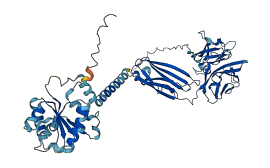
The autoinhibited protein was predicted that may have potential autoinhibitory elements via cis-regPred.
Autoinhibitory domains (AIDs)
Target domain |
|
Relief mechanism |
|
Assay |
cis-regPred |
Accessory elements
No accessory elements
Autoinhibited structure

Activated structure
3 structures for Q61730
| Entry ID | Method | Resolution | Chain | Position | Source |
|---|---|---|---|---|---|
| 4YFD | X-ray | 325 A | B | 21-351 | PDB |
| 5VI4 | X-ray | 279 A | C/F | 21-350 | PDB |
| AF-Q61730-F1 | Predicted | AlphaFoldDB |
28 variants for Q61730
| Variant ID(s) | Position | Change | Description | Diseaes Association | Provenance |
|---|---|---|---|---|---|
| rs3389370483 | 123 | S>R | No | EVA | |
| rs3405106178 | 160 | C>F | No | EVA | |
| rs3405106142 | 161 | P>A | No | EVA | |
| rs3405884437 | 161 | P>R | No | EVA | |
| rs3406826044 | 162 | N>H | No | EVA | |
| rs3389407715 | 184 | I>K | No | EVA | |
| rs3389413589 | 292 | V>I | No | EVA | |
| rs3389426691 | 328 | R>P | No | EVA | |
| rs3389419347 | 332 | C>Y | No | EVA | |
| rs251560257 | 346 | K>N | No | EVA | |
| rs864262171 | 383 | L>Q | No | EVA | |
| rs48051280 | 415 | V>A | No | EVA | |
| rs3389419318 | 426 | R>C | No | EVA | |
| rs3389413656 | 433 | F>S | No | EVA | |
| rs864258719 | 438 | C>S | No | EVA | |
| rs3389370519 | 463 | R>G | No | EVA | |
| rs3389416188 | 467 | V>I | No | EVA | |
| rs3389377983 | 469 | S>N | No | EVA | |
| rs3389419346 | 476 | G>E | No | EVA | |
| rs3389359465 | 477 | T>S | No | EVA | |
| rs3389419280 | 523 | V>F | No | EVA | |
| rs3389389520 | 538 | F>Y | No | EVA | |
| rs3407091424 | 550 | K>N | No | EVA | |
| rs3389406591 | 554 | W>* | No | EVA | |
| rs3389400717 | 555 | S>F | No | EVA | |
| rs3389419866 | 560 | Q>R | No | EVA | |
| rs3389404958 | 567 | L>V | No | EVA | |
| rs3406779305 | 571 | V>L | No | EVA |
No associated diseases with Q61730
7 regional properties for Q61730
| Type | Name | Position | InterPro Accession |
|---|---|---|---|
| domain | Toll/interleukin-1 receptor homology (TIR) domain | 403 - 558 | IPR000157 |
| domain | Immunoglobulin subtype | 32 - 132 | IPR003599-1 |
| domain | Immunoglobulin subtype | 145 - 232 | IPR003599-2 |
| domain | Immunoglobulin subtype | 251 - 350 | IPR003599-3 |
| domain | Immunoglobulin-like domain | 158 - 230 | IPR007110-1 |
| domain | Immunoglobulin-like domain | 243 - 348 | IPR007110-2 |
| domain | IL-1Ra-like, immunoglobulin domain | 68 - 140 | IPR041416 |
Functions
| Description | ||
|---|---|---|
| EC Number | 3.2.2.6 | Hydrolyzing N-glycosyl compounds |
| Subcellular Localization |
|
|
| PANTHER Family | ||
| PANTHER Subfamily | ||
| PANTHER Protein Class | ||
| PANTHER Pathway Category | No pathway information available | |
6 GO annotations of cellular component
| Name | Definition |
|---|---|
| cytoplasm | The contents of a cell excluding the plasma membrane and nucleus, but including other subcellular structures. |
| extracellular region | The space external to the outermost structure of a cell. For cells without external protective or external encapsulating structures this refers to space outside of the plasma membrane. This term covers the host cell environment outside an intracellular parasite. |
| glutamatergic synapse | A synapse that uses glutamate as a neurotransmitter. |
| integral component of membrane | The component of a membrane consisting of the gene products and protein complexes having at least some part of their peptide sequence embedded in the hydrophobic region of the membrane. |
| plasma membrane | The membrane surrounding a cell that separates the cell from its external environment. It consists of a phospholipid bilayer and associated proteins. |
| protein-containing complex | A stable assembly of two or more macromolecules, i.e. proteins, nucleic acids, carbohydrates or lipids, in which at least one component is a protein and the constituent parts function together. |
5 GO annotations of molecular function
| Name | Definition |
|---|---|
| interleukin-1 receptor activity | Combining with interleukin-1 to initiate a change in cell activity. Interleukin-1 is produced mainly by activated macrophages and is involved in the inflammatory response. |
| interleukin-1 receptor binding | Binding to an interleukin-1 receptor. |
| interleukin-33 receptor activity | Combining with interleukin-33 and transmitting the signal from one side of the membrane to the other to initiate a change in cell activity. |
| NAD(P)+ nucleosidase activity | Catalysis of the reaction: NAD(P)+ + H2O = ADP-ribose(P) + nicotinamide. |
| NAD+ nucleotidase, cyclic ADP-ribose generating | Catalysis of the reaction: NAD+ + H2O = nicotinamide + ADP-ribose that proceeds in a stepwise fashion by ADP-ribosyl cyclase activity followed by cyclic ADP-ribose hydrolase activity. |
14 GO annotations of biological process
| Name | Definition |
|---|---|
| cytokine-mediated signaling pathway | The series of molecular signals initiated by the binding of a cytokine to a receptor on the surface of a cell, and ending with the regulation of a downstream cellular process, e.g. transcription. |
| inflammatory response | The immediate defensive reaction (by vertebrate tissue) to infection or injury caused by chemical or physical agents. The process is characterized by local vasodilation, extravasation of plasma into intercellular spaces and accumulation of white blood cells and macrophages. |
| innate immune response | Innate immune responses are defense responses mediated by germline encoded components that directly recognize components of potential pathogens. |
| interleukin-33-mediated signaling pathway | The series of molecular signals initiated by interleukin-33 binding to its receptor on the surface of a target cell, and ending with the regulation of a downstream cellular process, e.g. transcription. |
| positive regulation of interleukin-13 production | Any process that activates or increases the frequency, rate, or extent of interleukin-13 production. |
| positive regulation of interleukin-4 production | Any process that activates or increases the frequency, rate, or extent of interleukin-4 production. |
| positive regulation of interleukin-5 production | Any process that activates or increases the frequency, rate, or extent of interleukin-5 production. |
| positive regulation of interleukin-6 production | Any process that activates or increases the frequency, rate, or extent of interleukin-6 production. |
| positive regulation of NF-kappaB transcription factor activity | Any process that activates or increases the frequency, rate or extent of activity of the transcription factor NF-kappaB. |
| positive regulation of synapse assembly | Any process that activates, maintains or increases the frequency, rate or extent of synapse assembly, the aggregation, arrangement and bonding together of a set of components to form a synapse. |
| regulation of postsynaptic density assembly | Any process that modulates the frequency, rate or extent of postsynaptic density assembly, the aggregation, arrangement and bonding together of a set of components to form a postsynaptic density. |
| regulation of presynapse assembly | Any process that modulates the frequency, rate or extent of presynapse assembly. |
| synaptic membrane adhesion | The attachment of presynaptic membrane to postsynaptic membrane via adhesion molecules that are at least partially embedded in the plasma membrane. |
| trans-synaptic signaling by trans-synaptic complex | Cell-cell signaling between presynapse and postsynapse mediated by a trans-synaptic protein complex. |
4 homologous proteins in AiPD
| UniProt AC | Gene Name | Protein Name | Species | Evidence Code |
|---|---|---|---|---|
| Q9NPH3 | IL1RAP | Interleukin-1 receptor accessory protein | Homo sapiens (Human) | PR |
| Q9Z2B1 | Il18rap | Interleukin-18 receptor accessory protein | Mus musculus (Mouse) | PR |
| P13504 | Il1r1 | Interleukin-1 receptor type 1 | Mus musculus (Mouse) | PR |
| P14719 | Il1rl1 | Interleukin-1 receptor-like 1 | Mus musculus (Mouse) | PR |
| 10 | 20 | 30 | 40 | 50 | 60 |
| MGLLWYLMSL | SFYGILQSHA | SERCDDWGLD | TMRQIQVFED | EPARIKCPLF | EHFLKYNYST |
| 70 | 80 | 90 | 100 | 110 | 120 |
| AHSSGLTLIW | YWTRQDRDLE | EPINFRLPEN | RISKEKDVLW | FRPTLLNDTG | NYTCMLRNTT |
| 130 | 140 | 150 | 160 | 170 | 180 |
| YCSKVAFPLE | VVQKDSCFNS | AMRFPVHKMY | IEHGIHKITC | PNVDGYFPSS | VKPSVTWYKG |
| 190 | 200 | 210 | 220 | 230 | 240 |
| CTEIVDFHNV | LPEGMNLSFF | IPLVSNNGNY | TCVVTYPENG | RLFHLTRTVT | VKVVGSPKDA |
| 250 | 260 | 270 | 280 | 290 | 300 |
| LPPQIYSPND | RVVYEKEPGE | ELVIPCKVYF | SFIMDSHNEV | WWTIDGKKPD | DVTVDITINE |
| 310 | 320 | 330 | 340 | 350 | 360 |
| SVSYSSTEDE | TRTQILSIKK | VTPEDLRRNY | VCHARNTKGE | AEQAAKVKQK | VIPPRYTVEL |
| 370 | 380 | 390 | 400 | 410 | 420 |
| ACGFGATVFL | VVVLIVVYHV | YWLEMVLFYR | AHFGTDETIL | DGKEYDIYVS | YARNVEEEEF |
| 430 | 440 | 450 | 460 | 470 | 480 |
| VLLTLRGVLE | NEFGYKLCIF | DRDSLPGGIV | TDETLSFIQK | SRRLLVVLSP | NYVLQGTQAL |
| 490 | 500 | 510 | 520 | 530 | 540 |
| LELKAGLENM | ASRGNINVIL | VQYKAVKDMK | VKELKRAKTV | LTVIKWKGEK | SKYPQGRFWK |
| 550 | 560 | ||||
| QLQVAMPVKK | SPRWSSNDKQ | GLSYSSLKNV |