Q61235
Gene name |
Sntb2 (Snt2b2) |
Protein name |
Beta-2-syntrophin |
Names |
59 kDa dystrophin-associated protein A1 basic component 2, Syntrophin-3, SNT3, Syntrophin-like, SNTL |
Species |
Mus musculus (Mouse) |
KEGG Pathway |
mmu:20650 |
EC number |
|
Protein Class |
|
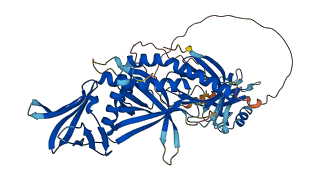
Descriptions
The autoinhibited protein was predicted that may have potential autoinhibitory elements via cis-regPred.
Autoinhibitory domains (AIDs)
Target domain |
|
Relief mechanism |
|
Assay |
cis-regPred |
Accessory elements
No accessory elements
Autoinhibited structure

Activated structure
1 structures for Q61235
| Entry ID | Method | Resolution | Chain | Position | Source |
|---|---|---|---|---|---|
| AF-Q61235-F1 | Predicted | AlphaFoldDB |
23 variants for Q61235
| Variant ID(s) | Position | Change | Description | Diseaes Association | Provenance |
|---|---|---|---|---|---|
| rs3399669582 | 104 | G>A | No | EVA | |
| rs3389007119 | 187 | P>T | No | EVA | |
| rs3389000500 | 204 | S>G | No | EVA | |
| rs3399560328 | 215 | K>* | No | EVA | |
| rs226217758 | 225 | V>I | No | EVA | |
| rs3389009853 | 267 | T>I | No | EVA | |
| rs3389000540 | 288 | A>T | No | EVA | |
| rs3399604835 | 288 | A>V | No | EVA | |
| rs3399392564 | 292 | A>G | No | EVA | |
| rs3389006096 | 296 | A>V | No | EVA | |
| rs3398649911 | 297 | T>A | No | EVA | |
| rs3389007057 | 298 | S>N | No | EVA | |
| rs3388985470 | 365 | V>F | No | EVA | |
| rs3389014847 | 385 | R>S | No | EVA | |
| rs3388989511 | 388 | S>P | No | EVA | |
| rs3389010105 | 394 | M>I | No | EVA | |
| rs3388985479 | 410 | R>I | No | EVA | |
| rs248714286 | 456 | A>T | No | EVA | |
| rs3389013982 | 475 | G>E | No | EVA | |
| rs3389011159 | 483 | F>L | No | EVA | |
| rs3389002102 | 492 | M>I | No | EVA | |
| rs3389002042 | 501 | I>N | No | EVA | |
| rs3388959992 | 512 | K>N | No | EVA |
No associated diseases with Q61235
4 regional properties for Q61235
| Type | Name | Position | InterPro Accession |
|---|---|---|---|
| domain | PDZ domain | 95 - 178 | IPR001478 |
| domain | Pleckstrin homology domain | 144 - 282 | IPR001849-1 |
| domain | Pleckstrin homology domain | 305 - 419 | IPR001849-2 |
| domain | Syntrophin, split Pleckstrin homology (PH) domain | 220 - 281 | IPR041428 |
Functions
10 GO annotations of cellular component
| Name | Definition |
|---|---|
| anchoring junction | A cell junction that mechanically attaches a cell (and its cytoskeleton) to neighboring cells or to the extracellular matrix. |
| cytoplasm | The contents of a cell excluding the plasma membrane and nucleus, but including other subcellular structures. |
| dystrophin-associated glycoprotein complex | A multiprotein complex that forms a strong mechanical link between the cytoskeleton and extracellular matrix; typical of, but not confined to, muscle cells. The complex is composed of transmembrane, cytoplasmic, and extracellular proteins, including dystrophin, sarcoglycans, dystroglycan, dystrobrevins, syntrophins, sarcospan, caveolin-3, and NO synthase. |
| Golgi apparatus | A membrane-bound cytoplasmic organelle of the endomembrane system that further processes the core oligosaccharides (e.g. N-glycans) added to proteins in the endoplasmic reticulum and packages them into membrane-bound vesicles. The Golgi apparatus operates at the intersection of the secretory, lysosomal, and endocytic pathways. |
| microtubule | Any of the long, generally straight, hollow tubes of internal diameter 12-15 nm and external diameter 24 nm found in a wide variety of eukaryotic cells; each consists (usually) of 13 protofilaments of polymeric tubulin, staggered in such a manner that the tubulin monomers are arranged in a helical pattern on the microtubular surface, and with the alpha/beta axes of the tubulin subunits parallel to the long axis of the tubule; exist in equilibrium with pool of tubulin monomers and can be rapidly assembled or disassembled in response to physiological stimuli; concerned with force generation, e.g. in the spindle. |
| nucleoplasm | That part of the nuclear content other than the chromosomes or the nucleolus. |
| plasma membrane | The membrane surrounding a cell that separates the cell from its external environment. It consists of a phospholipid bilayer and associated proteins. |
| protein-containing complex | A stable assembly of two or more macromolecules, i.e. proteins, nucleic acids, carbohydrates or lipids, in which at least one component is a protein and the constituent parts function together. |
| synapse | The junction between an axon of one neuron and a dendrite of another neuron, a muscle fiber or a glial cell. As the axon approaches the synapse it enlarges into a specialized structure, the presynaptic terminal bouton, which contains mitochondria and synaptic vesicles. At the tip of the terminal bouton is the presynaptic membrane; facing it, and separated from it by a minute cleft (the synaptic cleft) is a specialized area of membrane on the receiving cell, known as the postsynaptic membrane. In response to the arrival of nerve impulses, the presynaptic terminal bouton secretes molecules of neurotransmitters into the synaptic cleft. These diffuse across the cleft and transmit the signal to the postsynaptic membrane. |
| transport vesicle membrane | The lipid bilayer surrounding a transport vesicle. |
3 GO annotations of molecular function
| Name | Definition |
|---|---|
| actin binding | Binding to monomeric or multimeric forms of actin, including actin filaments. |
| calmodulin binding | Binding to calmodulin, a calcium-binding protein with many roles, both in the calcium-bound and calcium-free states. |
| structural molecule activity | The action of a molecule that contributes to the structural integrity of a complex or its assembly within or outside a cell. |
No GO annotations of biological process
| Name | Definition |
|---|---|
| No GO annotations for biological process |
| 10 | 20 | 30 | 40 | 50 | 60 |
| MAVWTRATKA | GLVELLLRER | WVRVVAELSG | ESLSLTGDAA | AVEPEPPAAA | FNGLPNGGGG |
| 70 | 80 | 90 | 100 | 110 | 120 |
| ESLPGSPNRG | LGPPSPPAPP | RGPAGEASAS | PPVRRVRVVK | QEAGGLGISI | KGGRENRMPI |
| 130 | 140 | 150 | 160 | 170 | 180 |
| LISKIFPGLA | ADQSRALRLG | DAILSVNGTD | LRQATHDQAV | QALKRAGKEV | LLEVKFIREV |
| 190 | 200 | 210 | 220 | 230 | 240 |
| TPYIKKPSLV | SDLPWEGASP | QSPSFSGSED | SGSPKHQNTT | KDRKVIPLKM | CFAARNLSMP |
| 250 | 260 | 270 | 280 | 290 | 300 |
| DLENRLIELH | SPDSRNTLIL | RCKDTATAHS | WFVAIHTNIM | ALLPQVLAEL | NAMLGATSTA |
| 310 | 320 | 330 | 340 | 350 | 360 |
| GGSKEVKHIA | WLAEQAKLDG | GRQQWRPVLM | AVTEKDLLLY | DCMPWTRDAW | ASPCHSYPLV |
| 370 | 380 | 390 | 400 | 410 | 420 |
| ATRLVHSGSG | CRSPSLGSDL | TFATRTGSRQ | GIEMHLFRVE | THRDLSTWTR | ILVQGCHAAA |
| 430 | 440 | 450 | 460 | 470 | 480 |
| ELIKEVSLGC | TLSGQEVRFT | VHYEHGFTIT | RDNGGASSIL | YRYPFERLKM | SADDGIRNLY |
| 490 | 500 | 510 | |||
| LDFGGPEGEL | TMDLHSCPKP | IVFVLHTFLS | AKVTRMGLLV |