Descriptions
The autoinhibited protein was predicted that may have potential autoinhibitory elements via cis-regPred.
Autoinhibitory domains (AIDs)
Target domain |
|
Relief mechanism |
|
Assay |
cis-regPred |
Accessory elements
No accessory elements
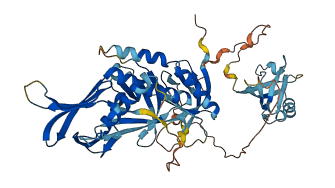
Autoinhibited structure

Activated structure
28 variants for Q61234
| Variant ID(s) | Position | Change | Description | Diseaes Association | Provenance |
|---|---|---|---|---|---|
| rs1134281423 | 100 | R>W | No | EVA | |
| rs3388604002 | 126 | G>V | No | EVA | |
| rs3388605294 | 135 | E>G | No | EVA | |
| rs3413020323 | 146 | V>I | No | EVA | |
| rs3388605223 | 165 | E>G | No | EVA | |
| rs3388600688 | 185 | P>S | No | EVA | |
| rs258873337 | 197 | G>V | No | EVA | |
| rs3388604061 | 232 | I>F | No | EVA | |
| rs3388605215 | 238 | Q>R | No | EVA | |
| rs247419025 | 263 | G>S | No | EVA | |
| rs3388603868 | 267 | P>S | No | EVA | |
| rs3388605130 | 279 | A>S | No | EVA | |
| rs255051067 | 304 | A>T | No | EVA | |
| rs3388594513 | 307 | L>M | No | EVA | |
| rs3388605255 | 316 | L>F | No | EVA | |
| rs3388606063 | 345 | R>M | No | EVA | |
| rs3388603524 | 372 | H>Q | No | EVA | |
| rs3388603508 | 391 | T>P | No | EVA | |
| rs3388605136 | 391 | T>S | No | EVA | |
| rs3388603588 | 404 | G>D | No | EVA | |
| rs13461839 | 405 | I>V | No | EVA | |
| rs3388600551 | 413 | T>K | No | EVA | |
| rs3388600583 | 416 | G>A | No | EVA | |
| rs3388600220 | 456 | D>H | No | EVA | |
| rs3388599649 | 463 | F>I | No | EVA | |
| rs3388596096 | 465 | D>E | No | EVA | |
| rs3388594496 | 467 | G>W | No | EVA | |
| rs3388606030 | 482 | K>I | No | EVA |
No associated diseases with Q61234
4 regional properties for Q61234
| Type | Name | Position | InterPro Accession |
|---|---|---|---|
| domain | PDZ domain | 81 - 164 | IPR001478 |
| domain | Pleckstrin homology domain | 7 - 265 | IPR001849-1 |
| domain | Pleckstrin homology domain | 287 - 401 | IPR001849-2 |
| domain | Syntrophin, split Pleckstrin homology (PH) domain | 203 - 264 | IPR041428 |
Functions
9 GO annotations of cellular component
| Name | Definition |
|---|---|
| anchoring junction | A cell junction that mechanically attaches a cell (and its cytoskeleton) to neighboring cells or to the extracellular matrix. |
| cytoplasm | The contents of a cell excluding the plasma membrane and nucleus, but including other subcellular structures. |
| cytoskeleton | A cellular structure that forms the internal framework of eukaryotic and prokaryotic cells. The cytoskeleton includes intermediate filaments, microfilaments, microtubules, the microtrabecular lattice, and other structures characterized by a polymeric filamentous nature and long-range order within the cell. The various elements of the cytoskeleton not only serve in the maintenance of cellular shape but also have roles in other cellular functions, including cellular movement, cell division, endocytosis, and movement of organelles. |
| dystrophin-associated glycoprotein complex | A multiprotein complex that forms a strong mechanical link between the cytoskeleton and extracellular matrix; typical of, but not confined to, muscle cells. The complex is composed of transmembrane, cytoplasmic, and extracellular proteins, including dystrophin, sarcoglycans, dystroglycan, dystrobrevins, syntrophins, sarcospan, caveolin-3, and NO synthase. |
| neuromuscular junction | The junction between the axon of a motor neuron and a muscle fiber. In response to the arrival of action potentials, the presynaptic button releases molecules of neurotransmitters into the synaptic cleft. These diffuse across the cleft and transmit the signal to the postsynaptic membrane of the muscle fiber, leading to a change in post-synaptic potential. |
| postsynaptic membrane | A specialized area of membrane facing the presynaptic membrane on the tip of the nerve ending and separated from it by a minute cleft (the synaptic cleft). Neurotransmitters cross the synaptic cleft and transmit the signal to the postsynaptic membrane. |
| protein-containing complex | A stable assembly of two or more macromolecules, i.e. proteins, nucleic acids, carbohydrates or lipids, in which at least one component is a protein and the constituent parts function together. |
| sarcolemma | The outer membrane of a muscle cell, consisting of the plasma membrane, a covering basement membrane (about 100 nm thick and sometimes common to more than one fiber), and the associated loose network of collagen fibers. |
| synapse | The junction between an axon of one neuron and a dendrite of another neuron, a muscle fiber or a glial cell. As the axon approaches the synapse it enlarges into a specialized structure, the presynaptic terminal bouton, which contains mitochondria and synaptic vesicles. At the tip of the terminal bouton is the presynaptic membrane; facing it, and separated from it by a minute cleft (the synaptic cleft) is a specialized area of membrane on the receiving cell, known as the postsynaptic membrane. In response to the arrival of nerve impulses, the presynaptic terminal bouton secretes molecules of neurotransmitters into the synaptic cleft. These diffuse across the cleft and transmit the signal to the postsynaptic membrane. |
8 GO annotations of molecular function
| Name | Definition |
|---|---|
| actin binding | Binding to monomeric or multimeric forms of actin, including actin filaments. |
| ATPase binding | Binding to an ATPase, any enzyme that catalyzes the hydrolysis of ATP. |
| calmodulin binding | Binding to calmodulin, a calcium-binding protein with many roles, both in the calcium-bound and calcium-free states. |
| nitric-oxide synthase binding | Binding to nitric-oxide synthase. |
| PDZ domain binding | Binding to a PDZ domain of a protein, a domain found in diverse signaling proteins. |
| sodium channel regulator activity | Binds to and modulates the activity of a sodium channel. |
| structural molecule activity | The action of a molecule that contributes to the structural integrity of a complex or its assembly within or outside a cell. |
| transmembrane transporter binding | Binding to a transmembrane transporter, a protein or protein complex that enables the transfer of a substance, usually a specific substance or a group of related substances, from one side of a membrane to the other. |
7 GO annotations of biological process
| Name | Definition |
|---|---|
| negative regulation of peptidyl-cysteine S-nitrosylation | Any process that stops, prevents or reduces the frequency, rate or extent of peptidyl-cysteine S-nitrosylation. |
| neuromuscular junction development | A process that is carried out at the cellular level which results in the assembly, arrangement of constituent parts, or disassembly of a neuromuscular junction. |
| regulation of heart rate | Any process that modulates the frequency or rate of heart contraction. |
| regulation of sodium ion transmembrane transport | Any process that modulates the frequency, rate or extent of sodium ion transmembrane transport. |
| regulation of vasoconstriction by circulating norepinephrine | Any process that modulates the frequency, rate or extent of reductions in the diameter of blood vessels as a result of secretion of norepinephrine into the bloodstream. |
| regulation of ventricular cardiac muscle cell membrane repolarization | Any process that modulates the establishment or extent of a membrane potential in the polarizing direction towards the resting potential in a ventricular cardiomyocyte. |
| ventricular cardiac muscle cell action potential | An action potential that occurs in a ventricular cardiac muscle cell. |
| 10 | 20 | 30 | 40 | 50 | 60 |
| MASGRRAPRT | GLLELRCGAG | SGAGGERWQR | VLLSLAEDAL | TVSPADGEPG | PEPEPAQLNG |
| 70 | 80 | 90 | 100 | 110 | 120 |
| AAEPGAAPPQ | LPEALLLQRR | RVTVRKADAG | GLGISIKGGR | ENKMPILISK | IFKGLAADQT |
| 130 | 140 | 150 | 160 | 170 | 180 |
| EALFVGDAIL | SVNGEDLSSA | THDEAVQALK | KTGKEVVLEV | KYMKEVSPYF | KNSAGGTSVG |
| 190 | 200 | 210 | 220 | 230 | 240 |
| WDSPPASPLQ | RQPSSPGPQP | RNLSEAKHVS | LKMAYVSRRC | TPTDPEPRYL | EICAADGQDA |
| 250 | 260 | 270 | 280 | 290 | 300 |
| VFLRAKDEAS | ARSWAGAIQA | QIGTFIPWVK | DELQALLTAT | GTAGSQDIKQ | IGWLTEQLPS |
| 310 | 320 | 330 | 340 | 350 | 360 |
| GGTAPTLALL | TEKELLFYCS | LPQSREALSR | PTRTAPLIAT | SSAHRLVHSG | PSKGSVPYDA |
| 370 | 380 | 390 | 400 | 410 | 420 |
| ELSFALRTGT | RHGVDTHLFS | VESPQELAAW | TRQLVDGCHR | AAEGIQEVST | ACTWNGRPCS |
| 430 | 440 | 450 | 460 | 470 | 480 |
| LSVHIDKGFT | LWAAEPGAAR | AMLLRQPFEK | LQMSSDDGTS | LLFLDFGGAE | GEIQLDLHSC |
| 490 | 500 | ||||
| PKTMVFIIHS | FLSAKVTRLG | LLA |