Q5XIC2
Gene name |
Ecsit |
Protein name |
Evolutionarily conserved signaling intermediate in Toll pathway, mitochondrial |
Names |
|
Species |
Rattus norvegicus (Rat) |
KEGG Pathway |
rno:300447 |
EC number |
|
Protein Class |
|
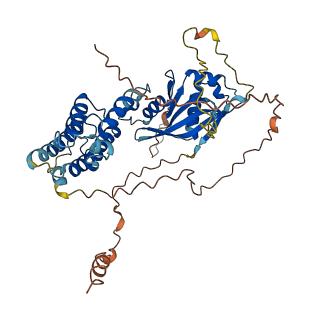
Descriptions
The autoinhibited protein was predicted that may have potential autoinhibitory elements via cis-regPred.
Autoinhibitory domains (AIDs)
Target domain |
|
Relief mechanism |
|
Assay |
cis-regPred |
Accessory elements
No accessory elements
Autoinhibited structure

Activated structure
1 structures for Q5XIC2
| Entry ID | Method | Resolution | Chain | Position | Source |
|---|---|---|---|---|---|
| AF-Q5XIC2-F1 | Predicted | AlphaFoldDB |
1 variants for Q5XIC2
| Variant ID(s) | Position | Change | Description | Diseaes Association | Provenance |
|---|---|---|---|---|---|
| rs197442647 | 24 | V>A | No | EVA |
No associated diseases with Q5XIC2
6 GO annotations of cellular component
| Name | Definition |
|---|---|
| cytoplasm | The contents of a cell excluding the plasma membrane and nucleus, but including other subcellular structures. |
| cytosol | The part of the cytoplasm that does not contain organelles but which does contain other particulate matter, such as protein complexes. |
| mitochondrion | A semiautonomous, self replicating organelle that occurs in varying numbers, shapes, and sizes in the cytoplasm of virtually all eukaryotic cells. It is notably the site of tissue respiration. |
| nucleoplasm | That part of the nuclear content other than the chromosomes or the nucleolus. |
| nucleus | A membrane-bounded organelle of eukaryotic cells in which chromosomes are housed and replicated. In most cells, the nucleus contains all of the cell's chromosomes except the organellar chromosomes, and is the site of RNA synthesis and processing. In some species, or in specialized cell types, RNA metabolism or DNA replication may be absent. |
| transcription regulator complex | A protein complex that is capable of associating with DNA by direct binding, or via other DNA-binding proteins or complexes, and regulating transcription. |
2 GO annotations of molecular function
| Name | Definition |
|---|---|
| chromatin binding | Binding to chromatin, the network of fibers of DNA, protein, and sometimes RNA, that make up the chromosomes of the eukaryotic nucleus during interphase. |
| DNA-binding transcription factor activity | A transcription regulator activity that modulates transcription of gene sets via selective and non-covalent binding to a specific double-stranded genomic DNA sequence (sometimes referred to as a motif) within a cis-regulatory region. Regulatory regions include promoters (proximal and distal) and enhancers. Genes are transcriptional units, and include bacterial operons. |
7 GO annotations of biological process
| Name | Definition |
|---|---|
| BMP signaling pathway | The series of molecular signals initiated by the binding of a member of the BMP (bone morphogenetic protein) family to a receptor on the surface of a target cell, and ending with the regulation of a downstream cellular process, e.g. transcription. |
| innate immune response | Innate immune responses are defense responses mediated by germline encoded components that directly recognize components of potential pathogens. |
| mesoderm formation | The process that gives rise to the mesoderm. This process pertains to the initial formation of the structure from unspecified parts. |
| regulation of oxidoreductase activity | Any process that modulates the frequency, rate or extent of oxidoreductase activity, the catalysis of an oxidation-reduction (redox) reaction, a reversible chemical reaction in which the oxidation state of an atom or atoms within a molecule is altered. One substrate acts as a hydrogen or electron donor and becomes oxidized, while the other acts as hydrogen or electron acceptor and becomes reduced. |
| regulation of protein complex stability | Any process that affects the structure and integrity of a protein complex by altering the likelihood of its assembly or disassembly. |
| regulation of transcription by RNA polymerase II | Any process that modulates the frequency, rate or extent of transcription mediated by RNA polymerase II. |
| transmembrane receptor protein serine/threonine kinase signaling pathway | The series of molecular signals initiated by an extracellular ligand binding to a receptor on the surface of the target cell where the receptor possesses serine/threonine kinase activity, and ending with the regulation of a downstream cellular process, e.g. transcription. |
3 homologous proteins in AiPD
| UniProt AC | Gene Name | Protein Name | Species | Evidence Code |
|---|---|---|---|---|
| Q3SX05 | ECSIT | Evolutionarily conserved signaling intermediate in Toll pathway, mitochondrial | Bos taurus (Bovine) | PR |
| Q9QZH6 | Ecsit | Evolutionarily conserved signaling intermediate in Toll pathway, mitochondrial | Mus musculus (Mouse) | PR |
| Q08CK1 | ecsit | Evolutionarily conserved signaling intermediate in Toll pathway, mitochondrial | Danio rerio (Zebrafish) (Brachydanio rerio) | PR |
| 10 | 20 | 30 | 40 | 50 | 60 |
| MSWVQVNLLA | RGLSRGWGSI | CRTVLSGTPF | AQPSLQARGL | HCSAVTHKDD | VWLVPRPSEP |
| 70 | 80 | 90 | 100 | 110 | 120 |
| QKKPIKVPAM | HEDLFRPSGN | GEQDKASFLN | AVRSFGEHNV | RKRGHVDFIY | LALRKMPEFG |
| 130 | 140 | 150 | 160 | 170 | 180 |
| VERDLSVYNL | LLDVFPKEVF | RPRNAIQRIF | VHYPRQQECG | VAVLEQMERH | GVMPNTETEF |
| 190 | 200 | 210 | 220 | 230 | 240 |
| LLIQVFGHKS | YPMLKFLRMK | LWFTRFKNIN | PYPVPRDLPQ | DPLDLAKLGL | RHMEPDLSAK |
| 250 | 260 | 270 | 280 | 290 | 300 |
| VTVYQMSLPS | ESTGIEDPTQ | PHIVGIQSPD | QQAALARHNP | SRPVFVEGPF | PLWLRNKCVY |
| 310 | 320 | 330 | 340 | 350 | 360 |
| YHILRADLPP | PEEETVEEIP | EEWNLYYPMQ | LDLEYSRSAW | DNYEFDMDEV | TEGPVFAMCM |
| 370 | 380 | 390 | 400 | 410 | 420 |
| TGAHDQATLV | KWIQGLQETN | PTLAQIPVVF | RLARSTGELL | ATTRLEGQSP | PHSPPKGPEE |
| 430 | |||||
| DDEAIQAQQR | QGQS |