Q5U349
Gene name |
Usp2 (Ubp41, Ubp69) |
Protein name |
Ubiquitin carboxyl-terminal hydrolase 2 |
Names |
41 kDa ubiquitin-specific protease, Deubiquitinating enzyme 2, Ubiquitin thioesterase 2, Ubiquitin-specific-processing protease 2, Ubiquitin-specific-processing protease testis, UBP-t |
Species |
Rattus norvegicus (Rat) |
KEGG Pathway |
rno:115771 |
EC number |
3.4.19.12: Omega peptidases |
Protein Class |
|
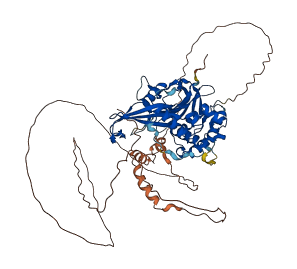
Descriptions
The autoinhibited protein was predicted that may have potential autoinhibitory elements via cis-regPred.
Autoinhibitory domains (AIDs)
Target domain |
|
Relief mechanism |
|
Assay |
cis-regPred |
Accessory elements
No accessory elements
Autoinhibited structure

Activated structure
1 structures for Q5U349
| Entry ID | Method | Resolution | Chain | Position | Source |
|---|---|---|---|---|---|
| AF-Q5U349-F1 | Predicted | AlphaFoldDB |
No variants for Q5U349
| Variant ID(s) | Position | Change | Description | Diseaes Association | Provenance |
|---|---|---|---|---|---|
| No variants for Q5U349 | |||||
No associated diseases with Q5U349
4 regional properties for Q5U349
| Type | Name | Position | InterPro Accession |
|---|---|---|---|
| domain | Peptidase C19, ubiquitin carboxyl-terminal hydrolase | 281 - 609 | IPR001394 |
| conserved_site | Ubiquitin specific protease, conserved site | 281 - 296 | IPR018200-1 |
| conserved_site | Ubiquitin specific protease, conserved site | 554 - 571 | IPR018200-2 |
| domain | Ubiquitin specific protease domain | 280 - 612 | IPR028889 |
Functions
| Description | ||
|---|---|---|
| EC Number | 3.4.19.12 | Omega peptidases |
| Subcellular Localization |
|
|
| PANTHER Family | ||
| PANTHER Subfamily | ||
| PANTHER Protein Class | ||
| PANTHER Pathway Category | No pathway information available | |
5 GO annotations of cellular component
| Name | Definition |
|---|---|
| centrosome | A structure comprised of a core structure (in most organisms, a pair of centrioles) and peripheral material from which a microtubule-based structure, such as a spindle apparatus, is organized. Centrosomes occur close to the nucleus during interphase in many eukaryotic cells, though in animal cells it changes continually during the cell-division cycle. |
| cytoplasm | The contents of a cell excluding the plasma membrane and nucleus, but including other subcellular structures. |
| membrane | A lipid bilayer along with all the proteins and protein complexes embedded in it an attached to it. |
| nucleus | A membrane-bounded organelle of eukaryotic cells in which chromosomes are housed and replicated. In most cells, the nucleus contains all of the cell's chromosomes except the organellar chromosomes, and is the site of RNA synthesis and processing. In some species, or in specialized cell types, RNA metabolism or DNA replication may be absent. |
| perinuclear region of cytoplasm | Cytoplasm situated near, or occurring around, the nucleus. |
5 GO annotations of molecular function
| Name | Definition |
|---|---|
| cyclin binding | Binding to cyclins, proteins whose levels in a cell varies markedly during the cell cycle, rising steadily until mitosis, then falling abruptly to zero. As cyclins reach a threshold level, they are thought to drive cells into G2 phase and thus to mitosis. |
| cysteine-type deubiquitinase activity | An thiol-dependent isopeptidase activity that cleaves ubiquitin from a target protein to which it is conjugated. |
| identical protein binding | Binding to an identical protein or proteins. |
| metal ion binding | Binding to a metal ion. |
| ubiquitin protein ligase binding | Binding to a ubiquitin protein ligase enzyme, any of the E3 proteins. |
14 GO annotations of biological process
| Name | Definition |
|---|---|
| cell cycle | The progression of biochemical and morphological phases and events that occur in a cell during successive cell replication or nuclear replication events. Canonically, the cell cycle comprises the replication and segregation of genetic material followed by the division of the cell, but in endocycles or syncytial cells nuclear replication or nuclear division may not be followed by cell division. |
| circadian behavior | The specific behavior of an organism that recurs with a regularity of approximately 24 hours. |
| circadian regulation of gene expression | Any process that modulates the frequency, rate or extent of gene expression such that an expression pattern recurs with a regularity of approximately 24 hours. |
| entrainment of circadian clock by photoperiod | The synchronization of a circadian rhythm to photoperiod, the intermittent cycle of light (day) and dark (night). |
| locomotor rhythm | The rhythm of the locomotor activity of an organism during its 24 hour activity cycle. |
| muscle organ development | The process whose specific outcome is the progression of the muscle over time, from its formation to the mature structure. The muscle is an organ consisting of a tissue made up of various elongated cells that are specialized to contract and thus to produce movement and mechanical work. |
| negative regulation of calcium ion transport | Any process that stops, prevents, or reduces the frequency, rate or extent of the directed movement of calcium ions into, out of or within a cell, or between cells, by means of some agent such as a transporter or pore. |
| negative regulation of skeletal muscle tissue development | Any process that stops, prevents, or reduces the frequency, rate or extent of skeletal muscle tissue development. |
| negative regulation of transcription by RNA polymerase II | Any process that stops, prevents, or reduces the frequency, rate or extent of transcription mediated by RNA polymerase II. |
| positive regulation of mitotic cell cycle | Any process that activates or increases the rate or extent of progression through the mitotic cell cycle. |
| positive regulation of skeletal muscle tissue development | Any process that activates, maintains or increases the rate of skeletal muscle tissue development. |
| protein deubiquitination | The removal of one or more ubiquitin groups from a protein. |
| protein stabilization | Any process involved in maintaining the structure and integrity of a protein and preventing it from degradation or aggregation. |
| ubiquitin-dependent protein catabolic process | The chemical reactions and pathways resulting in the breakdown of a protein or peptide by hydrolysis of its peptide bonds, initiated by the covalent attachment of a ubiquitin group, or multiple ubiquitin groups, to the protein. |
5 homologous proteins in AiPD
| UniProt AC | Gene Name | Protein Name | Species | Evidence Code |
|---|---|---|---|---|
| Q2KHV7 | USP2 | Ubiquitin carboxyl-terminal hydrolase 2 | Bos taurus (Bovine) | PR |
| P40818 | USP8 | Ubiquitin carboxyl-terminal hydrolase 8 | Homo sapiens (Human) | PR |
| O75604 | USP2 | Ubiquitin carboxyl-terminal hydrolase 2 | Homo sapiens (Human) | PR |
| Q80U87 | Usp8 | Ubiquitin carboxyl-terminal hydrolase 8 | Mus musculus (Mouse) | PR |
| O88623 | Usp2 | Ubiquitin carboxyl-terminal hydrolase 2 | Mus musculus (Mouse) | PR |
| 10 | 20 | 30 | 40 | 50 | 60 |
| MSQLSSTLKR | YTESSRYTDA | PYAKSGYGTY | TPSSYGANLA | ASFLEKEKLG | FKPVSPTSFL |
| 70 | 80 | 90 | 100 | 110 | 120 |
| PRPRTYGPSS | ILDCDRGRPL | LRSDITGGSK | RSESQTRGNE | RPSGSGLNGG | SGFPYGVTSN |
| 130 | 140 | 150 | 160 | 170 | 180 |
| SLSYLPMNAR | DQGVTLGQKK | SNSQSDLARD | FSSLRTSDSY | RTSDGYRASD | GFRIDPGNLG |
| 190 | 200 | 210 | 220 | 230 | 240 |
| RSPMLARTRK | ELCALQGLYQ | AASRSEYLTD | YLENYGRKGS | APQVLTQAPP | SRVPEVLSPT |
| 250 | 260 | 270 | 280 | 290 | 300 |
| YRPSGRYTLW | EKNKGQASGP | SRSTSPGRDT | MNSKSAQGLA | GLRNLGNTCF | MNSILQCLSN |
| 310 | 320 | 330 | 340 | 350 | 360 |
| TRELRDYCLQ | RLYMRDLGHT | SSAHTALMEE | FAKLIQTIWT | SSPNDVVSPS | EFKTQIQRYA |
| 370 | 380 | 390 | 400 | 410 | 420 |
| PRFVGYNQQD | AQEFLRFLLD | GLHNEVNRVA | ARPKPSPESL | DHLPDEEKGR | QMWRKYLERE |
| 430 | 440 | 450 | 460 | 470 | 480 |
| DSRIGDLFVG | QLKSSLTCTD | CGYCSTVFDP | FWDLSLPIAK | RGYPEVTLMD | CMRLFTKEDV |
| 490 | 500 | 510 | 520 | 530 | 540 |
| LDGDEKPTCC | RCRARKRCIK | KFSVQRFPKI | LVLHLKRFSE | SRIRTSKLTT | FVNFPLRDLD |
| 550 | 560 | 570 | 580 | 590 | 600 |
| LREFASENTN | HAVYNLYAVS | NHSGTTMGGH | YTAYCRSPVT | GEWHTFNDSS | VTPMSSSQVR |
| 610 | |||||
| TSDAYLLFYE | LASPPSRM |