Q5TA89
Gene name |
HES5 (BHLHB38) |
Protein name |
Transcription factor HES-5 |
Names |
Class B basic helix-loop-helix protein 38, bHLHb38, Hairy and enhancer of split 5 |
Species |
Homo sapiens (Human) |
KEGG Pathway |
hsa:388585 |
EC number |
|
Protein Class |
|
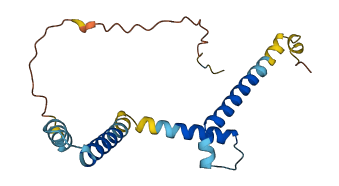
Descriptions
The autoinhibited protein was predicted that may have potential autoinhibitory elements via cis-regPred.
Autoinhibitory domains (AIDs)
Target domain |
|
Relief mechanism |
|
Assay |
cis-regPred |
Accessory elements
No accessory elements
Autoinhibited structure

Activated structure
1 structures for Q5TA89
| Entry ID | Method | Resolution | Chain | Position | Source |
|---|---|---|---|---|---|
| AF-Q5TA89-F1 | Predicted | AlphaFoldDB |
155 variants for Q5TA89
| Variant ID(s) | Position | Change | Description | Diseaes Association | Provenance |
|---|---|---|---|---|---|
|
CA541084 rs376151919 |
2 | A>D | No |
ClinGen ESP ExAC TOPMed gnomAD |
|
|
rs1171036406 CA337998943 |
3 | P>L | No |
gnomAD ClinGen |
|
|
CA337998939 rs1434198675 |
4 | S>G | No |
gnomAD ClinGen |
|
|
rs1350014175 CA337998920 |
5 | T>S | No |
TOPMed ClinGen |
|
|
rs761617059 CA541083 |
7 | A>V | No |
ClinGen ExAC TOPMed gnomAD |
|
| TCGA novel | 8 | V>A | Variant assessed as Somatic; impact. [NCI-TCGA] | No | NCI-TCGA |
|
CA541080 rs374481404 |
8 | V>M | No |
ClinGen ESP ExAC TOPMed gnomAD |
|
|
CA16949137 rs911300495 |
9 | E>K | No |
Ensembl ClinGen |
|
|
CA337998875 rs1256956275 |
11 | L>V | No |
gnomAD ClinGen |
|
|
rs770377114 CA541078 |
12 | S>N | No |
ClinGen ExAC TOPMed gnomAD |
|
| TCGA novel | 14 | K>E | Variant assessed as Somatic; impact. [NCI-TCGA] | No | NCI-TCGA |
|
CA541077 rs746394534 |
16 | K>E | No |
ExAC gnomAD ClinGen |
|
|
CA16949131 rs1033348989 |
16 | K>R | No |
ClinGen TOPMed |
|
|
rs1205799660 CA337998790 |
18 | R>Q | No |
gnomAD ClinGen |
|
|
CA337998721 rs753373048 |
20 | R>L | No |
ClinGen ExAC gnomAD |
|
|
CA541041 rs753373048 |
20 | R>Q | No |
ClinGen ExAC gnomAD |
|
|
rs1224041687 CA337998724 |
20 | R>W | No |
ClinGen gnomAD |
|
|
rs1385343399 CA337998719 |
21 | K>Q | No |
gnomAD ClinGen |
|
|
CA541038 rs773669311 |
23 | V>A | No |
ExAC TOPMed gnomAD ClinGen |
|
|
CA337998614 rs1380721046 |
27 | M>I | No |
gnomAD ClinGen |
|
|
rs1274311018 CA337998624 |
27 | M>L | No |
TOPMed ClinGen |
|
|
CA337998620 rs1234649558 |
27 | M>T | No |
TOPMed ClinGen |
|
|
rs1333359977 CA337998610 |
28 | R>S | No |
TOPMed ClinGen |
|
|
COSM3943783 CA541036 rs762103606 |
29 | R>C | ovary [Cosmic] | No |
ClinGen cosmic curated ExAC gnomAD |
|
CA541034 rs201320010 |
30 | D>A | No |
ClinGen 1000Genomes ExAC gnomAD |
|
|
CA16949016 rs889804585 |
30 | D>E | No |
ClinGen TOPMed gnomAD |
|
|
CA337998590 rs1478611953 |
30 | D>N | No |
ClinGen gnomAD |
|
|
CA16949014 rs866186692 |
31 | R>H | No |
ClinGen gnomAD |
|
|
CA337998570 rs866186692 |
31 | R>L | No |
ClinGen gnomAD |
|
|
rs749379887 CA541033 |
34 | S>G | No |
ClinGen ExAC TOPMed gnomAD |
|
|
rs780153699 CA541032 |
36 | I>M | No |
ExAC gnomAD ClinGen |
|
|
rs1200976594 CA337998506 |
37 | E>K | No |
gnomAD ClinGen |
|
|
CA337998479 rs1254053214 |
38 | Q>H | No |
gnomAD ClinGen |
|
|
rs1346988024 CA337998482 |
38 | Q>R | No |
gnomAD ClinGen |
|
|
CA541030 rs746969697 |
40 | K>N | No |
ClinGen ExAC gnomAD |
|
|
rs769957671 CA541031 |
40 | K>Q | No |
ClinGen ExAC TOPMed gnomAD |
|
|
CA337998453 rs1412391732 |
41 | L>V | No |
TOPMed ClinGen |
|
|
rs1298702030 CA337998435 |
43 | L>V | No |
ClinGen gnomAD |
|
|
CA541029 rs199741438 |
44 | E>D | No |
1000Genomes ExAC TOPMed gnomAD ClinGen |
|
|
CA337998427 rs1437535393 |
44 | E>Q | No |
ClinGen TOPMed gnomAD |
|
|
CA541026 rs778489792 |
46 | E>D | No |
ClinGen ExAC TOPMed gnomAD |
|
|
rs1302863026 CA337998401 |
46 | E>K | No |
gnomAD ClinGen |
|
|
CA541027 rs747971857 |
46 | E>V | No |
ClinGen ExAC gnomAD |
|
|
rs754633773 CA541025 |
47 | F>C | No |
ExAC gnomAD ClinGen |
|
|
CA337998377 rs1465888071 |
47 | F>L | No |
ClinGen gnomAD |
|
|
rs753325453 CA541024 |
48 | A>P | No |
ClinGen ExAC gnomAD |
|
|
rs1190173761 CA337998369 |
48 | A>V | No |
gnomAD ClinGen |
|
|
CA541022 rs199682108 |
49 | R>L | No |
ClinGen ExAC TOPMed gnomAD |
|
|
rs199682108 CA16948983 |
49 | R>Q | No |
ExAC TOPMed gnomAD ClinGen |
|
|
CA541023 rs765901251 |
49 | R>W | No |
ExAC gnomAD ClinGen |
|
|
CA541021 rs573666488 |
50 | H>Q | No |
ClinGen 1000Genomes ExAC TOPMed gnomAD |
|
|
rs1249646268 CA337998340 |
51 | Q>R | No |
ClinGen TOPMed |
|
|
CA337998333 rs762230250 |
52 | P>A | No |
ClinGen ExAC TOPMed gnomAD |
|
|
CA337998324 rs1199802332 |
52 | P>L | No |
ClinGen TOPMed gnomAD |
|
|
CA541019 rs762230250 |
52 | P>S | No |
ExAC TOPMed gnomAD ClinGen |
|
|
rs764265290 CA541017 |
53 | N>T | No |
ExAC gnomAD ClinGen |
|
|
CA541015 rs775526036 |
54 | S>C | No |
ExAC gnomAD ClinGen |
|
|
CA541016 rs556965399 |
54 | S>P | No |
1000Genomes ExAC gnomAD ClinGen |
|
|
CA337998293 rs1350066544 |
55 | K>R | No |
TOPMed ClinGen |
|
|
rs770012439 CA541014 |
56 | L>V | No |
ExAC TOPMed gnomAD ClinGen |
|
|
CA337998251 rs745880943 |
58 | K>N | No |
ClinGen ExAC TOPMed gnomAD |
|
|
CA16948966 rs778367486 |
58 | K>T | No |
ClinGen gnomAD |
|
|
rs764855346 CA541012 |
59 | A>S | No |
ClinGen ExAC TOPMed gnomAD |
|
|
CA337998249 rs764855346 |
59 | A>T | No |
ExAC TOPMed gnomAD ClinGen |
|
|
CA541011 rs772125059 |
60 | D>G | No |
ClinGen ExAC gnomAD |
|
|
rs747940054 CA541010 |
61 | I>V | No |
ClinGen ExAC gnomAD |
|
|
rs779623635 CA541006 COSM1667082 |
64 | M>I | breast [Cosmic] | No |
ClinGen cosmic curated ExAC gnomAD |
|
rs748987789 CA541007 |
64 | M>T | No |
ClinGen ExAC gnomAD |
|
|
rs1473533385 CA337998196 |
64 | M>V | No |
gnomAD ClinGen |
|
|
rs1483305735 CA337998185 |
65 | A>T | No |
gnomAD ClinGen |
|
|
rs1202695844 CA337998159 |
67 | S>T | No |
ClinGen gnomAD |
|
|
rs755624177 CA541005 |
68 | Y>H | No |
ClinGen ExAC gnomAD |
|
|
rs1415696299 CA337998133 |
69 | L>P | No |
ClinGen TOPMed |
|
|
rs1447816061 CA337998116 |
71 | H>N | No |
ClinGen gnomAD |
|
|
rs1233214944 CA337998100 |
72 | S>N | No |
TOPMed gnomAD ClinGen |
|
|
rs1021201777 CA16948946 |
74 | A>T | No |
TOPMed gnomAD ClinGen |
|
|
CA16948903 rs896087687 |
76 | V>A | No |
ClinGen TOPMed |
|
|
rs779746892 CA337998031 |
76 | V>F | No |
ClinGen ExAC TOPMed gnomAD |
|
|
CA540986 rs779746892 |
76 | V>I | No |
ExAC TOPMed gnomAD ClinGen |
|
|
rs1192668050 CA337998018 |
78 | A>T | No |
ClinGen gnomAD |
|
|
rs1291780492 CA337998013 |
78 | A>V | No |
ClinGen TOPMed |
|
|
rs745424451 CA540984 |
81 | P>A | No |
ClinGen ExAC TOPMed gnomAD |
|
|
rs745424451 CA337997987 |
81 | P>S | No |
ExAC TOPMed gnomAD ClinGen |
|
|
rs780713859 CA540983 |
83 | S>R | No |
ExAC TOPMed gnomAD ClinGen |
|
|
CA337997927 rs1557456823 |
86 | Q>E | No |
Ensembl ClinGen |
|
|
rs926290877 CA16948895 |
87 | D>E | No |
TOPMed ClinGen |
|
|
rs1158632818 CA337997916 |
87 | D>N | No |
ClinGen TOPMed |
|
|
rs1190028370 CA337997879 |
89 | S>R | No |
TOPMed ClinGen |
|
|
CA540982 rs756674081 |
90 | E>K | No |
ClinGen ExAC gnomAD |
|
|
CA337997839 rs1316807197 |
93 | S>A | No |
ClinGen TOPMed gnomAD |
|
|
rs752121812 CA540981 |
93 | S>L | No |
ClinGen ExAC TOPMed gnomAD |
|
|
rs913614442 CA16948884 |
94 | W>C | No |
TOPMed gnomAD ClinGen |
|
|
CA337997823 rs1208957959 |
95 | C>S | No |
TOPMed ClinGen |
|
|
CA337997807 rs1302318042 |
96 | L>P | No |
gnomAD ClinGen |
|
|
CA337997793 rs1298534855 |
97 | Q>H | No |
TOPMed ClinGen |
|
|
rs988398485 CA16948880 |
99 | A>T | No |
TOPMed gnomAD ClinGen |
|
|
CA337997764 rs1453006708 |
100 | V>M | No |
ClinGen gnomAD |
|
|
CA337997751 rs1359623062 |
101 | Q>* | No |
ClinGen gnomAD |
|
|
CA337997744 rs1165727910 |
101 | Q>H | No |
TOPMed gnomAD ClinGen |
|
|
rs1432651303 CA337997726 |
103 | L>P | No |
ClinGen TOPMed |
|
|
CA337997718 rs1178103718 |
104 | T>M | Variant assessed as Somatic; 0.0 impact. [NCI-TCGA] | No |
ClinGen NCI-TCGA TOPMed gnomAD |
|
rs1320221304 CA337997707 |
106 | H>R | No |
ClinGen TOPMed |
|
|
CA337997709 rs1412609512 |
106 | H>Y | No |
ClinGen gnomAD |
|
|
rs1173261363 CA337997701 |
107 | A>P | No |
gnomAD ClinGen |
|
|
rs1450250369 CA337997691 |
108 | A>S | No |
TOPMed gnomAD ClinGen |
|
|
rs1450250369 CA337997693 |
108 | A>T | No |
TOPMed gnomAD ClinGen |
|
|
CA337997681 rs1347076967 |
109 | S>R | No |
ClinGen TOPMed |
|
| TCGA novel | 110 | D>H | Variant assessed as Somatic; impact. [NCI-TCGA] | No | NCI-TCGA |
|
rs986028820 CA16948872 |
110 | D>N | No |
TOPMed gnomAD ClinGen |
|
|
rs1413930504 CA337997652 |
111 | T>K | No |
TOPMed ClinGen |
|
|
CA337997627 rs1448117650 |
113 | M>T | No |
TOPMed ClinGen |
|
|
CA337997630 rs1184270454 |
113 | M>V | No |
ClinGen TOPMed gnomAD |
|
|
CA337997570 rs1485569287 |
118 | H>Y | No |
TOPMed gnomAD ClinGen |
|
|
CA540978 rs753102026 |
120 | Q>R | No |
ExAC gnomAD ClinGen |
|
|
rs1027647005 CA16948866 |
121 | R>W | No |
TOPMed gnomAD ClinGen |
|
|
rs1208848205 CA337997525 |
122 | P>L | No |
ClinGen TOPMed |
|
| TCGA novel | 123 | P>S | Variant assessed as Somatic; impact. [NCI-TCGA] | No | NCI-TCGA |
|
rs867697758 CA337997496 |
125 | A>P | No |
gnomAD ClinGen |
|
|
rs867697758 CA16948861 |
125 | A>T | No |
gnomAD ClinGen |
|
|
rs1483311413 CA337997444 |
130 | A>S | No |
ClinGen TOPMed gnomAD |
|
|
rs1301257329 CA337997432 |
131 | K>E | No |
TOPMed ClinGen |
|
|
rs1304571819 CA337997428 |
131 | K>T | No |
ClinGen TOPMed gnomAD |
|
|
CA16948848 rs1014986514 |
134 | K>T | No |
TOPMed ClinGen |
|
|
rs1014849600 CA16948845 |
135 | A>S | No |
ClinGen TOPMed |
|
|
rs1014849600 CA337997380 |
135 | A>T | No |
TOPMed ClinGen |
|
|
CA337997374 rs1374628915 |
135 | A>V | No |
gnomAD ClinGen |
|
|
CA337997367 rs1171602558 |
136 | P>R | No |
ClinGen TOPMed |
|
|
CA337997353 rs1202707316 |
138 | A>T | No |
gnomAD ClinGen |
|
|
CA337997318 rs1483330478 |
141 | P>Q | No |
ClinGen TOPMed |
|
|
CA16948840 rs529118406 |
141 | P>S | No |
1000Genomes TOPMed gnomAD ClinGen |
|
|
CA337997301 rs1271306832 |
143 | A>T | No |
TOPMed ClinGen |
|
|
rs942995118 CA16948837 |
144 | L>F | No |
ClinGen TOPMed gnomAD |
|
|
CA16948834 rs567343294 |
145 | S>C | No |
ClinGen 1000Genomes |
|
|
rs550513919 CA16948833 |
146 | A>V | No |
1000Genomes TOPMed ClinGen |
|
|
CA337997238 rs1265711380 |
149 | T>A | No |
ClinGen TOPMed gnomAD |
|
|
rs904751282 CA16948828 |
150 | A>D | No |
ClinGen TOPMed gnomAD |
|
|
CA16948830 rs937587295 |
150 | A>T | No |
TOPMed gnomAD ClinGen |
|
|
rs1043787911 CA16948825 |
152 | A>P | No |
ClinGen TOPMed |
|
|
rs1319469098 CA337997198 |
153 | A>T | No |
ClinGen gnomAD |
|
|
CA337997182 rs1289608156 |
154 | A>T | No |
gnomAD ClinGen |
|
|
rs1463857688 CA337997179 |
154 | A>V | No |
ClinGen TOPMed |
|
|
rs1230787389 CA337997173 |
155 | A>G | No |
ClinGen TOPMed gnomAD |
|
|
rs1230787389 CA337997171 |
155 | A>V | No |
TOPMed gnomAD ClinGen |
|
|
rs1487414460 CA337997159 |
156 | H>Q | No |
TOPMed ClinGen |
|
|
CA337997168 rs1351599195 |
156 | H>Y | No |
TOPMed gnomAD ClinGen |
|
|
CA337997146 rs1264611661 |
157 | Q>H | No |
ClinGen TOPMed |
|
|
rs530921518 CA16948814 |
158 | P>H | No |
1000Genomes gnomAD ClinGen |
|
|
rs530921518 CA337997138 |
158 | P>L | No |
1000Genomes gnomAD ClinGen |
|
|
rs1244385331 CA337997133 |
159 | A>T | No |
ClinGen TOPMed |
|
|
rs1335771036 CA337997123 |
159 | A>V | No |
TOPMed ClinGen |
|
|
CA337997116 rs1570560700 |
160 | C>Y | No |
ClinGen Ensembl |
|
|
rs1390078712 CA337997098 |
162 | L>I | No |
TOPMed gnomAD ClinGen |
|
|
CA16948811 rs1052180176 |
162 | L>P | No |
TOPMed ClinGen |
|
|
rs1390078712 CA337997097 |
162 | L>V | No |
ClinGen TOPMed gnomAD |
|
|
CA337997057 rs1393313834 |
165 | P>H | No |
ClinGen gnomAD |
No associated diseases with Q5TA89
2 GO annotations of cellular component
| Name | Definition |
|---|---|
| chromatin | The ordered and organized complex of DNA, protein, and sometimes RNA, that forms the chromosome. |
| nucleoplasm | That part of the nuclear content other than the chromosomes or the nucleolus. |
6 GO annotations of molecular function
| Name | Definition |
|---|---|
| chromatin binding | Binding to chromatin, the network of fibers of DNA, protein, and sometimes RNA, that make up the chromosomes of the eukaryotic nucleus during interphase. |
| DNA-binding transcription factor activity, RNA polymerase II-specific | A DNA-binding transcription factor activity that modulates the transcription of specific gene sets transcribed by RNA polymerase II. |
| DNA-binding transcription repressor activity, RNA polymerase II-specific | A DNA-binding transcription factor activity that represses or decreases the transcription of specific gene sets transcribed by RNA polymerase II. |
| protein dimerization activity | The formation of a protein dimer, a macromolecular structure consists of two noncovalently associated identical or nonidentical subunits. |
| RNA polymerase II cis-regulatory region sequence-specific DNA binding | Binding to a specific upstream regulatory DNA sequence (transcription factor recognition sequence or binding site) located in cis relative to the transcription start site (i.e., on the same strand of DNA) of a gene transcribed by RNA polymerase II. |
| sequence-specific double-stranded DNA binding | Binding to double-stranded DNA of a specific nucleotide composition, e.g. GC-rich DNA binding, or with a specific sequence motif or type of DNA, e.g. promotor binding or rDNA binding. |
46 GO annotations of biological process
| Name | Definition |
|---|---|
| anterior/posterior pattern specification | The regionalization process in which specific areas of cell differentiation are determined along the anterior-posterior axis. The anterior-posterior axis is defined by a line that runs from the head or mouth of an organism to the tail or opposite end of the organism. |
| astrocyte differentiation | The process in which a relatively unspecialized cell acquires the specialized features of an astrocyte. An astrocyte is the most abundant type of glial cell. Astrocytes provide support for neurons and regulate the environment in which they function. |
| BMP signaling pathway | The series of molecular signals initiated by the binding of a member of the BMP (bone morphogenetic protein) family to a receptor on the surface of a target cell, and ending with the regulation of a downstream cellular process, e.g. transcription. |
| brain development | The process whose specific outcome is the progression of the brain over time, from its formation to the mature structure. Brain development begins with patterning events in the neural tube and ends with the mature structure that is the center of thought and emotion. The brain is responsible for the coordination and control of bodily activities and the interpretation of information from the senses (sight, hearing, smell, etc.). |
| camera-type eye development | The process whose specific outcome is the progression of the camera-type eye over time, from its formation to the mature structure. The camera-type eye is an organ of sight that receives light through an aperture and focuses it through a lens, projecting it on a photoreceptor field. |
| cartilage development | The process whose specific outcome is the progression of a cartilage element over time, from its formation to the mature structure. Cartilage elements are skeletal elements that consist of connective tissue dominated by extracellular matrix containing collagen type II and large amounts of proteoglycan, particularly chondroitin sulfate. |
| cell adhesion | The attachment of a cell, either to another cell or to an underlying substrate such as the extracellular matrix, via cell adhesion molecules. |
| cell maturation | A developmental process, independent of morphogenetic (shape) change, that is required for a cell to attain its fully functional state. |
| central nervous system myelination | The process in which neuronal axons and dendrites become coated with a segmented lipid-rich sheath (myelin) to enable faster and more energetically efficient conduction of electrical impulses. The sheath is formed by the cell membranes of oligodendrocytes in the central nervous system. Adjacent myelin segments are separated by a non-myelinated stretch of axon called a node of Ranvier. |
| comma-shaped body morphogenesis | The process in which the comma-shaped body is generated and organized. The comma-shaped body is the precursor structure to the S-shaped body that contributes to the morphogenesis of the nephron. |
| establishment of epithelial cell polarity | The specification and formation of anisotropic intracellular organization of an epithelial cell. |
| forebrain radial glial cell differentiation | The process in which neuroepithelial cells of the neural tube give rise to radial glial cells, specialized bipotential progenitors cells of the forebrain. Differentiation includes the processes involved in commitment of a cell to a specific fate. |
| glial cell fate commitment | The process in which the developmental fate of a cell becomes restricted such that it will develop into a glial cell. |
| inner ear auditory receptor cell differentiation | The process in which a relatively unspecialized inner cell acquires specialized features of an auditory hair cell. |
| inner ear receptor cell stereocilium organization | A process that is carried out at the cellular level which results in the assembly, arrangement of constituent parts, or disassembly of a stereocilium. A stereocilium is an actin-based protrusion from the apical surface of inner ear receptor cells. |
| metanephric nephron tubule morphogenesis | The process in which the anatomical structures of a metanephric nephron tubule are generated and organized. A metanephric nephron tubule is an epithelial tube that is part of the metanephric nephron, the functional part of the metanephros. |
| negative regulation of astrocyte differentiation | Any process that stops, prevents, or reduces the frequency, rate or extent of astrocyte differentiation. |
| negative regulation of forebrain neuron differentiation | Any process that stops, prevents or reduces the frequency, rate or extent of forebrain neuron differentiation. |
| negative regulation of inner ear auditory receptor cell differentiation | Any process that stops, prevents, or reduces the frequency, rate or extent of auditory hair cell differentiation. |
| negative regulation of neuron differentiation | Any process that stops, prevents, or reduces the frequency, rate or extent of neuron differentiation. |
| negative regulation of oligodendrocyte differentiation | Any process that stops, prevents, or reduces the frequency, rate or extent of oligodendrocyte differentiation. |
| negative regulation of pro-B cell differentiation | Any process that stops, prevents or reduces the frequency, rate or extent of pro-B cell differentiation. |
| negative regulation of stem cell differentiation | Any process that stops, prevents or reduces the frequency, rate or extent of stem cell differentiation. |
| negative regulation of transcription by RNA polymerase II | Any process that stops, prevents, or reduces the frequency, rate or extent of transcription mediated by RNA polymerase II. |
| neural tube development | The process whose specific outcome is the progression of the neural tube over time, from its formation to the mature structure. The mature structure of the neural tube exists when the tube has been segmented into the forebrain, midbrain, hindbrain and spinal cord regions. In addition neural crest has budded away from the epithelium. |
| neuronal stem cell population maintenance | Any process in by an organism or tissue maintains a population of neuronal stem cells. |
| Notch signaling pathway | The series of molecular signals initiated by an extracellular ligand binding to the receptor Notch on the surface of a target cell, and ending with the regulation of a downstream cellular process, e.g. transcription. |
| oligodendrocyte development | The process aimed at the progression of an oligodendrocyte over time, from initial commitment of the cell to a specific fate, to the fully functional differentiated cell. An oligodendrocyte is a type of glial cell involved in myelinating the axons in the central nervous system. |
| positive regulation of BMP signaling pathway | Any process that activates or increases the frequency, rate or extent of BMP signaling pathway activity. |
| positive regulation of cell population proliferation | Any process that activates or increases the rate or extent of cell proliferation. |
| positive regulation of DNA-templated transcription | Any process that activates or increases the frequency, rate or extent of cellular DNA-templated transcription. |
| positive regulation of Notch signaling pathway | Any process that activates or increases the frequency, rate or extent of the Notch signaling pathway. |
| positive regulation of receptor signaling pathway via JAK-STAT | Any process that activates or increases the frequency, rate or extent of the JAK-STAT signaling pathway activity. |
| positive regulation of smooth muscle cell proliferation | Any process that activates or increases the rate or extent of smooth muscle cell proliferation. |
| positive regulation of transcription by RNA polymerase II | Any process that activates or increases the frequency, rate or extent of transcription from an RNA polymerase II promoter. |
| positive regulation of tyrosine phosphorylation of STAT protein | Any process that activates or increases the frequency, rate or extent of the introduction of a phosphate group to a tyrosine residue of a STAT (Signal Transducer and Activator of Transcription) protein. |
| protein-containing complex assembly | The aggregation, arrangement and bonding together of a set of macromolecules to form a protein-containing complex. |
| regulation of cell differentiation | Any process that modulates the frequency, rate or extent of cell differentiation, the process in which relatively unspecialized cells acquire specialized structural and functional features. |
| regulation of epithelial cell proliferation | Any process that modulates the frequency, rate or extent of epithelial cell proliferation. |
| regulation of myelination | Any process that modulates the frequency, rate or extent of the formation of a myelin sheath around nerve axons. |
| regulation of neurogenesis | Any process that modulates the frequency, rate or extent of neurogenesis, the generation of cells in the nervous system. |
| regulation of transcription by RNA polymerase II | Any process that modulates the frequency, rate or extent of transcription mediated by RNA polymerase II. |
| S-shaped body morphogenesis | The process in which the S-shaped body is generated and organized. The S-shaped body is the successor of the comma-shaped body that contributes to the morphogenesis of the nephron. |
| smoothened signaling pathway | The series of molecular signals generated as a consequence of activation of the transmembrane protein Smoothened. |
| specification of loop of Henle identity | The process in which the loop of Henle of the kidney nephron acquires its identity. |
| telencephalon development | The process whose specific outcome is the progression of the telencephalon over time, from its formation to the mature structure. The telencephalon is the paired anteriolateral division of the prosencephalon plus the lamina terminalis from which the olfactory lobes, cerebral cortex, and subcortical nuclei are derived. |
4 homologous proteins in AiPD
| UniProt AC | Gene Name | Protein Name | Species | Evidence Code |
|---|---|---|---|---|
| P14003 | h | Protein hairy | Drosophila melanogaster (Fruit fly) | PR |
| Q9Y543 | HES2 | Transcription factor HES-2 | Homo sapiens (Human) | PR |
| Q03062 | Hes5 | Transcription factor HES-5 | Rattus norvegicus (Rat) | PR |
| Q18053 | hlh-26 | Helix-loop-helix protein 26 | Caenorhabditis elegans | PR |
| 10 | 20 | 30 | 40 | 50 | 60 |
| MAPSTVAVEL | LSPKEKNRLR | KPVVEKMRRD | RINSSIEQLK | LLLEQEFARH | QPNSKLEKAD |
| 70 | 80 | 90 | 100 | 110 | 120 |
| ILEMAVSYLK | HSKAFVAAAG | PKSLHQDYSE | GYSWCLQEAV | QFLTLHAASD | TQMKLLYHFQ |
| 130 | 140 | 150 | 160 | ||
| RPPAAPAAPA | KEPKAPGAAP | PPALSAKATA | AAAAAHQPAC | GLWRPW |