Q5FVJ3
Gene name |
Plpp7 |
Protein name |
Inactive phospholipid phosphatase 7 |
Names |
Phosphatidic acid phosphatase type 2 domain-containing protein 3 |
Species |
Rattus norvegicus (Rat) |
KEGG Pathway |
rno:296635 |
EC number |
|
Protein Class |
|
Descriptions
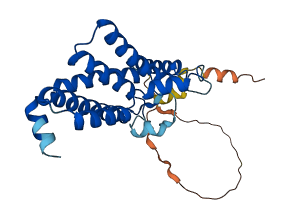
The autoinhibited protein was predicted that may have potential autoinhibitory elements via cis-regPred.
Autoinhibitory domains (AIDs)
Target domain |
|
Relief mechanism |
|
Assay |
cis-regPred |
Accessory elements
No accessory elements
Autoinhibited structure

Activated structure
1 structures for Q5FVJ3
| Entry ID | Method | Resolution | Chain | Position | Source |
|---|---|---|---|---|---|
| AF-Q5FVJ3-F1 | Predicted | AlphaFoldDB |
1 variants for Q5FVJ3
| Variant ID(s) | Position | Change | Description | Diseaes Association | Provenance |
|---|---|---|---|---|---|
| rs199301353 | 3 | V>A | No | EVA |
No associated diseases with Q5FVJ3
1 regional properties for Q5FVJ3
| Type | Name | Position | InterPro Accession |
|---|---|---|---|
| domain | Phosphatidic acid phosphatase type 2/haloperoxidase | 143 - 255 | IPR000326 |
Functions
4 GO annotations of cellular component
| Name | Definition |
|---|---|
| endoplasmic reticulum membrane | The lipid bilayer surrounding the endoplasmic reticulum. |
| integral component of membrane | The component of a membrane consisting of the gene products and protein complexes having at least some part of their peptide sequence embedded in the hydrophobic region of the membrane. |
| membrane | A lipid bilayer along with all the proteins and protein complexes embedded in it an attached to it. |
| nuclear envelope | The double lipid bilayer enclosing the nucleus and separating its contents from the rest of the cytoplasm; includes the intermembrane space, a gap of width 20-40 nm (also called the perinuclear space). |
1 GO annotations of molecular function
| Name | Definition |
|---|---|
| sphingosine-1-phosphate phosphatase activity | Catalysis of the reaction: sphingosine 1-phosphate + H2O = sphingosine + phosphate. |
1 GO annotations of biological process
| Name | Definition |
|---|---|
| negative regulation of myotube differentiation | Any process that decreases the frequency, rate or extent of myotube differentiation. Myotube differentiation is the process in which a relatively unspecialized cell acquires specialized features of a myotube cell. Myotubes are multinucleated cells that are formed when proliferating myoblasts exit the cell cycle, differentiate and fuse. |
3 homologous proteins in AiPD
| 10 | 20 | 30 | 40 | 50 | 60 |
| MPVSQSRARA | RDRNNVLNRA | EFLSLNQPPK | GTQEPRSSGR | KASGPSTQPP | PSSDGARERR |
| 70 | 80 | 90 | 100 | 110 | 120 |
| QSQQLPEEDC | MQLNPSFKGI | AFNSLLAIDI | CMSKRLGVCA | GRAASWASAR | SMVKLIGITS |
| 130 | 140 | 150 | 160 | 170 | 180 |
| HGIPWIGGTI | LCLVRSSTLA | GQEVLMNLLL | ALLLDIMTVA | GVQKLIKRRG | PYETSPGLLD |
| 190 | 200 | 210 | 220 | 230 | 240 |
| YLTMDIYAFP | AGHASRAAMV | SKFFLSHLVL | AVPLRVLLVL | WAFCVGLSRV | MIGRHHITDV |
| 250 | 260 | 270 | |||
| ISGFIIGYFQ | FRLVELVWMS | SNTCQMLISA | W |