Q58CY6
Gene name |
PRXL2B (FAM213B) |
Protein name |
Prostamide/prostaglandin F synthase |
Names |
Prostamide/PG F synthase, Prostamide/PGF synthase, Peroxiredoxin-like 2B |
Species |
Bos taurus (Bovine) |
KEGG Pathway |
bta:617001 |
EC number |
1.11.1.20: Peroxidases |
Protein Class |
|
Descriptions
The autoinhibited protein was predicted that may have potential autoinhibitory elements via cis-regPred.
Autoinhibitory domains (AIDs)
Target domain |
|
Relief mechanism |
|
Assay |
cis-regPred |
Accessory elements
No accessory elements
Autoinhibited structure

Activated structure
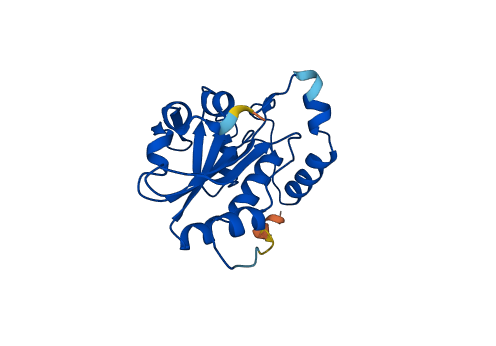
1 structures for Q58CY6
| Entry ID | Method | Resolution | Chain | Position | Source |
|---|---|---|---|---|---|
| AF-Q58CY6-F1 | Predicted | AlphaFoldDB |
No variants for Q58CY6
| Variant ID(s) | Position | Change | Description | Diseaes Association | Provenance |
|---|---|---|---|---|---|
| No variants for Q58CY6 | |||||
No associated diseases with Q58CY6
No regional properties for Q58CY6
| Type | Name | Position | InterPro Accession |
|---|---|---|---|
| No domain, repeats, and functional sites for Q58CY6 | |||
Functions
| Description | ||
|---|---|---|
| EC Number | 1.11.1.20 | Peroxidases |
| Subcellular Localization |
|
|
| PANTHER Family | ||
| PANTHER Subfamily | ||
| PANTHER Protein Class | ||
| PANTHER Pathway Category | No pathway information available | |
4 GO annotations of cellular component
| Name | Definition |
|---|---|
| cytoplasm | The contents of a cell excluding the plasma membrane and nucleus, but including other subcellular structures. |
| cytosol | The part of the cytoplasm that does not contain organelles but which does contain other particulate matter, such as protein complexes. |
| endoplasmic reticulum | The irregular network of unit membranes, visible only by electron microscopy, that occurs in the cytoplasm of many eukaryotic cells. The membranes form a complex meshwork of tubular channels, which are often expanded into slitlike cavities called cisternae. The ER takes two forms, rough (or granular), with ribosomes adhering to the outer surface, and smooth (with no ribosomes attached). |
| myelin sheath | An electrically insulating fatty layer that surrounds the axons of many neurons. It is an outgrowth of glial cells: Schwann cells supply the myelin for peripheral neurons while oligodendrocytes supply it to those of the central nervous system. |
3 GO annotations of molecular function
| Name | Definition |
|---|---|
| antioxidant activity | Inhibition of the reactions brought about by dioxygen (O2) or peroxides. Usually the antioxidant is effective because it can itself be more easily oxidized than the substance protected. The term is often applied to components that can trap free radicals, thereby breaking the chain reaction that normally leads to extensive biological damage. |
| oxidoreductase activity, acting on the CH-OH group of donors, NAD or NADP as acceptor | Catalysis of an oxidation-reduction (redox) reaction in which a CH-OH group acts as a hydrogen or electron donor and reduces NAD+ or NADP. |
| prostaglandin-F synthase activity | Catalysis of the reaction: NADP+ + (5Z,13E)-(15S)-9-alpha,11-alpha,15-trihydroxyprosta-5,13-dienoate = NADPH + H+ + (5Z,13E)-(15S)-9-alpha,15-dihydroxy-11-oxoprosta-5,13-dienoate. |
1 GO annotations of biological process
| Name | Definition |
|---|---|
| prostaglandin biosynthetic process | The chemical reactions and pathways resulting in the formation of prostaglandins, any of a group of biologically active metabolites which contain a cyclopentane ring. |
| 10 | 20 | 30 | 40 | 50 | 60 |
| MSTVDLARVG | ACVLKHAVTG | EAVELRNLWQ | EQACVVAGLR | RFGCMVCRWI | ARDLSNLKGL |
| 70 | 80 | 90 | 100 | 110 | 120 |
| LDQHGVRLVG | VGPEALGLQE | FLDGGYFAGE | LYLDESKQFY | KELGFKRYNS | LSILPAALGK |
| 130 | 140 | 150 | 160 | 170 | 180 |
| PVREVAAKAK | AVGIQGNLSG | DLLQSGGLLV | VAKGGDKVLL | HFVQKSPGDY | APLESILQAL |
| 190 | 200 | ||||
| GISAEVGPSE | LPQCDEEACS | R |