Q4FZT0
Gene name |
Stoml2 |
Protein name |
Stomatin-like protein 2, mitochondrial |
Names |
SLP-2 |
Species |
Rattus norvegicus (Rat) |
KEGG Pathway |
rno:298203 |
EC number |
|
Protein Class |
|
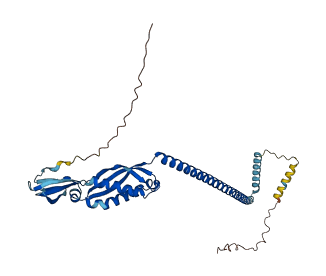
Descriptions
The autoinhibited protein was predicted that may have potential autoinhibitory elements via cis-regPred.
Autoinhibitory domains (AIDs)
Target domain |
|
Relief mechanism |
|
Assay |
cis-regPred |
Accessory elements
No accessory elements
Autoinhibited structure

Activated structure
1 structures for Q4FZT0
| Entry ID | Method | Resolution | Chain | Position | Source |
|---|---|---|---|---|---|
| AF-Q4FZT0-F1 | Predicted | AlphaFoldDB |
1 variants for Q4FZT0
| Variant ID(s) | Position | Change | Description | Diseaes Association | Provenance |
|---|---|---|---|---|---|
| rs3320550388 | 296 | V>I | No | EVA |
No associated diseases with Q4FZT0
Functions
10 GO annotations of cellular component
| Name | Definition |
|---|---|
| actin cytoskeleton | The part of the cytoskeleton (the internal framework of a cell) composed of actin and associated proteins. Includes actin cytoskeleton-associated complexes. |
| COP9 signalosome | A protein complex that catalyzes the deneddylation of proteins, including the cullin component of SCF ubiquitin E3 ligase; deneddylation increases the activity of cullin family ubiquitin ligases. The signalosome is involved in many regulatory process, including some which control development, in many species; also regulates photomorphogenesis in plants; in many species its subunits are highly similar to those of the proteasome. |
| extrinsic component of plasma membrane | The component of a plasma membrane consisting of gene products and protein complexes that are loosely bound to one of its surfaces, but not integrated into the hydrophobic region. |
| immunological synapse | An area of close contact between a lymphocyte (T-, B-, or natural killer cell) and a target cell formed through the clustering of particular signaling and adhesion molecules and their associated membrane rafts on both the lymphocyte and the target cell and facilitating activation of the lymphocyte, transfer of membrane from the target cell to the lymphocyte, and in some situations killing of the target cell through release of secretory granules and/or death-pathway ligand-receptor interaction. |
| membrane raft | Any of the small (10-200 nm), heterogeneous, highly dynamic, sterol- and sphingolipid-enriched membrane domains that compartmentalize cellular processes. Small rafts can sometimes be stabilized to form larger platforms through protein-protein and protein-lipid interactions. |
| mitochondrial inner membrane | The inner, i.e. lumen-facing, lipid bilayer of the mitochondrial envelope. It is highly folded to form cristae. |
| mitochondrial intermembrane space | The region between the inner and outer lipid bilayers of the mitochondrial envelope. |
| mitochondrion | A semiautonomous, self replicating organelle that occurs in varying numbers, shapes, and sizes in the cytoplasm of virtually all eukaryotic cells. It is notably the site of tissue respiration. |
| plasma membrane | The membrane surrounding a cell that separates the cell from its external environment. It consists of a phospholipid bilayer and associated proteins. |
| T cell receptor complex | A protein complex that contains a disulfide-linked heterodimer of T cell receptor (TCR) chains, which are members of the immunoglobulin superfamily, and mediates antigen recognition, ultimately resulting in T cell activation. The TCR heterodimer is associated with the CD3 complex, which consists of the nonpolymorphic polypeptides gamma, delta, epsilon, zeta, and, in some cases, eta (an RNA splice variant of zeta) or Fc epsilon chains. |
2 GO annotations of molecular function
| Name | Definition |
|---|---|
| cardiolipin binding | Binding to cardiolipin. |
| GTPase binding | Binding to a GTPase, any enzyme that catalyzes the hydrolysis of GTP. |
14 GO annotations of biological process
| Name | Definition |
|---|---|
| CD4-positive, alpha-beta T cell activation | The change in morphology and behavior of a CD4-positive, alpha-beta T cell resulting from exposure to a mitogen, cytokine, chemokine, cellular ligand, or an antigen for which it is specific. |
| cellular calcium ion homeostasis | Any process involved in the maintenance of an internal steady state of calcium ions at the level of a cell. |
| lipid localization | Any process in which a lipid is transported to, or maintained in, a specific location. |
| mitochondrial calcium ion transmembrane transport | The process in which a calcium ion (Ca2+) is transported across a mitochondrial membrane, into or out of the mitochondrion. |
| mitochondrial protein processing | The peptide cleavage of mitochondrial proteins, including cleavage contributing to their import. |
| mitochondrion organization | A process that is carried out at the cellular level which results in the assembly, arrangement of constituent parts, or disassembly of a mitochondrion; includes mitochondrial morphogenesis and distribution, and replication of the mitochondrial genome as well as synthesis of new mitochondrial components. |
| positive regulation of cardiolipin metabolic process | Any process that activates or increases the frequency, rate or extent of cardiolipin metabolic process. |
| positive regulation of interleukin-2 production | Any process that activates or increases the frequency, rate, or extent of interleukin-2 production. |
| positive regulation of mitochondrial DNA replication | Any process that increases the rate, frequency or extent of the process in which new strands of DNA are synthesized in the mitochondrion. |
| positive regulation of mitochondrial membrane potential | Any process that activates or increases the frequency, rate or extent of establishment or extent of a mitochondrial membrane potential, the electric potential existing across any mitochondrial membrane arising from charges in the membrane itself and from the charges present in the media on either side of the membrane. |
| protein complex oligomerization | The process of creating protein oligomers, compounds composed of a small number, usually between three and ten, of component monomers; protein oligomers may be composed of different or identical monomers. Oligomers may be formed by the polymerization of a number of monomers or the depolymerization of a large protein polymer. |
| proton motive force-driven mitochondrial ATP synthesis | The transport of protons across a mitochondrial membrane to generate an electrochemical gradient (proton-motive force) that powers ATP synthesis. |
| stress-induced mitochondrial fusion | Merging of two or more mitochondria within a cell to form a single compartment, as a result of a disturbance in cellular homeostasis. |
| T cell receptor signaling pathway | The series of molecular signals initiated by the cross-linking of an antigen receptor on a T cell. |
3 homologous proteins in AiPD
| 10 | 20 | 30 | 40 | 50 | 60 |
| MLARAARGTG | ALLLRGSVQA | SGRIPRRASS | GLPRNTVILF | VPQQEAWVVE | RMGRFHRILE |
| 70 | 80 | 90 | 100 | 110 | 120 |
| PGLNVLIPVL | DRIRYVQSLK | EIVINVPEQS | AVTLDNVTLQ | IDGVLYLRIM | DPYKASYGVE |
| 130 | 140 | 150 | 160 | 170 | 180 |
| DPEYAVTQLA | QTTMRSELGK | LSLDKVFRER | ESLNANIVDA | INQAADCWGI | RCLRYEIKDI |
| 190 | 200 | 210 | 220 | 230 | 240 |
| HVPPRVKESM | QMQVEAERRK | RATVLESEGT | RESAINVAEG | KKQAQILASE | AEKAEQINQA |
| 250 | 260 | 270 | 280 | 290 | 300 |
| AGEASAVLAK | AKAKAEAIRI | LAGALTQHNG | DAAASLTVAE | QYVSAFSKLA | KDSNTVLLPS |
| 310 | 320 | 330 | 340 | 350 | |
| NPSDVTSMVA | QAMGVYGALT | KAPVPGAQNS | SEARRDVQTT | DTSIEELGRV | KLS |