Q3TCT4
Gene name |
Entpd7 (Kiaa4066, Lalp1) |
Protein name |
Ectonucleoside triphosphate diphosphohydrolase 7 |
Names |
NTPDase 7, Lysosomal apyrase-like protein 1 |
Species |
Mus musculus (Mouse) |
KEGG Pathway |
mmu:93685 |
EC number |
3.6.1.15: In phosphorus-containing anhydrides |
Protein Class |
|
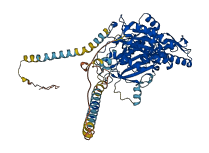
Descriptions
The autoinhibited protein was predicted that may have potential autoinhibitory elements via cis-regPred.
Autoinhibitory domains (AIDs)
Target domain |
|
Relief mechanism |
|
Assay |
cis-regPred |
Accessory elements
No accessory elements
Autoinhibited structure

Activated structure
1 structures for Q3TCT4
| Entry ID | Method | Resolution | Chain | Position | Source |
|---|---|---|---|---|---|
| AF-Q3TCT4-F1 | Predicted | AlphaFoldDB |
31 variants for Q3TCT4
| Variant ID(s) | Position | Change | Description | Diseaes Association | Provenance |
|---|---|---|---|---|---|
| rs236106408 | 9 | L>I | No | EVA | |
| rs250432082 | 49 | L>I | No | EVA | |
| rs3389550756 | 171 | I>T | No | EVA | |
| rs3389534174 | 172 | L>P | No | EVA | |
| rs3389550837 | 243 | S>F | No | EVA | |
| rs3409373493 | 308 | Y>H | No | EVA | |
| rs3389542196 | 326 | D>Y | No | EVA | |
| rs3389520693 | 355 | C>Y | No | EVA | |
| rs253576373 | 363 | M>V | No | EVA | |
| rs263881784 | 368 | N>S | No | EVA | |
| rs3389497288 | 380 | A>T | No | EVA | |
| rs234697484 | 385 | L>M | No | EVA | |
| rs3389540743 | 392 | R>P | No | EVA | |
| rs3389449387 | 396 | S>N | No | EVA | |
| rs3389540729 | 397 | Q>H | No | EVA | |
| rs3389497342 | 398 | A>D | No | EVA | |
| rs3389534130 | 398 | A>P | No | EVA | |
| rs3389497342 | 398 | A>V | No | EVA | |
| rs3389542215 | 408 | I>L | No | EVA | |
| rs3389556657 | 408 | I>N | No | EVA | |
| rs3389542175 | 409 | D>Y | No | EVA | |
| rs3389520725 | 410 | F>L | No | EVA | |
| rs3389507463 | 456 | A>V | No | EVA | |
| rs3389449377 | 496 | D>N | No | EVA | |
| rs3389556619 | 536 | G>* | No | EVA | |
| rs3389541344 | 563 | V>M | No | EVA | |
| rs3389534394 | 571 | L>H | No | EVA | |
| rs3389489551 | 590 | L>V | No | EVA | |
| rs3389489532 | 591 | L>M | No | EVA | |
| rs3389449333 | 595 | Q>* | No | EVA | |
| rs3389542163 | 600 | I>V | No | EVA |
No associated diseases with Q3TCT4
No regional properties for Q3TCT4
| Type | Name | Position | InterPro Accession |
|---|---|---|---|
| No domain, repeats, and functional sites for Q3TCT4 | |||
Functions
| Description | ||
|---|---|---|
| EC Number | 3.6.1.15 | In phosphorus-containing anhydrides |
| Subcellular Localization |
|
|
| PANTHER Family | ||
| PANTHER Subfamily | ||
| PANTHER Protein Class | ||
| PANTHER Pathway Category | No pathway information available | |
5 GO annotations of cellular component
| Name | Definition |
|---|---|
| cytoplasmic vesicle membrane | The lipid bilayer surrounding a cytoplasmic vesicle. |
| Golgi apparatus | A membrane-bound cytoplasmic organelle of the endomembrane system that further processes the core oligosaccharides (e.g. N-glycans) added to proteins in the endoplasmic reticulum and packages them into membrane-bound vesicles. The Golgi apparatus operates at the intersection of the secretory, lysosomal, and endocytic pathways. |
| integral component of membrane | The component of a membrane consisting of the gene products and protein complexes having at least some part of their peptide sequence embedded in the hydrophobic region of the membrane. |
| membrane | A lipid bilayer along with all the proteins and protein complexes embedded in it an attached to it. |
| nucleus | A membrane-bounded organelle of eukaryotic cells in which chromosomes are housed and replicated. In most cells, the nucleus contains all of the cell's chromosomes except the organellar chromosomes, and is the site of RNA synthesis and processing. In some species, or in specialized cell types, RNA metabolism or DNA replication may be absent. |
8 GO annotations of molecular function
| Name | Definition |
|---|---|
| ATP hydrolysis activity | Catalysis of the reaction: ATP + H2O = ADP + H+ phosphate. ATP hydrolysis is used in some reactions as an energy source, for example to catalyze a reaction or drive transport against a concentration gradient. |
| CTPase activity | Catalysis of the reaction: CTP + H2O = CDP + H+ + phosphate. May or may not be coupled to another reaction. |
| GDP phosphatase activity | Catalysis of the reaction: GDP + H2O = GMP + phosphate. |
| GTPase activity | Catalysis of the reaction: GTP + H2O = GDP + H+ + phosphate. |
| metal ion binding | Binding to a metal ion. |
| nucleoside diphosphate phosphatase activity | Catalysis of the reaction: a nucleoside diphosphate + H2O = a nucleoside monophosphate + phosphate. |
| ribonucleoside triphosphate phosphatase activity | Catalysis of the reaction: a ribonucleoside triphosphate + H2O = a ribonucleoside diphosphate + H+ + phosphate. |
| UDP phosphatase activity | Catalysis of the reaction: UDP + H2O = UMP + phosphate. |
10 GO annotations of biological process
| Name | Definition |
|---|---|
| CTP catabolic process | The chemical reactions and pathways resulting in the breakdown of CTP, cytidine 5'-triphosphate. |
| GTP metabolic process | The chemical reactions and pathways involving GTP, guanosine triphosphate. |
| nucleobase-containing small molecule catabolic process | The chemical reactions and pathways resulting in the breakdown of a nucleobase-containing small molecule: a nucleobase, a nucleoside, or a nucleotide. |
| nucleoside diphosphate catabolic process | The chemical reactions and pathways resulting in the breakdown of a nucleoside diphosphate, a compound consisting of a nucleobase linked to a deoxyribose or ribose sugar esterified with diphosphate on the sugar. |
| regulation of immune response | Any process that modulates the frequency, rate or extent of the immune response, the immunological reaction of an organism to an immunogenic stimulus. |
| ribonucleoside diphosphate catabolic process | The chemical reactions and pathways resulting in the breakdown of a ribonucleoside diphosphate, a compound consisting of a nucleobase linked to a ribose sugar esterified with diphosphate on the sugar. |
| ribonucleoside triphosphate catabolic process | The chemical reactions and pathways resulting in the breakdown of a ribonucleoside triphosphate, a compound consisting of a nucleobase linked to a ribose sugar esterified with triphosphate on the sugar. |
| T-helper 17 cell differentiation | The process in which a relatively unspecialized T cell acquires the specialized features of a T-helper 17 (Th17) cell. A Th17 cell is a CD4-positive, alpha-beta T cell with the phenotype RORgamma-t-positive that produces IL-17. |
| UDP catabolic process | The chemical reactions and pathways resulting in the breakdown of UDP, uridine (5'-)diphosphate. |
| UTP catabolic process | The chemical reactions and pathways resulting in the breakdown of UTP, uridine (5'-)triphosphate. |
3 homologous proteins in AiPD
| UniProt AC | Gene Name | Protein Name | Species | Evidence Code |
|---|---|---|---|---|
| Q9NQZ7 | ENTPD7 | Ectonucleoside triphosphate diphosphohydrolase 7 | Homo sapiens (Human) | PR |
| P55772 | Entpd1 | Ectonucleoside triphosphate diphosphohydrolase 1 | Mus musculus (Mouse) | PR |
| P97687 | Entpd1 | Ectonucleoside triphosphate diphosphohydrolase 1 | Rattus norvegicus (Rat) | PR |
| 10 | 20 | 30 | 40 | 50 | 60 |
| MARISFSYLC | PASWYFTVPT | VSPFLRQRVA | FLGLFFIPCV | LLLLLIMDLR | HWATSLPRDR |
| 70 | 80 | 90 | 100 | 110 | 120 |
| QYERYLARVG | DLEATNTEDP | NLNYGLVVDC | GSSGSRIFVY | FWPRHNGNPH | DLLDIKQMRD |
| 130 | 140 | 150 | 160 | 170 | 180 |
| RNSQPVVKKI | KPGISAMADT | PEHASDYLRP | LLSFAAAHVP | VKKHRETPLY | ILCTAGMRLL |
| 190 | 200 | 210 | 220 | 230 | 240 |
| PERQQLAILA | DLVKDLPLEF | DFLFSQSQAE | VISGKQEGVY | AWIGINFVLG | RFDHEDESDS |
| 250 | 260 | 270 | 280 | 290 | 300 |
| DTSVDSAAGR | RRTVGILDMG | GASLQIAYEV | PTSASDLPPK | QEEAAKILLA | EFNLGCDVQH |
| 310 | 320 | 330 | 340 | 350 | 360 |
| TEHVYRVYVT | TFLGFGGNFA | RQRYEDLVLN | ETLNKNRLLG | QKTGLSPDNP | FLDPCLPVGL |
| 370 | 380 | 390 | 400 | 410 | 420 |
| TDMVKRNNQV | LHFRGKGDWA | SCRTLLSPLL | ARSNTSQASL | NGIYQSPIDF | NNSEFYGFSE |
| 430 | 440 | 450 | 460 | 470 | 480 |
| FFYCTEDVLR | IGGHYHGPTF | AKAAQDYCGM | AWPVLAQRFK | NGLFSSHADE | HRLKYQCFKS |
| 490 | 500 | 510 | 520 | 530 | 540 |
| AWMYEVLHEG | FHFPYDYPNL | QTAQLVYDRE | VQWTLGAILY | KTRFLPLRDL | RQGQGGVRPA |
| 550 | 560 | 570 | 580 | 590 | 600 |
| HGSWLRLSFV | YNHYLFFACT | LVVLLAIVLY | LLRIHRIHRR | QTRASAPLDL | LWIEQVVPMI |
| GVQVGP |