P55772
Gene name |
Entpd1 (Cd39) |
Protein name |
Ectonucleoside triphosphate diphosphohydrolase 1 |
Names |
|
Species |
Mus musculus (Mouse) |
KEGG Pathway |
mmu:12495 |
EC number |
3.6.1.5: In phosphorus-containing anhydrides |
Protein Class |
|
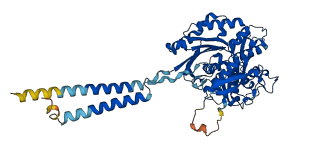
Descriptions
The autoinhibited protein was predicted that may have potential autoinhibitory elements via cis-regPred.
Autoinhibitory domains (AIDs)
Target domain |
|
Relief mechanism |
|
Assay |
cis-regPred |
Accessory elements
No accessory elements
Autoinhibited structure

Activated structure
1 structures for P55772
| Entry ID | Method | Resolution | Chain | Position | Source |
|---|---|---|---|---|---|
| AF-P55772-F1 | Predicted | AlphaFoldDB |
29 variants for P55772
| Variant ID(s) | Position | Change | Description | Diseaes Association | Provenance |
|---|---|---|---|---|---|
| rs3389495557 | 84 | C>Y | No | EVA | |
| rs248887205 | 91 | I>V | No | EVA | |
| rs3389548497 | 115 | L>P | No | EVA | |
| rs258492218 | 121 | H>Q | No | EVA | |
| rs3389505237 | 149 | L>Q | No | EVA | |
| rs50631529 | 158 | S>G | No | EVA | |
| rs3389550705 | 170 | T>I | No | EVA | |
| rs3389554309 | 172 | Q>K | No | EVA | |
| rs3389486377 | 180 | I>N | No | EVA | |
| rs3389543341 | 183 | N>T | No | EVA | |
| rs3389550723 | 187 | G>D | No | EVA | |
| rs3389532447 | 190 | T>I | No | EVA | |
| rs262287260 | 276 | V>I | No | EVA | |
| rs235685804 | 289 | V>I | No | EVA | |
| rs254463842 | 302 | K>E | No | EVA | |
| rs254415654 | 312 | Q>R | No | EVA | |
| rs215791797 | 314 | R>Q | No | EVA | |
| rs3409437576 | 320 | D>V | No | EVA | |
| rs3389518247 | 347 | V>I | No | EVA | |
| rs3389518247 | 347 | V>L | No | EVA | |
| rs3389495534 | 354 | G>W | No | EVA | |
| rs3389554362 | 364 | F>I | No | EVA | |
| rs3389505283 | 369 | F>L | No | EVA | |
| rs3389543427 | 372 | V>L | No | EVA | |
| rs3389532424 | 373 | A>S | No | EVA | |
| rs3389505239 | 397 | E>G | No | EVA | |
| rs3389518201 | 406 | K>M | No | EVA | |
| rs253593016 | 438 | H>Y | No | EVA | |
| rs215403547 | 507 | K>N | No | EVA |
No associated diseases with P55772
No regional properties for P55772
| Type | Name | Position | InterPro Accession |
|---|---|---|---|
| No domain, repeats, and functional sites for P55772 | |||
Functions
| Description | ||
|---|---|---|
| EC Number | 3.6.1.5 | In phosphorus-containing anhydrides |
| Subcellular Localization |
|
|
| PANTHER Family | ||
| PANTHER Subfamily | ||
| PANTHER Protein Class | ||
| PANTHER Pathway Category | No pathway information available | |
13 GO annotations of cellular component
| Name | Definition |
|---|---|
| basement membrane | A collagen-containing extracellular matrix consisting of a thin layer of dense material found in various animal tissues interposed between the cells and the adjacent connective tissue. It consists of the basal lamina plus an associated layer of reticulin fibers. |
| basolateral plasma membrane | The region of the plasma membrane that includes the basal end and sides of the cell. Often used in reference to animal polarized epithelial membranes, where the basal membrane is the part attached to the extracellular matrix, or in plant cells, where the basal membrane is defined with respect to the zygotic axis. |
| cell surface | The external part of the cell wall and/or plasma membrane. |
| external side of plasma membrane | The leaflet of the plasma membrane that faces away from the cytoplasm and any proteins embedded or anchored in it or attached to its surface. |
| extracellular space | That part of a multicellular organism outside the cells proper, usually taken to be outside the plasma membranes, and occupied by fluid. |
| integral component of membrane | The component of a membrane consisting of the gene products and protein complexes having at least some part of their peptide sequence embedded in the hydrophobic region of the membrane. |
| membrane | A lipid bilayer along with all the proteins and protein complexes embedded in it an attached to it. |
| neuron projection | A prolongation or process extending from a nerve cell, e.g. an axon or dendrite. |
| neuronal cell body | The portion of a neuron that includes the nucleus, but excludes cell projections such as axons and dendrites. |
| plasma membrane | The membrane surrounding a cell that separates the cell from its external environment. It consists of a phospholipid bilayer and associated proteins. |
| postsynaptic density | An electron dense network of proteins within and adjacent to the postsynaptic membrane of an asymmetric, neuron-neuron synapse. Its major components include neurotransmitter receptors and the proteins that spatially and functionally organize them such as anchoring and scaffolding molecules, signaling enzymes and cytoskeletal components. |
| synaptic membrane | A specialized area of membrane on either the presynaptic or the postsynaptic side of a synapse, the junction between a nerve fiber of one neuron and another neuron or muscle fiber or glial cell. |
| synaptic vesicle | A secretory organelle, typically 50 nm in diameter, of presynaptic nerve terminals; accumulates in high concentrations of neurotransmitters and secretes these into the synaptic cleft by fusion with the 'active zone' of the presynaptic plasma membrane. |
8 GO annotations of molecular function
| Name | Definition |
|---|---|
| ADP phosphatase activity | Catalysis of the reaction: ADP + H2O = AMP + phosphate. |
| ATP binding | Binding to ATP, adenosine 5'-triphosphate, a universally important coenzyme and enzyme regulator. |
| ATP hydrolysis activity | Catalysis of the reaction: ATP + H2O = ADP + H+ phosphate. ATP hydrolysis is used in some reactions as an energy source, for example to catalyze a reaction or drive transport against a concentration gradient. |
| GDP phosphatase activity | Catalysis of the reaction: GDP + H2O = GMP + phosphate. |
| identical protein binding | Binding to an identical protein or proteins. |
| nucleoside diphosphate phosphatase activity | Catalysis of the reaction: a nucleoside diphosphate + H2O = a nucleoside monophosphate + phosphate. |
| ribonucleoside triphosphate phosphatase activity | Catalysis of the reaction: a ribonucleoside triphosphate + H2O = a ribonucleoside diphosphate + H+ + phosphate. |
| UDP phosphatase activity | Catalysis of the reaction: UDP + H2O = UMP + phosphate. |
7 GO annotations of biological process
| Name | Definition |
|---|---|
| ADP catabolic process | The chemical reactions and pathways resulting in the breakdown of ADP, adenosine 5'-diphosphate. |
| G protein-coupled receptor signaling pathway | The series of molecular signals initiated by a ligand binding to its receptor, in which the activated receptor promotes the exchange of GDP for GTP on the alpha-subunit of an associated heterotrimeric G-protein complex. The GTP-bound activated alpha-G-protein then dissociates from the beta- and gamma-subunits to further transmit the signal within the cell. The pathway begins with receptor-ligand interaction, and ends with regulation of a downstream cellular process. The pathway can start from the plasma membrane, Golgi or nuclear membrane. |
| negative regulation of ATP biosynthetic process | Any process that stops, prevents or reduces the frequency, rate or extent of ATP biosynthetic process. |
| negative regulation of dopamine secretion | Any process that stops, prevents, or reduces the frequency, rate or extent of the regulated release of dopamine. |
| nucleoside diphosphate catabolic process | The chemical reactions and pathways resulting in the breakdown of a nucleoside diphosphate, a compound consisting of a nucleobase linked to a deoxyribose or ribose sugar esterified with diphosphate on the sugar. |
| platelet activation | A series of progressive, overlapping events triggered by exposure of the platelets to subendothelial tissue. These events include shape change, adhesiveness, aggregation, and release reactions. When carried through to completion, these events lead to the formation of a stable hemostatic plug. |
| purine ribonucleoside diphosphate catabolic process | The chemical reactions and pathways resulting in the breakdown of purine ribonucleoside diphosphate, a compound consisting of a purine base linked to a ribose sugar esterified with diphosphate on the sugar. |
3 homologous proteins in AiPD
| UniProt AC | Gene Name | Protein Name | Species | Evidence Code |
|---|---|---|---|---|
| Q9NQZ7 | ENTPD7 | Ectonucleoside triphosphate diphosphohydrolase 7 | Homo sapiens (Human) | PR |
| Q3TCT4 | Entpd7 | Ectonucleoside triphosphate diphosphohydrolase 7 | Mus musculus (Mouse) | PR |
| P97687 | Entpd1 | Ectonucleoside triphosphate diphosphohydrolase 1 | Rattus norvegicus (Rat) | PR |
| 10 | 20 | 30 | 40 | 50 | 60 |
| MEDIKDSKVK | RFCSKNILII | LGFTSILAVI | ALIAVGLTQN | KPLPENVKYG | IVLDAGSSHT |
| 70 | 80 | 90 | 100 | 110 | 120 |
| NLYIYKWPAE | KENDTGVVQQ | LEECQVKGPG | ISKYAQKTDE | IGAYLAECME | LSTELIPTSK |
| 130 | 140 | 150 | 160 | 170 | 180 |
| HHQTPVYLGA | TAGMRLLRME | SEQSADEVLA | AVSTSLKSYP | FDFQGAKIIT | GQEEGAYGWI |
| 190 | 200 | 210 | 220 | 230 | 240 |
| TINYLLGRFT | QEQSWLSLIS | DSQKQETFGA | LDLGGASTQI | TFVPQNSTIE | SPENSLQFRL |
| 250 | 260 | 270 | 280 | 290 | 300 |
| YGEDYTVYTH | SFLCYGKDQA | LWQKLAKDIQ | VSSGGVLKDP | CFNPGYEKVV | NVSELYGTPC |
| 310 | 320 | 330 | 340 | 350 | 360 |
| TKRFEKKLPF | DQFRIQGTGD | YEQCHQSILE | LFNNSHCPYS | QCAFNGVFLP | PLHGSFGAFS |
| 370 | 380 | 390 | 400 | 410 | 420 |
| AFYFVMDFFK | KVAKNSVISQ | EKMTEITKNF | CSKSWEETKT | SYPSVKEKYL | SEYCFSGAYI |
| 430 | 440 | 450 | 460 | 470 | 480 |
| LSLLQGYNFT | DSSWEQIHFM | GKIKDSNAGW | TLGYMLNLTN | MIPAEQPLSP | PLPHSTYIGL |
| 490 | 500 | ||||
| MVLFSLLLVA | VAITGLFIYS | KPSYFWKEAV |