Q3TCH7
Gene name |
Cul4a |
Protein name |
Cullin-4A |
Names |
CUL-4A |
Species |
Mus musculus (Mouse) |
KEGG Pathway |
mmu:99375 |
EC number |
|
Protein Class |
|
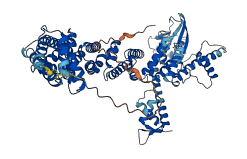
Descriptions
The autoinhibited protein was predicted that may have potential autoinhibitory elements via cis-regPred.
Autoinhibitory domains (AIDs)
Target domain |
|
Relief mechanism |
|
Assay |
cis-regPred |
Accessory elements
No accessory elements
Autoinhibited structure

Activated structure
1 structures for Q3TCH7
| Entry ID | Method | Resolution | Chain | Position | Source |
|---|---|---|---|---|---|
| AF-Q3TCH7-F1 | Predicted | AlphaFoldDB |
19 variants for Q3TCH7
| Variant ID(s) | Position | Change | Description | Diseaes Association | Provenance |
|---|---|---|---|---|---|
| rs3388974361 | 99 | S>P | No | EVA | |
| rs3388972298 | 157 | D>E | No | EVA | |
| rs3388964499 | 157 | D>V | No | EVA | |
| rs3388972501 | 164 | N>S | No | EVA | |
| rs3388974965 | 177 | L>Q | No | EVA | |
| rs3388967133 | 265 | K>I | No | EVA | |
| rs3388972490 | 282 | T>I | No | EVA | |
| rs3398737117 | 320 | T>I | No | EVA | |
| rs3388923671 | 384 | E>K | No | EVA | |
| rs3388974383 | 387 | I>S | No | EVA | |
| rs223013140 | 388 | N>K | No | EVA | |
| rs3398286869 | 388 | N>S | No | EVA | |
| rs3388974937 | 457 | L>V | No | EVA | |
| rs3388963350 | 502 | K>N | No | EVA | |
| rs3388974453 | 530 | M>I | No | EVA | |
| rs3388972034 | 531 | G>A | No | EVA | |
| rs3388974363 | 558 | Y>* | No | EVA | |
| rs3388971974 | 573 | L>R | No | EVA | |
| rs3388969801 | 706 | M>I | No | EVA |
No associated diseases with Q3TCH7
4 GO annotations of cellular component
| Name | Definition |
|---|---|
| Cul4-RING E3 ubiquitin ligase complex | A ubiquitin ligase complex in which a cullin from the Cul4 family and a RING domain protein form the catalytic core; substrate specificity is conferred by an adaptor protein. |
| Cul4A-RING E3 ubiquitin ligase complex | A ubiquitin ligase complex in which a cullin from the Cul4A subfamily and a RING domain protein form the catalytic core; substrate specificity is conferred by an adaptor protein. |
| cullin-RING ubiquitin ligase complex | Any ubiquitin ligase complex in which the catalytic core consists of a member of the cullin family and a RING domain protein; the core is associated with one or more additional proteins that confer substrate specificity. |
| nucleus | A membrane-bounded organelle of eukaryotic cells in which chromosomes are housed and replicated. In most cells, the nucleus contains all of the cell's chromosomes except the organellar chromosomes, and is the site of RNA synthesis and processing. In some species, or in specialized cell types, RNA metabolism or DNA replication may be absent. |
2 GO annotations of molecular function
| Name | Definition |
|---|---|
| protein-macromolecule adaptor activity | The binding activity of a protein that brings together two or more macromolecules in contact, permitting those molecules to function in a coordinated way. The adaptor can bring together two proteins, or a protein and another macromolecule such as a lipid or a nucleic acid. |
| ubiquitin protein ligase binding | Binding to a ubiquitin protein ligase enzyme, any of the E3 proteins. |
20 GO annotations of biological process
| Name | Definition |
|---|---|
| cell population proliferation | The multiplication or reproduction of cells, resulting in the expansion of a cell population. |
| cellular response to DNA damage stimulus | Any process that results in a change in state or activity of a cell (in terms of movement, secretion, enzyme production, gene expression, etc.) as a result of a stimulus indicating damage to its DNA from environmental insults or errors during metabolism. |
| cellular response to UV | Any process that results in a change in state or activity of a cell (in terms of movement, secretion, enzyme production, gene expression, etc.) as a result of an ultraviolet radiation (UV light) stimulus. Ultraviolet radiation is electromagnetic radiation with a wavelength in the range of 10 to 380 nanometers. |
| DNA repair | The process of restoring DNA after damage. Genomes are subject to damage by chemical and physical agents in the environment (e.g. UV and ionizing radiations, chemical mutagens, fungal and bacterial toxins, etc.) and by free radicals or alkylating agents endogenously generated in metabolism. DNA is also damaged because of errors during its replication. A variety of different DNA repair pathways have been reported that include direct reversal, base excision repair, nucleotide excision repair, photoreactivation, bypass, double-strand break repair pathway, and mismatch repair pathway. |
| hemopoiesis | The process whose specific outcome is the progression of the myeloid and lymphoid derived organ/tissue systems of the blood and other parts of the body over time, from formation to the mature structure. The site of hemopoiesis is variable during development, but occurs primarily in bone marrow or kidney in many adult vertebrates. |
| in utero embryonic development | The process whose specific outcome is the progression of the embryo in the uterus over time, from formation of the zygote in the oviduct, to birth. An example of this process is found in Mus musculus. |
| negative regulation of granulocyte differentiation | Any process that stops, prevents, or reduces the frequency, rate or extent of granulocyte differentiation. |
| positive regulation of cell population proliferation | Any process that activates or increases the rate or extent of cell proliferation. |
| positive regulation of G1/S transition of mitotic cell cycle | Any signalling pathway that increases or activates a cell cycle cyclin-dependent protein kinase to modulate the switch from G1 phase to S phase of the mitotic cell cycle. |
| positive regulation of protein catabolic process | Any process that activates or increases the frequency, rate or extent of the chemical reactions and pathways resulting in the breakdown of a protein by the destruction of the native, active configuration, with or without the hydrolysis of peptide bonds. |
| proteasome-mediated ubiquitin-dependent protein catabolic process | The chemical reactions and pathways resulting in the breakdown of a protein or peptide by hydrolysis of its peptide bonds, initiated by the covalent attachment of ubiquitin, and mediated by the proteasome. |
| protein ubiquitination | The process in which one or more ubiquitin groups are added to a protein. |
| regulation of DNA damage checkpoint | Any process that modulates the frequency, rate or extent of a DNA damage checkpoint. |
| regulation of nucleotide-excision repair | Any process that modulates the frequency, rate or extent of nucleotide-excision repair. |
| regulation of protein metabolic process | Any process that modulates the frequency, rate or extent of the chemical reactions and pathways involving a protein. |
| rhythmic process | Any process pertinent to the generation and maintenance of rhythms in the physiology of an organism. |
| ribosome biogenesis | A cellular process that results in the biosynthesis of constituent macromolecules, assembly, and arrangement of constituent parts of ribosome subunits; includes transport to the sites of protein synthesis. |
| SCF-dependent proteasomal ubiquitin-dependent protein catabolic process | The chemical reactions and pathways resulting in the breakdown of a protein or peptide by hydrolysis of its peptide bonds, initiated by the covalent attachment of ubiquitin, with ubiquitin-protein ligation catalyzed by an SCF (Skp1/Cul1/F-box protein) complex, and mediated by the proteasome. |
| somatic stem cell population maintenance | Any process by which an organism retains a population of somatic stem cells, undifferentiated cells in the embryo or adult which can undergo unlimited division and give rise to cell types of the body other than those of the germ-line. |
| ubiquitin-dependent protein catabolic process | The chemical reactions and pathways resulting in the breakdown of a protein or peptide by hydrolysis of its peptide bonds, initiated by the covalent attachment of a ubiquitin group, or multiple ubiquitin groups, to the protein. |
5 homologous proteins in AiPD
| UniProt AC | Gene Name | Protein Name | Species | Evidence Code |
|---|---|---|---|---|
| Q13620 | CUL4B | Cullin-4B | Homo sapiens (Human) | PR |
| Q13619 | CUL4A | Cullin-4A | Homo sapiens (Human) | PR |
| A2A432 | Cul4b | Cullin-4B | Mus musculus (Mouse) | PR |
| Q17392 | cul-4 | Cullin-4 | Caenorhabditis elegans | PR |
| P0CH31 | At1g43140 | Putative cullin-like protein 1 | Arabidopsis thaliana (Mouse-ear cress) | PR |
| 10 | 20 | 30 | 40 | 50 | 60 |
| MADEGPRKGS | VSALMGRTNG | LTKPAALAGG | PAKPGGTGGS | RKLVIKNFRD | RPRLPDNYTQ |
| 70 | 80 | 90 | 100 | 110 | 120 |
| DTWRKLHEAV | KAIQSSTSIR | YNLEELYQAV | ENLCSHKVSP | TLYKQLRQVC | EDHVQAQILP |
| 130 | 140 | 150 | 160 | 170 | 180 |
| FREDSLDSVL | FLKKINTCWQ | DHCRQMIMIR | SIFLFLDRTY | VLQNSMLPSI | WDMGLELFRN |
| 190 | 200 | 210 | 220 | 230 | 240 |
| HIISDRMVQS | KTIDGILLLI | GRERSGEAVD | RSLLRSLLSM | LSDLQVYKDS | FELKFLEETN |
| 250 | 260 | 270 | 280 | 290 | 300 |
| CLYAAEGQRL | MQDREVPEYL | NHVSKRLEEE | ADRVITYLDH | STQKPLIACV | EKQLLGEHLT |
| 310 | 320 | 330 | 340 | 350 | 360 |
| AILQKGLEHL | LDENRVPDLT | QMYQLFSRVK | GGQHALLQHW | SEYIKTFGTT | IVINPEKDKD |
| 370 | 380 | 390 | 400 | 410 | 420 |
| MVQDLLDFKD | KVDHVVEVCF | QRNERFINLM | KESFETFINK | RPNKPAELIA | KHVDSKLRAG |
| 430 | 440 | 450 | 460 | 470 | 480 |
| NKEATDEELE | RILDKIMILF | RFIHGKDVFE | AFYKKDLAKR | LLVGKSASVD | AEKSMLSKLK |
| 490 | 500 | 510 | 520 | 530 | 540 |
| HECGAAFTSK | LEGMFKDMEL | SKDIMVHFKQ | HMQNQSAPGP | IDLTVNILTM | GYWPTYTPME |
| 550 | 560 | 570 | 580 | 590 | 600 |
| VHLPPEMVRL | QEVFKTFYLG | KHSGRKLQWQ | TTLGHAVLKA | DFKEGKKEFQ | VSLFQTLVLL |
| 610 | 620 | 630 | 640 | 650 | 660 |
| MFNEGDGFSF | EEIKMATGIE | DSELRRTLQS | LACGKARVLI | KSPKGKEVED | GDKFIFNADF |
| 670 | 680 | 690 | 700 | 710 | 720 |
| KHKLFRIKIN | QIQMKETVEE | QVSTTERVFQ | DRQYQIDAAI | VRIMKMRKTL | GHNLLVSELY |
| 730 | 740 | 750 | |||
| NQLKFPVKPG | DLKKRIESLI | DRDYMERDKD | SPNQYHYVA |