A2A432
Gene name |
Cul4b |
Protein name |
Cullin-4B |
Names |
CUL-4B |
Species |
Mus musculus (Mouse) |
KEGG Pathway |
mmu:72584 |
EC number |
|
Protein Class |
|
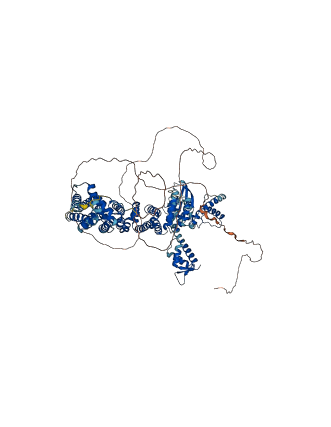
Descriptions
The autoinhibited protein was predicted that may have potential autoinhibitory elements via cis-regPred.
Autoinhibitory domains (AIDs)
Target domain |
|
Relief mechanism |
|
Assay |
cis-regPred |
Accessory elements
No accessory elements
Autoinhibited structure

Activated structure
1 structures for A2A432
| Entry ID | Method | Resolution | Chain | Position | Source |
|---|---|---|---|---|---|
| AF-A2A432-F1 | Predicted | AlphaFoldDB |
55 variants for A2A432
| Variant ID(s) | Position | Change | Description | Diseaes Association | Provenance |
|---|---|---|---|---|---|
| rs3389568652 | 5 | T>A | No | EVA | |
| rs3409888880 | 53 | T>I | No | EVA | |
| rs3410259325 | 89 | S>T | No | EVA | |
| rs3410259298 | 94 | E>V | No | EVA | |
| rs3408803758 | 95 | V>G | No | EVA | |
| rs3409517145 | 96 | R>G | No | EVA | |
| rs3410504992 | 97 | S>C | No | EVA | |
| rs3410259358 | 102 | N>I | No | EVA | |
| rs3410135172 | 104 | S>I | No | EVA | |
| rs3408722412 | 105 | T>S | No | EVA | |
| rs3409879396 | 209 | Q>L | No | EVA | |
| rs3408803733 | 211 | Q>* | No | EVA | |
| rs3409888838 | 244 | A>V | No | EVA | |
| rs3409998369 | 253 | K>T | No | EVA | |
| rs3389568835 | 315 | K>T | No | EVA | |
| rs3389572260 | 321 | C>Y | No | EVA | |
| rs3389504919 | 322 | E>G | No | EVA | |
| rs3410505005 | 329 | I>V | No | EVA | |
| rs3409888869 | 374 | Q>K | No | EVA | |
| rs3389465093 | 382 | W>C | No | EVA | |
| rs3389549667 | 384 | M>V | No | EVA | |
| rs3389556606 | 385 | G>R | No | EVA | |
| rs3389514101 | 391 | A>V | No | EVA | |
| rs3389504946 | 402 | K>T | No | EVA | |
| rs3389557744 | 411 | I>N | No | EVA | |
| rs3389549668 | 418 | E>V | No | EVA | |
| rs3389558266 | 436 | Q>H | No | EVA | |
| rs3389523687 | 446 | F>L | No | EVA | |
| rs3389551929 | 481 | E>D | No | EVA | |
| rs3389561058 | 516 | K>N | No | EVA | |
| rs3389568589 | 540 | V>L | No | EVA | |
| rs3409888850 | 572 | M>I | No | EVA | |
| rs3408803720 | 573 | V>L | No | EVA | |
| rs13471580 | 593 | K>E | No | EVA | |
| rs3389504973 | 619 | L>V | No | EVA | |
| rs3409879414 | 620 | I>R | No | EVA | |
| rs3389561060 | 624 | V>M | No | EVA | |
| rs3389504993 | 640 | L>* | No | EVA | |
| rs3389557703 | 641 | E>G | No | EVA | |
| rs3389556515 | 657 | K>* | No | EVA | |
| rs3389551856 | 657 | K>E | No | EVA | |
| rs3389514086 | 667 | D>V | No | EVA | |
| rs3389558234 | 725 | N>S | No | EVA | |
| rs3389504982 | 786 | H>Q | No | EVA | |
| rs3408803744 | 801 | Q>R | No | EVA | |
| rs3389523747 | 803 | S>F | No | EVA | |
| rs3389553214 | 804 | L>P | No | EVA | |
| rs3389523732 | 820 | S>R | No | EVA | |
| rs3389561078 | 853 | N>I | No | EVA | |
| rs3389556514 | 898 | R>T | No | EVA | |
| rs3389523674 | 910 | A>V | No | EVA | |
| rs3389572231 | 919 | K>I | No | EVA | |
| rs3408721511 | 958 | R>S | No | EVA | |
| rs3409168953 | 962 | N>Y | No | EVA | |
| rs3389557685 | 971 | A>S | No | EVA |
No associated diseases with A2A432
Functions
7 GO annotations of cellular component
| Name | Definition |
|---|---|
| Cul4-RING E3 ubiquitin ligase complex | A ubiquitin ligase complex in which a cullin from the Cul4 family and a RING domain protein form the catalytic core; substrate specificity is conferred by an adaptor protein. |
| Cul4A-RING E3 ubiquitin ligase complex | A ubiquitin ligase complex in which a cullin from the Cul4A subfamily and a RING domain protein form the catalytic core; substrate specificity is conferred by an adaptor protein. |
| Cul4B-RING E3 ubiquitin ligase complex | A ubiquitin ligase complex in which a cullin from the Cul4B subfamily and a RING domain protein form the catalytic core; substrate specificity is conferred by unknown subunits. |
| cullin-RING ubiquitin ligase complex | Any ubiquitin ligase complex in which the catalytic core consists of a member of the cullin family and a RING domain protein; the core is associated with one or more additional proteins that confer substrate specificity. |
| cytosol | The part of the cytoplasm that does not contain organelles but which does contain other particulate matter, such as protein complexes. |
| nucleoplasm | That part of the nuclear content other than the chromosomes or the nucleolus. |
| nucleus | A membrane-bounded organelle of eukaryotic cells in which chromosomes are housed and replicated. In most cells, the nucleus contains all of the cell's chromosomes except the organellar chromosomes, and is the site of RNA synthesis and processing. In some species, or in specialized cell types, RNA metabolism or DNA replication may be absent. |
3 GO annotations of molecular function
| Name | Definition |
|---|---|
| damaged DNA binding | Binding to damaged DNA. |
| protein-macromolecule adaptor activity | The binding activity of a protein that brings together two or more macromolecules in contact, permitting those molecules to function in a coordinated way. The adaptor can bring together two proteins, or a protein and another macromolecule such as a lipid or a nucleic acid. |
| ubiquitin protein ligase binding | Binding to a ubiquitin protein ligase enzyme, any of the E3 proteins. |
14 GO annotations of biological process
| Name | Definition |
|---|---|
| astrocyte differentiation | The process in which a relatively unspecialized cell acquires the specialized features of an astrocyte. An astrocyte is the most abundant type of glial cell. Astrocytes provide support for neurons and regulate the environment in which they function. |
| cell cycle | The progression of biochemical and morphological phases and events that occur in a cell during successive cell replication or nuclear replication events. Canonically, the cell cycle comprises the replication and segregation of genetic material followed by the division of the cell, but in endocycles or syncytial cells nuclear replication or nuclear division may not be followed by cell division. |
| cellular response to DNA damage stimulus | Any process that results in a change in state or activity of a cell (in terms of movement, secretion, enzyme production, gene expression, etc.) as a result of a stimulus indicating damage to its DNA from environmental insults or errors during metabolism. |
| cellular response to UV | Any process that results in a change in state or activity of a cell (in terms of movement, secretion, enzyme production, gene expression, etc.) as a result of an ultraviolet radiation (UV light) stimulus. Ultraviolet radiation is electromagnetic radiation with a wavelength in the range of 10 to 380 nanometers. |
| gene expression | The process in which a gene's sequence is converted into a mature gene product (protein or RNA). This includes the production of an RNA transcript and its processing, translation and maturation for protein-coding genes. |
| histone H2A monoubiquitination | The modification of histone H2A by addition of a single ubiquitin group. |
| neuron projection development | The process whose specific outcome is the progression of a neuron projection over time, from its formation to the mature structure. A neuron projection is any process extending from a neural cell, such as axons or dendrites (collectively called neurites). |
| positive regulation of G1/S transition of mitotic cell cycle | Any signalling pathway that increases or activates a cell cycle cyclin-dependent protein kinase to modulate the switch from G1 phase to S phase of the mitotic cell cycle. |
| positive regulation of protein catabolic process | Any process that activates or increases the frequency, rate or extent of the chemical reactions and pathways resulting in the breakdown of a protein by the destruction of the native, active configuration, with or without the hydrolysis of peptide bonds. |
| proteasomal protein catabolic process | The chemical reactions and pathways resulting in the breakdown of a protein or peptide by hydrolysis of its peptide bonds that is mediated by the proteasome. |
| protein ubiquitination | The process in which one or more ubiquitin groups are added to a protein. |
| ribosome biogenesis | A cellular process that results in the biosynthesis of constituent macromolecules, assembly, and arrangement of constituent parts of ribosome subunits; includes transport to the sites of protein synthesis. |
| SCF-dependent proteasomal ubiquitin-dependent protein catabolic process | The chemical reactions and pathways resulting in the breakdown of a protein or peptide by hydrolysis of its peptide bonds, initiated by the covalent attachment of ubiquitin, with ubiquitin-protein ligation catalyzed by an SCF (Skp1/Cul1/F-box protein) complex, and mediated by the proteasome. |
| UV-damage excision repair | A DNA repair process that is initiated by an endonuclease that introduces a single-strand incision immediately 5' of a UV-induced damage site. UV-damage excision repair acts on both cyclobutane pyrimidine dimers (CPDs) and pyrimidine-pyrimidone 6-4 photoproducts (6-4PPs). |
5 homologous proteins in AiPD
| UniProt AC | Gene Name | Protein Name | Species | Evidence Code |
|---|---|---|---|---|
| Q13619 | CUL4A | Cullin-4A | Homo sapiens (Human) | PR |
| Q13620 | CUL4B | Cullin-4B | Homo sapiens (Human) | PR |
| Q3TCH7 | Cul4a | Cullin-4A | Mus musculus (Mouse) | PR |
| Q17392 | cul-4 | Cullin-4 | Caenorhabditis elegans | PR |
| P0CH31 | At1g43140 | Putative cullin-like protein 1 | Arabidopsis thaliana (Mouse-ear cress) | PR |
| 10 | 20 | 30 | 40 | 50 | 60 |
| MSRSTRSKER | RENDTDSEDN | SSETSNQERR | RCRQGPPRPP | YPPLLPPVFP | PPTPPPQVRR |
| 70 | 80 | 90 | 100 | 110 | 120 |
| TRGLQDLGAM | KSVCPGTSGF | SSPNPSAASA | AAQEVRSATD | GNTSTTPPTS | AKKRKLNSSS |
| 130 | 140 | 150 | 160 | 170 | 180 |
| SSSNSSNERE | DFDSTSSSST | PPQPRDSASP | STSSFCLGVP | VATSSHVPIQ | KKLRFEDTLE |
| 190 | 200 | 210 | 220 | 230 | 240 |
| FVGIDTKMAE | ESSSSSSSSS | PTAATSQQQQ | QQQLKTKSIL | ISSVASVHHA | NGLAKSSTAV |
| 250 | 260 | 270 | 280 | 290 | 300 |
| SSFANSKPGS | AKKLVIKNFK | DKPKLPENYT | DETWQKLKEA | VEAIQNSTSI | KYNLEELYQA |
| 310 | 320 | 330 | 340 | 350 | 360 |
| VENLCSHKIS | ANLYKQLRQI | CEDHIKAQIH | QFREDSLDSV | LFLKKIDRCW | QNHCRQMIMI |
| 370 | 380 | 390 | 400 | 410 | 420 |
| RSIFLFLDRT | YVLQNSMLPS | IWDMGLELFR | AHIISDQKVQ | TKTIDGILLL | IERERNGEAI |
| 430 | 440 | 450 | 460 | 470 | 480 |
| DRSLLRSLLS | MLSDLQIYQD | SFEQQFLQET | NRLYAAEGQK | LMQEREVPEY | LHHVNKRLEE |
| 490 | 500 | 510 | 520 | 530 | 540 |
| EADRLITYLD | QTTQKSLIAS | VEKQLLGEHL | TAILQKGLNS | LLDENRIQDL | SLLYQLFSRV |
| 550 | 560 | 570 | 580 | 590 | 600 |
| RGGVQVLLQQ | WIEYIKAFGS | TIVINPEKDK | TMVQELLDFK | DKVDHIIDTC | FLKNEKFINA |
| 610 | 620 | 630 | 640 | 650 | 660 |
| MKEAFETFIN | KRPNKPAELI | AKYVDSKLRA | GNKEATDEEL | EKMLDKIMII | FRFIYGKDVF |
| 670 | 680 | 690 | 700 | 710 | 720 |
| EAFYKKDLAK | RLLVGKSASV | DAEKSMLSKL | KHECGAAFTS | KLEGMFKDME | LSKDIMIQFK |
| 730 | 740 | 750 | 760 | 770 | 780 |
| QYMQNQNVPG | NIELTVNILT | MGYWPTYVPM | EVHLPPEMVK | LQEIFKTFYL | GKHSGRKLQW |
| 790 | 800 | 810 | 820 | 830 | 840 |
| QSTLGHCVLK | AEFKEGKKEL | QVSLFQTMVL | LMFNEGEEFS | LEEIKHATGI | EDGELRRTLQ |
| 850 | 860 | 870 | 880 | 890 | 900 |
| SLACGKARVL | AKNPKGKDIE | DGDKFICNDD | FKHKLFRIKI | NQIQMKETVE | EQASTTERVF |
| 910 | 920 | 930 | 940 | 950 | 960 |
| QDRQYQIDAA | IVRIMKMRKT | LSHNLLVSEV | YNQLKFPVKP | ADLKKRIESL | IDRDYMERDK |
| ENPNQYNYIA |