Q3EDG5
Gene name |
TPST (At1g08030, T6D22.29) |
Protein name |
Protein-tyrosine sulfotransferase |
Names |
Tyrosylprotein sulfotransferase |
Species |
Arabidopsis thaliana (Mouse-ear cress) |
KEGG Pathway |
ath:AT1G08030 |
EC number |
2.8.2.20: Sulfotransferases |
Protein Class |
|
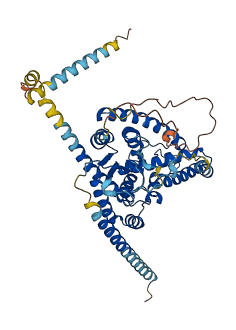
Descriptions
The autoinhibited protein was predicted that may have potential autoinhibitory elements via cis-regPred.
Autoinhibitory domains (AIDs)
Target domain |
|
Relief mechanism |
|
Assay |
cis-regPred |
Accessory elements
No accessory elements
Autoinhibited structure

Activated structure
1 structures for Q3EDG5
| Entry ID | Method | Resolution | Chain | Position | Source |
|---|---|---|---|---|---|
| AF-Q3EDG5-F1 | Predicted | AlphaFoldDB |
28 variants for Q3EDG5
| Variant ID(s) | Position | Change | Description | Diseaes Association | Provenance |
|---|---|---|---|---|---|
| ENSVATH01023526 | 5 | S>P | No | 1000Genomes | |
| ENSVATH01023525 | 7 | W>L | No | 1000Genomes | |
| ENSVATH01023524 | 10 | S>A | No | 1000Genomes | |
| ENSVATH00011134 | 12 | G>E | No | 1000Genomes | |
| ENSVATH04537459 | 21 | G>C | No | 1000Genomes | |
| ENSVATH01023520 | 33 | T>S | No | 1000Genomes | |
| tmp_1_2492531_C_T | 39 | A>T | No | 1000Genomes | |
| ENSVATH01023518 | 49 | V>I | No | 1000Genomes | |
| tmp_1_2492485_C_A | 54 | R>L | No | 1000Genomes | |
| ENSVATH04537456 | 84 | S>N | No | 1000Genomes | |
| tmp_1_2491966_T_G | 101 | K>T | No | 1000Genomes | |
| tmp_1_2491805_G_A | 155 | P>S | No | 1000Genomes | |
| ENSVATH00011125 | 177 | D>H | No | 1000Genomes | |
| tmp_1_2491702_C_T | 189 | R>K | No | 1000Genomes | |
| tmp_1_2491688_C_T | 194 | A>T | No | 1000Genomes | |
| tmp_1_2491475_G_C | 229 | P>A | No | 1000Genomes | |
| ENSVATH10764842 | 241 | F>Y | No | 1000Genomes | |
| ENSVATH01023499 | 251 | H>Y | No | 1000Genomes | |
| tmp_1_2491088_T_A | 301 | N>Y | No | 1000Genomes | |
| tmp_1_2491052_G_A | 313 | P>S | No | 1000Genomes | |
| tmp_1_2491040_T_C | 317 | T>A | No | 1000Genomes | |
| ENSVATH00011116 | 322 | A>T | No | 1000Genomes | |
| tmp_1_2491022_G_T | 323 | L>I | No | 1000Genomes | |
| tmp_1_2490255_T_G | 354 | E>A | No | 1000Genomes | |
| ENSVATH10764722 | 368 | V>I | No | 1000Genomes | |
| tmp_1_2489840_T_A | 439 | N>I | No | 1000Genomes | |
| tmp_1_2489739_T_C | 447 | R>G | No | 1000Genomes | |
| ENSVATH04537428 | 456 | L>S | No | 1000Genomes |
No associated diseases with Q3EDG5
No regional properties for Q3EDG5
| Type | Name | Position | InterPro Accession |
|---|---|---|---|
| No domain, repeats, and functional sites for Q3EDG5 | |||
Functions
| Description | ||
|---|---|---|
| EC Number | 2.8.2.20 | Sulfotransferases |
| Subcellular Localization |
|
|
| PANTHER Family | ||
| PANTHER Subfamily | ||
| PANTHER Protein Class | ||
| PANTHER Pathway Category | No pathway information available | |
5 GO annotations of cellular component
| Name | Definition |
|---|---|
| endosome | A vacuole to which materials ingested by endocytosis are delivered. |
| Golgi apparatus | A membrane-bound cytoplasmic organelle of the endomembrane system that further processes the core oligosaccharides (e.g. N-glycans) added to proteins in the endoplasmic reticulum and packages them into membrane-bound vesicles. The Golgi apparatus operates at the intersection of the secretory, lysosomal, and endocytic pathways. |
| Golgi membrane | The lipid bilayer surrounding any of the compartments of the Golgi apparatus. |
| integral component of membrane | The component of a membrane consisting of the gene products and protein complexes having at least some part of their peptide sequence embedded in the hydrophobic region of the membrane. |
| trans-Golgi network | The network of interconnected tubular and cisternal structures located within the Golgi apparatus on the side distal to the endoplasmic reticulum, from which secretory vesicles emerge. The trans-Golgi network is important in the later stages of protein secretion where it is thought to play a key role in the sorting and targeting of secreted proteins to the correct destination. |
2 GO annotations of molecular function
| Name | Definition |
|---|---|
| heparan sulfate 6-O-sulfotransferase activity | Catalysis of the reaction: 3'-phosphoadenosine 5'-phosphosulfate + heparan sulfate = adenosine 3',5'-bisphosphate + heparan sulfate 6-O-sulfate; results in 6-O-sulfation of glucosamine residues in heparan sulfate. |
| protein-tyrosine sulfotransferase activity | Catalysis of the reaction: 3'-phosphoadenosine 5'-phosphosulfate + protein tyrosine = adenosine 3',5'-bisphosphate + protein tyrosine-O-sulfate. |
8 GO annotations of biological process
| Name | Definition |
|---|---|
| copper ion homeostasis | Any process involved in the maintenance of an internal steady state of copper ions within an organism or cell. |
| heparan sulfate proteoglycan biosynthetic process, enzymatic modification | The modification, often by sulfation, of sugars incorporated into heparan sulfate after polymerization. |
| innate immune response | Innate immune responses are defense responses mediated by germline encoded components that directly recognize components of potential pathogens. |
| negative regulation of ethylene biosynthetic process | Any process that stops, prevents, or reduces the frequency, rate or extent of an ethylene biosynthetic process. |
| regulation of gene expression | Any process that modulates the frequency, rate or extent of gene expression. Gene expression is the process in which a gene's coding sequence is converted into a mature gene product (protein or RNA). |
| regulation of root meristem growth | Any process involved in maintaining the size and shape of a root meristem. |
| response to auxin | Any process that results in a change in state or activity of a cell or an organism (in terms of movement, secretion, enzyme production, gene expression, etc.) as a result of an auxin stimulus. |
| stem cell population maintenance | The process by which an organism or tissue maintains a population of stem cells of a single type. This can be achieved by a number of mechanisms: stem cell asymmetric division maintains stem cell numbers; stem cell symmetric division increases them; maintenance of a stem cell niche maintains the conditions for commitment to the stem cell fate for some types of stem cell; stem cells may arise de novo from other cell types. |
| 10 | 20 | 30 | 40 | 50 | 60 |
| MQMNSVWKLS | LGLLLLSSVI | GSFAELDFGH | CETLVKKWAD | SSSSREEHVN | KDKRSLKDLL |
| 70 | 80 | 90 | 100 | 110 | 120 |
| FFLHVPRTGG | RTYFHCFLRK | LYDSSEECPR | SYDKLHFNPR | KEKCKLLATH | DDYSLMAKLP |
| 130 | 140 | 150 | 160 | 170 | 180 |
| RERTSVMTIV | RDPIARVLST | YEFSVEVAAR | FLVHPNLTSA | SRMSSRIRKS | NVISTLDIWP |
| 190 | 200 | 210 | 220 | 230 | 240 |
| WKYLVPWMRE | DLFARRDARK | LKEVVIIEDD | NPYDMEEMLM | PLHKYLDAPT | AHDIIHNGAT |
| 250 | 260 | 270 | 280 | 290 | 300 |
| FQIAGLTNNS | HLSEAHEVRH | CVQKFKSLGE | SVLQVAKRRL | DSMLYVGLTE | EHRESASLFA |
| 310 | 320 | 330 | 340 | 350 | 360 |
| NVVGSQVLSQ | VVPSNATAKI | KALKSEASVT | ISETGSDKSN | IQNGTSEVTL | NKAEAKSGNM |
| 370 | 380 | 390 | 400 | 410 | 420 |
| TVKTLMEVYE | GCITHLRKSQ | GTRRVNSLKR | ITPANFTRGT | RTRVPKEVIQ | QIKSLNNLDV |
| 430 | 440 | 450 | 460 | 470 | 480 |
| ELYKYAKVIF | AKEHELVSNK | LISSSKRSIV | DLPSELKSVL | GEMGEEKLWK | FVPVALMLLL |
| 490 | |||||
| IVLFFLFVNA | KRRRTSKVKI |