Q2QXY1
Gene name |
GLDH2 (Os12g0139600, LOC_Os12g04520, OsJ_35179) |
Protein name |
L-galactono-1,4-lactone dehydrogenase 2, mitochondrial |
Names |
|
Species |
Oryza sativa subsp japonica (Rice) |
KEGG Pathway |
osa:4351464 |
EC number |
1.3.2.3: With a cytochrome as acceptor |
Protein Class |
|
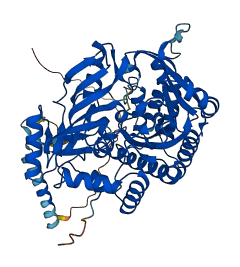
Descriptions
The autoinhibited protein was predicted that may have potential autoinhibitory elements via cis-regPred.
Autoinhibitory domains (AIDs)
Target domain |
|
Relief mechanism |
|
Assay |
cis-regPred |
Accessory elements
No accessory elements
Autoinhibited structure

Activated structure
1 structures for Q2QXY1
| Entry ID | Method | Resolution | Chain | Position | Source |
|---|---|---|---|---|---|
| AF-Q2QXY1-F1 | Predicted | AlphaFoldDB |
No variants for Q2QXY1
| Variant ID(s) | Position | Change | Description | Diseaes Association | Provenance |
|---|---|---|---|---|---|
| No variants for Q2QXY1 | |||||
No associated diseases with Q2QXY1
Functions
| Description | ||
|---|---|---|
| EC Number | 1.3.2.3 | With a cytochrome as acceptor |
| Subcellular Localization |
|
|
| PANTHER Family | ||
| PANTHER Subfamily | ||
| PANTHER Protein Class | ||
| PANTHER Pathway Category | No pathway information available | |
2 GO annotations of cellular component
| Name | Definition |
|---|---|
| integral component of membrane | The component of a membrane consisting of the gene products and protein complexes having at least some part of their peptide sequence embedded in the hydrophobic region of the membrane. |
| mitochondrial membrane | Either of the lipid bilayers that surround the mitochondrion and form the mitochondrial envelope. |
4 GO annotations of molecular function
| Name | Definition |
|---|---|
| D-arabinono-1,4-lactone oxidase activity | Catalysis of the reaction: D-arabinono-1,4-lactone + O(2) = dehydro-D-arabinono-1,4-lactone + H(2)O(2) + H(+). |
| FAD binding | Binding to the oxidized form, FAD, of flavin-adenine dinucleotide, the coenzyme or the prosthetic group of various flavoprotein oxidoreductase enzymes. |
| galactonolactone dehydrogenase activity | Catalysis of the reaction: L-galactono-1,4-lactone + 2 ferricytochrome c = L-ascorbate + 2 ferrocytochrome c. |
| oxidoreductase activity | Catalysis of an oxidation-reduction (redox) reaction, a reversible chemical reaction in which the oxidation state of an atom or atoms within a molecule is altered. One substrate acts as a hydrogen or electron donor and becomes oxidized, while the other acts as hydrogen or electron acceptor and becomes reduced. |
1 GO annotations of biological process
| Name | Definition |
|---|---|
| L-ascorbic acid biosynthetic process | The chemical reactions and pathways resulting in the formation of L-ascorbic acid; L-ascorbic acid ionizes to give L-ascorbate, (2R)-2-[(1S)-1,2-dihydroxyethyl]-4-hydroxy-5-oxo-2,5-dihydrofuran-3-olate, which is required as a cofactor in the oxidation of prolyl residues to hydroxyprolyl, and other reactions. |
5 homologous proteins in AiPD
| UniProt AC | Gene Name | Protein Name | Species | Evidence Code |
|---|---|---|---|---|
| Q3ZC33 | GULO | L-gulonolactone oxidase | Bos taurus (Bovine) | PR |
| P58710 | Gulo | L-gulonolactone oxidase | Mus musculus (Mouse) | PR |
| Q8HXW0 | GULO | L-gulonolactone oxidase | Sus scrofa (Pig) | PR |
| P10867 | Gulo | L-gulonolactone oxidase | Rattus norvegicus (Rat) | PR |
| Q2RAP0 | GLDH1 | L-galactono-1,4-lactone dehydrogenase 1, mitochondrial | Oryza sativa subsp japonica (Rice) | PR |
| 10 | 20 | 30 | 40 | 50 | 60 |
| MRRLLLAGIL | RRASSSPSSH | HHLHLVRALS | ASSPLPASDA | DLRKYAGYAL | LLLGCGAATY |
| 70 | 80 | 90 | 100 | 110 | 120 |
| YSFPLPPDAL | HKKAVPFKYA | PLPDDLHAVS | NWSATHEVHT | RVLLQPDSLP | VLHDALAAAH |
| 130 | 140 | 150 | 160 | 170 | 180 |
| GERRKLRPLG | SGLSPNGLAL | SRAGMVNLAL | MDKVLDVDAK | KKTVTVQAGI | RVAELVDTLR |
| 190 | 200 | 210 | 220 | 230 | 240 |
| EHGLTLQNFA | SIREQQVGGI | IQVGAHGTGA | RLPPIDEQVI | SMKLVTPAKG | TIELSREKDP |
| 250 | 260 | 270 | 280 | 290 | 300 |
| DLFYLARCGL | GGLGVVAEVT | LQCVERHQLI | EHTFVSSADE | VKKNHKKWLS | ENKHIKYLWI |
| 310 | 320 | 330 | 340 | 350 | 360 |
| PYTDTVVVVQ | CNPPSRWRTP | KFTSKYGKDE | AIQHVRDLYR | ESLKKYRTKA | ESNDPEVDQL |
| 370 | 380 | 390 | 400 | 410 | 420 |
| SFTELRDRLL | ALDPLDKDHV | IRINKAEAEY | WKKSEGYRMG | WSDEILGFDC | GGQQWVSETC |
| 430 | 440 | 450 | 460 | 470 | 480 |
| FPAGTLAKPN | MKDLDYIEEL | LQLIEKEDIP | APAPIEQRWT | ACSRSPMSPA | SSSQEDDIFS |
| 490 | 500 | 510 | 520 | 530 | 540 |
| WVGIIMYLPT | SDARQRKEIT | EEFFNYRSKT | QTNLWDGYSA | YEHWAKIEVP | KDKDELTELL |
| 550 | 560 | 570 | 580 | ||
| ARLRKRFPVD | AYNKARMELD | PNKVLSNAKL | EKLFPVTEVQ | HVK |