Q24342
Gene name |
fng (CG10580) |
Protein name |
Fringe glycosyltransferase |
Names |
O-fucosylpeptide 3-beta-N-acetylglucosaminyltransferase |
Species |
Drosophila melanogaster (Fruit fly) |
KEGG Pathway |
dme:Dmel_CG10580 |
EC number |
2.4.1.222: Hexosyltransferases |
Protein Class |
|
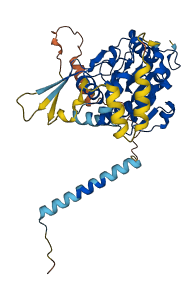
Descriptions
The autoinhibited protein was predicted that may have potential autoinhibitory elements via cis-regPred.
Autoinhibitory domains (AIDs)
Target domain |
|
Relief mechanism |
|
Assay |
cis-regPred |
Accessory elements
No accessory elements
Autoinhibited structure

Activated structure
1 structures for Q24342
| Entry ID | Method | Resolution | Chain | Position | Source |
|---|---|---|---|---|---|
| AF-Q24342-F1 | Predicted | AlphaFoldDB |
No variants for Q24342
| Variant ID(s) | Position | Change | Description | Diseaes Association | Provenance |
|---|---|---|---|---|---|
| No variants for Q24342 | |||||
No associated diseases with Q24342
No regional properties for Q24342
| Type | Name | Position | InterPro Accession |
|---|---|---|---|
| No domain, repeats, and functional sites for Q24342 | |||
Functions
| Description | ||
|---|---|---|
| EC Number | 2.4.1.222 | Hexosyltransferases |
| Subcellular Localization |
|
|
| PANTHER Family | ||
| PANTHER Subfamily | ||
| PANTHER Protein Class | ||
| PANTHER Pathway Category | No pathway information available | |
6 GO annotations of cellular component
| Name | Definition |
|---|---|
| cytoplasm | The contents of a cell excluding the plasma membrane and nucleus, but including other subcellular structures. |
| endoplasmic reticulum | The irregular network of unit membranes, visible only by electron microscopy, that occurs in the cytoplasm of many eukaryotic cells. The membranes form a complex meshwork of tubular channels, which are often expanded into slitlike cavities called cisternae. The ER takes two forms, rough (or granular), with ribosomes adhering to the outer surface, and smooth (with no ribosomes attached). |
| Golgi apparatus | A membrane-bound cytoplasmic organelle of the endomembrane system that further processes the core oligosaccharides (e.g. N-glycans) added to proteins in the endoplasmic reticulum and packages them into membrane-bound vesicles. The Golgi apparatus operates at the intersection of the secretory, lysosomal, and endocytic pathways. |
| Golgi medial cisterna | The middle Golgi cisterna (or cisternae). |
| Golgi stack | The set of thin, flattened membrane-bounded compartments, called cisternae, that form the central portion of the Golgi complex. The stack usually comprises cis, medial, and trans cisternae; the cis- and trans-Golgi networks are not considered part of the stack. |
| integral component of Golgi membrane | The component of the Golgi membrane consisting of the gene products and protein complexes having at least some part of their peptide sequence embedded in the hydrophobic region of the membrane. |
3 GO annotations of molecular function
| Name | Definition |
|---|---|
| acetylglucosaminyltransferase activity | Catalysis of the transfer of an N-acetylglucosaminyl residue from UDP-N-acetyl-glucosamine to a sugar. |
| metal ion binding | Binding to a metal ion. |
| O-fucosylpeptide 3-beta-N-acetylglucosaminyltransferase activity | Catalysis of the transfer of a beta-D-GlcNAc residue from UDP-D-GlcNAc to the fucose residue of a fucosylated protein acceptor. |
18 GO annotations of biological process
| Name | Definition |
|---|---|
| compound eye development | The process whose specific outcome is the progression of the compound eye over time, from its formation to the mature structure. The compound eye is an organ of sight that contains multiple repeating units, often arranged hexagonally. Each unit has its own lens and photoreceptor cell(s) and can generate either a single pixelated image or multiple images, per eye. |
| compound eye morphogenesis | The morphogenetic process in which the anatomical structures of the compound eye are generated and organized. The adult compound eye is a precise assembly of 700-800 ommatidia. Each ommatidium is composed of 20 cells, identified by cell type and position. An example of compound eye morphogenesis is found in Drosophila melanogaster. |
| cuticle pattern formation | The regionalization process that gives rise to the patterns of cell differentiation in the cuticle. |
| dorsal/ventral pattern formation, imaginal disc | The establishment, maintenance and elaboration of the dorsal/ventral axis of the imaginal disc. Imaginal disks are masses of hypodermic cells, carried by the larvae of some insects after leaving the egg, from which masses the wings and legs of the adult are subsequently formed. |
| female germ-line stem cell population maintenance | The process by which an organism or tissue maintains a population of female germ-line stem cells. |
| germarium-derived egg chamber formation | Construction of a stage-1 egg chamber in the anterior part of the germarium, from the progeny of germ-line and somatic stem cells. An example of this is found in Drosophila melanogaster. |
| imaginal disc-derived leg morphogenesis | The process in which the anatomical structures of a leg derived from an imaginal disc are generated and organized. A leg is a limb on which an animal walks and stands. An example of this is found in Drosophila melanogaster. |
| imaginal disc-derived leg segmentation | Division of an imaginal disc-derived leg into a series of semi-repetitive parts or segments. The Drosophila leg, for example, has nine segments, each separated from the next by a flexible joint. |
| imaginal disc-derived wing margin morphogenesis | The process in which the anatomical structures of the imaginal disc-derived wing margin are generated and organized. The wing margin is a strip of cells in the third instar disc at the boundary between the presumptive dorsal and ventral surfaces of the wing blade. |
| imaginal disc-derived wing morphogenesis | The process in which the anatomical structures of the imaginal disc-derived wing are generated and organized. The wing is an appendage modified for flying. |
| negative regulation of Notch signaling pathway | Any process that stops, prevents, or reduces the frequency, rate or extent of the Notch signaling pathway. |
| ovarian follicle cell development | The process that occurs during oogenesis involving the ovarian follicle cells, somatic cells which surround the germ cells of an ovary. An example of this is found in Drosophila melanogaster. |
| positive regulation of Notch signaling pathway | Any process that activates or increases the frequency, rate or extent of the Notch signaling pathway. |
| protein glycosylation | A protein modification process that results in the addition of a carbohydrate or carbohydrate derivative unit to a protein amino acid, e.g. the addition of glycan chains to proteins. |
| regulation of Notch signaling pathway | Any process that modulates the frequency, rate or extent of the Notch signaling pathway. |
| regulation of protein binding | Any process that modulates the frequency, rate or extent of protein binding. |
| wing disc anterior/posterior pattern formation | The establishment, maintenance and elaboration of the anterior/posterior axis of the wing disc, a precursor to the wing. |
| wing disc dorsal/ventral pattern formation | The establishment, maintenance and elaboration of the dorsal/ventral axis of the wing disc, a precursor to the adult wing. |
| 10 | 20 | 30 | 40 | 50 | 60 |
| MMSLTVLSPP | QRFKRILQAM | MLAVAVVYMT | LLLYQSAYGY | PGIQVPHSQV | DALASEAVTT |
| 70 | 80 | 90 | 100 | 110 | 120 |
| HRDQLLQDYV | QSSTPTQPGA | GAPAASPTTV | IIRKDIRSFN | FSDIEVSERP | TATLLTELAR |
| 130 | 140 | 150 | 160 | 170 | 180 |
| RSRNGELLRD | LSQRAVTATP | QPPVTELDDI | FISVKTTKNY | HDTRLALIIK | TWFQLARDQT |
| 190 | 200 | 210 | 220 | 230 | 240 |
| WFFTDTDDHY | YQEKTKGHLI | NTKCSQGHFR | KALCCKMSAE | LDVFLESGKK | WFCHFDDDNY |
| 250 | 260 | 270 | 280 | 290 | 300 |
| VNVPRLVKLL | DEYSPSVDWY | LGKPSISSPL | EIHLDSKNTT | TNKKITFWFA | TGGAGFCLSR |
| 310 | 320 | 330 | 340 | 350 | 360 |
| ALTLKMLPIA | GGGKFISIGD | KIRFPDDVTM | GFIIEHLLKV | PLTVVDNFHS | HLEPMEFIRQ |
| 370 | 380 | 390 | 400 | 410 | |
| DTFQDQVSFS | YAHMKNQWNV | IKVDGFDMKT | DPKRFYSLHC | QLFPYFSFCP | PR |